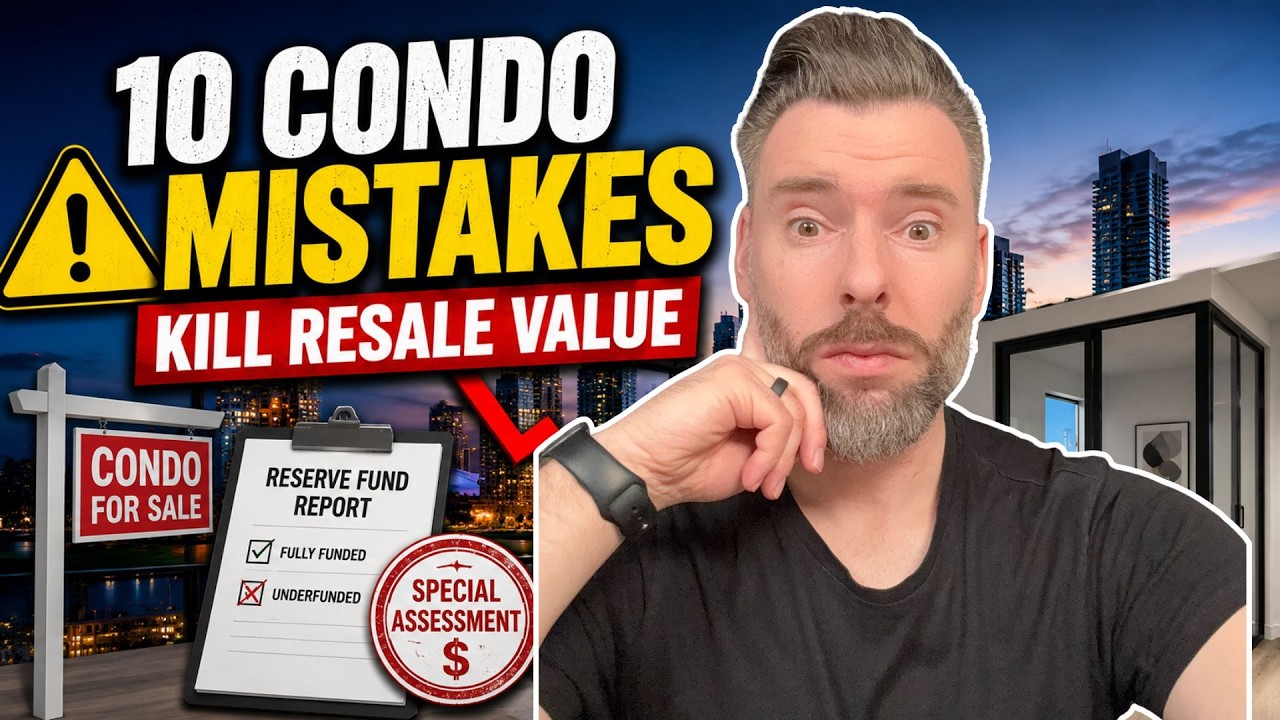
Condos account for 40 to 50% of all sales in the city of Toronto. A condo at a good price is not automatically a good purchase, because features of the unit and the building decide how easily it resells. Below are 10 to weigh before buying, plus two bonus items and one factor that outweighs most of the list.
1. No parking
Most new buildings in Toronto do not include parking with the unit, especially below two bedrooms, and new rules no longer require it. This year, smaller units without parking have taken longer to sell. Spaces in new buildings have sold for as much as $93,000. With every parking lot becoming a future tower, a space helps a unit hold its value.
2. An underfunded reserve fund
The reserve fund is the building’s savings for repairs, and in Ontario a third party must audit it every 3 years. Between 2018 and 2023, 16% of Ontario condos issued a special assessment. An underfunded reserve usually goes with fees too low to keep up with maintenance, a builder sales tactic. Michael bought a builder condo with fees of $0.38 a square foot, and once the building was running they climbed quickly. Every buyer on the team gets a status certificate review from a lawyer to see the reserve balance, when the study was last completed and what work is coming.
3. A pending or existing special assessment
Special assessments range from a few hundred dollars to $50,000 or more per unit, with larger amounts usually spread over months or years. One Toronto tower faced a $2.4 million shortfall on a single garage repair. The team’s offers include a clause that any assessment known to the seller is paid by the seller before possession.
4. Active litigation against the corporation
Status certificates must disclose ongoing litigation against the corporation. A 2024 Toronto ruling produced a $75,000 judgment against one corporation. What owners are asked to cover depends on the ruling, the reserve fund and the building’s insurance.
5. No short-term rental restrictions
This cuts both ways. A buyer who wants to run short-term rentals will look for buildings that allow them; an owner-occupier generally does not want one next door. Buildings with heavy short-term rental activity develop reputations that affect buyer perception, and insurance increases from related claims can flow into every owner’s fees. The team keeps a list of which buildings allow them.
6. No storage locker
Lockers in Toronto generally cost $3,000 to $10,000, and demand has risen because newer buildings have smaller units with little storage. Not having one affects resale most when the unit itself lacks storage.
7. Rapidly rising maintenance fees
Condo fees generally run from 60 cents to $1.20 a square foot. At 60 cents the fee will be increasing, because maintenance costs have gone up. If a building is within its first 5 or 10 years and fees are already over a dollar a square foot, something needs a closer look. A 530 square foot unit with $600 a month in fees is well past that mark. Fees very rarely go down, so the fee at purchase is likely the lowest an owner will pay. As a rule of thumb, fees should rise with inflation, around 3 to 5% a year in the Greater Toronto Area.
8. An older building nearing a major repair cycle
Buildings built from 2020 average around 65 to 75 cents a square foot, still rising where the reserve has not kept up. Older buildings average closer to 80 to 90 cents. A roof may last 20 years, so a 20-year-old building may be due. Reserve fund studies itemize upcoming work, and a buyer planning to hold for 5 years should know what falls due around the time they plan to sell.
9. Studios and small one-bedrooms
Studios and one-bedrooms, especially without parking, have been the hardest condo sale in Toronto in 2026. In newer buildings one-bedrooms start around 400 square feet and are effectively micro units, and most of the team’s buyers avoid them because they are difficult to resell. A one-bedroom of 500 square feet at minimum, with a good layout, is where to be; 500 to 600 square feet is enough. A den or second bedroom helps where the budget allows.
10. A high concentration of investor-owned units
Many new buildings are predominantly investor-owned because of unit size, and nearly half of new GTA condo closings in recent years were investor purchases. Investor-heavy buildings put many units up for rent or sale at the same time, so an owner renting or reselling competes inside their own building. They are also generally less well kept than owner-occupied buildings, which is where the team steers buyers.
Two bonus items and the one factor that outweighs the list
A second bedroom enclosed only by a sliding door is a tough sell. The legal definition of a bedroom requires a window and a closet, and a sliding glass door on a room with a closet has come to count, but most buyers do not want that setup unless the room is tucked into a cove. A two-bedroom split layout sells better than one where the second bedroom sits behind glass beside the kitchen. A den with sliding doors cannot be listed as a bedroom.
Most buyers want some outdoor space, at minimum a Juliet balcony. Lofts in converted garment and feather factories are the exception, since their character offsets it. A great interior layout still beats a weaker unit with outdoor space.
Location can trump most of this list. A prime location with walkability, transit and parks offsets no parking, no locker and no outdoor space. Condo buyers usually buy where a house is not attainable, and Toronto is building outward rather than inward, so a great location cannot be taken away.
If you are weighing a condo purchase and want the building checked against this list, book a conversation with the team.

Former pro hockey player and West Toronto's most data-driven agent. Michael publishes weekly market analysis on this blog and YouTube.