High Park is 400 acres of ravine, forest, and urban parkland wrapped in one of Toronto’s most desirable residential addresses. The neighbourhood that surrounds the park, bounded roughly by Bloor Street West to the north, The Queensway to the south, Parkside Drive to the east, and Ellis Avenue to the west, delivers something rare in Toronto: genuine proximity to nature without sacrificing walkability, transit, or access to the city. Families, professionals, and longtime residents share these streets because they offer what most Toronto neighbourhoods can only approximate: a daily relationship with serious green space.
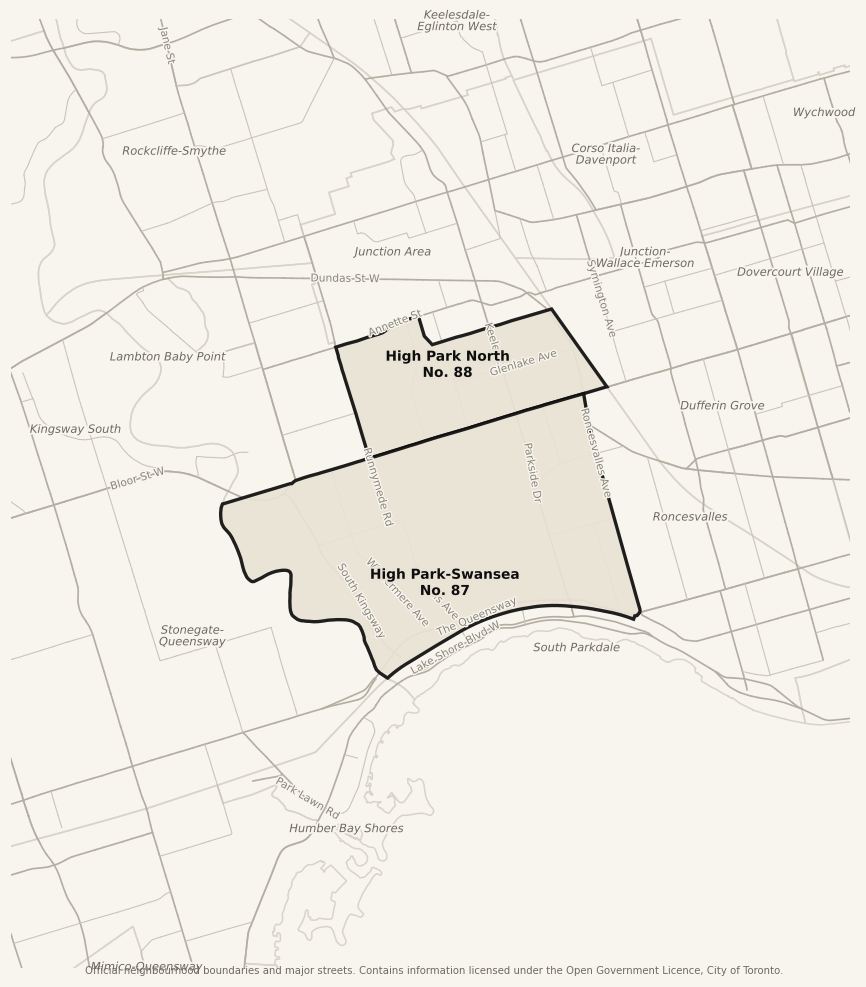
Official City of Toronto neighbourhoods: High Park North (No. 88) and High Park-Swansea (No. 87).
The History
High Park exists because of one man’s generosity. John George Howard, Toronto’s first City Surveyor, purchased 66 hectares of wooded land on the lakeshore west of the city in 1836, naming the estate High Park for its elevated position. In 1873, Howard and his wife Jemima deeded 120 acres to the City of Toronto “for the free use, benefit and enjoyment of the citizens of the City of Toronto forever,” in exchange for a yearly pension of $1,200. The park opened to the public in 1876 and has expanded to its current 161 hectares (roughly 400 acres), making it one of the largest urban parks in the country.
Howard’s legacy lives on in Colborne Lodge, the Regency-style cottage he built in 1837 at what is now 11 Colborne Lodge Drive. It operates as a museum today, open Wednesday through Sunday with guided tours, displaying original furnishings and Howard’s watercolour paintings of early Toronto. The park itself has been shaped by over a century of public use: a zoo since 1893, formal gardens, an amphitheatre for Shakespeare in the Park, and Grenadier Pond, which holds provincial significance as a wetland complex.
What You’ll Actually Find Here
The residential streets around High Park carry a mix of eras and styles that reflect over a century of development. The oldest homes date to the 1880s and 1890s, Victorian-era brick houses built for the merchant class, featuring leaded and stained glass windows, hardwood floors, decorative wood trim, and functional fireplaces. Edwardian homes from the early 1900s follow, with broader proportions, deeper front porches, and solid front doors replacing the more ornate Victorian styling.
Tudor-influenced homes appear on some streets, and mid-century development brought apartment buildings and higher-density living, particularly along Bloor Street. Since 2000, several mid-rise and high-rise condo buildings have been added near the Bloor corridor, broadening the housing mix considerably. The result is a neighbourhood that serves multiple price points and lifestyles: heritage detached homes on quiet interior streets, well-maintained semis, and modern condos with park proximity.
Lot sizes vary by era and location. The older residential streets south of Bloor tend toward narrower Victorian lots (20-25 feet wide), while streets further from the commercial strip offer deeper properties. Many homes have been thoughtfully updated while retaining period details, the best of both worlds for buyers who want character with modern function.
What Homes Cost in High Park (W01 and W02)
High Park spans two TRREB communities: High Park North, in District W02, and High Park-Swansea, in District W01. Here’s what you’re looking at in real terms, from January 1 to November 2, 2026 in High Park North and from January 2 to October 30, 2026 in High Park-Swansea:
- Detached homes: a median of $1,775,000 (40 sales) in High Park North and $1,920,000 (83 sales) in High Park-Swansea. Prices depend on size, condition, and proximity to the park. Fully renovated detached homes on premium streets closest to the park sell at the higher end, and period homes with original layouts in need of updating for less.
- Semi-detached homes: a median of $1,601,000 (21 sales) in High Park North and $1,245,000 (11 sales) in High Park-Swansea. The neighbourhood’s Victorian and Edwardian semis represent strong value for families wanting park access without the detached price tag. Well-presented semis near the park move quickly.
- Condos: condo apartments sold at a median of $762,500 (46 sales) in High Park North and $620,000 (90 sales) in High Park-Swansea. Prices vary with size, building age, and floor. Newer buildings along the Bloor corridor command premiums for views and modern amenities. Older low-rise buildings offer more affordable entry points.
The High Park market remains competitive for detached homes. In TRREB District W02, all home types averaged $1,198,431 over the 12 months to October 2026 (692 sales) and $1,266,814 in October 2026 alone (71 sales) (TRREB Market Watch). In TRREB District W01, all home types averaged $1,207,607 over the 12 months to October 2026 (457 sales) and $1,269,569 in October 2026 alone (51 sales) (TRREB Market Watch). The neighbourhood holds value because the combination of transit, parkland, and walkable retail is genuinely rare in Toronto.
What We Love About High Park
The park itself is the anchor, obviously. But what makes High Park work as a neighbourhood is the commercial infrastructure around it. The Bloor West Village strip to the northwest delivers everything you need on foot: Snappers Fish Market for fresh seafood, Bloor Meat Market for quality cuts, Sweet Flour Bake Shop for pastries, and The Coffee Tree for your morning espresso. Max’s Market handles specialty groceries. These aren’t chains filling retail space, they’re neighbourhood institutions that have been here for years.
Inside the park, the Grenadier Café is the gathering spot, breakfast, coffee, and a patio with views that make you forget you’re in a city of three million. The High Park Zoo, operating since 1893, is free and family-perfect, home to bison, llamas, highland cattle, and peacocks. Grenadier Pond is a provincially significant wetland where you can fish from the designated shoreline or simply walk the loop trail. In spring, the cherry blossoms draw thousands, peak bloom lasts only 4 to 10 days in late April to early May, and the park closes to vehicles during peak season to manage crowds.
The High Park Nature Centre runs year-round programs for families: nature walks, workshops, and camps. Shakespeare in the Park fills the amphitheatre on summer evenings. And the Jamie Bell Adventure Playground near the Duck Pond keeps kids occupied for hours with castle tops, rope bridges, and slides. This is a park that works for every age and every season.
The Honest Take
High Park is one of Toronto’s most desirable neighbourhoods, and the pricing reflects it. If you’re looking for value, this isn’t where you’ll find it, the proximity premium to 400 acres of parkland is real and persistent. Detached homes are competitive and multiple offers are common for well-priced properties.
The Victorian and Edwardian housing stock, while beautiful, carries the maintenance costs that come with century-old homes: knob-and-tube wiring replacements, foundation work, plumbing upgrades, and heating system overhauls are common renovation items. Budget accordingly if you’re buying an unrenovated property. Heritage designations on some streets may also restrict exterior modifications.
Parking is tight in the older residential areas, many Victorian homes were built before cars existed, and street parking is permit-based and competitive. During cherry blossom season and summer weekends, the neighbourhood sees significant tourist traffic. The park’s popularity is a double-edged sword: it’s what makes the neighbourhood special, and it’s what fills your street with visitors on sunny Saturdays.
The condo market along Bloor is softer than the freehold market, with more inventory and less competitive bidding.
Who Lives Here
High Park draws a mature, established demographic. The median age is 41, and the average individual income is $132,339, this is an affluent, educated neighbourhood. You’ll find established families who’ve been here for decades, attracted by the schools and the park. Young families upgrading from condos downtown who want their kids to grow up near green space. Professionals and couples who value walkability and transit but want more character than a downtown condo offers. The neighbourhood also retains Eastern European cultural influence, particularly visible in the restaurants and shops of adjacent Roncesvalles and Bloor West Village.
Schools
The school landscape around High Park is strong, with several well-regarded options across both public and Catholic boards.
- Howard Junior Public School (JK-6) on Marmaduke Street at Sunnyside Avenue serves the immediate High Park area with a solid academic program and strong parent involvement.
- Humberside Collegiate Institute (Grades 9-12) is the flagship secondary school, established in 1892. Humberside serves High Park, Bloor West Village, Baby Point, and Junction neighbourhoods with academic, Extended French, French Immersion, and strong music programs. It’s consistently one of the most sought-after public high schools in the west end.
- Runnymede Collegiate Institute (Grades 9-12) provides an additional secondary option with a solid academic program.
- Annette Street Junior and Senior Public School (JK-8) at 265 Annette Street offers both regular and alternative programming with a library, gym, pool, and playground.
French Immersion is available through the TDSB network, and the TCDSB operates Catholic school options in the area. Families moving to High Park for schools should confirm current catchment boundaries directly with the TDSB, as these shift periodically.
Getting Around
High Park Station on the Line 2 Bloor-Danforth subway is the primary transit hub, located just north of Bloor Street West between Quebec Avenue and High Park Avenue. It opened in 1968 and puts you on the subway within a 2-minute walk from the park’s north entrance. Keele Station is a 9-minute walk west. The 506 Carlton and 508 Lake Shore streetcars provide additional east-west service, and the 80 Queensway bus connects to destinations south of the park.
Cycling infrastructure has improved significantly. The High Park Movement Strategy installed protected bike lanes on Centre Road and Colborne Lodge Drive, with car-free routes on West Road. Ten Bike Share Toronto stations are located within and around the park at main entrances and facilities. The Martin Goodman Trail along the waterfront is accessible from the park’s southern end.
For drivers, The Queensway connects to the Gardiner Expressway and Lake Shore Boulevard within minutes. Downtown commute time is under 25 minutes via subway from High Park Station. The neighbourhood has a Walk Score above 90 around the Bloor corridor, meaning daily errands are entirely doable on foot.
Things to Do
High Park itself offers more than most neighbourhoods can dream of. The 400-acre park includes a free zoo (since 1893), Grenadier Pond for fishing and walking, cherry blossom groves, Colborne Lodge museum, the Jamie Bell Adventure Playground, a trackless train for kids, and the High Park Amphitheatre for summer Shakespeare performances. The High Park Nature Centre runs nature walks, workshops, and seasonal camps year-round.
Bloor West Village is steps from the park’s northwest corner. The strip along Bloor Street delivers everything from specialty groceries to sit-down dining. Sweet Flour Bake Shop, Snappers Fish Market, KINTON RAMEN, and Dil Se Indian Restaurant anchor a diverse food scene. For coffee, The Coffee Tree is a local institution.
Waterfront access is available from the park’s southern reaches. The Martin Goodman Trail connects to the broader Toronto waterfront cycling and walking network, linking through Sunnyside and the Humber Bay shores. The Sunnyside Gus Ryder Outdoor Pool, one of the city’s largest, operates in summer months.
Buying in High Park: What to Expect
High Park is a neighbourhood where demand consistently outpaces supply, particularly for freehold homes. Detached properties on desirable streets attract multiple offers and frequently sell above asking price. The combination of transit access, 400 acres of parkland, strong schools, and walkable retail creates a value proposition that holds up across market cycles.
Buyers should expect to move quickly on well-priced properties. From January 1 to November 2, 2026, detached homes in High Park North sold in a median of 8 days (an average of 14) and semi-detached homes in a median of 7 days (an average of 8); from January 2 to October 30, 2026, detached homes in High Park-Swansea sold in a median of 9 days (an average of 16) and semi-detached homes in a median of 5 days (an average of 8). Come with financing arranged and be prepared to make decisions fast. For condos, the pace is more measured and inventory is higher.
Renovation potential exists in the older housing stock, but factor in the costs of updating century-old systems. A $1.5M purchase with $300K in renovations is a common path to a $2M home in this neighbourhood. If you want turnkey, expect to pay the premium, there’s no shortage of buyers willing to pay for finished product here.
Michael Ouzas and his team work High Park as part of their core West End practice. The neighbourhood rewards buyers who understand micro-location: proximity to the park entrance, distance from the Bloor commercial strip, and the specific street character all affect value. That street-level knowledge is the difference between a good purchase and a great one.
For how High Park compares to neighbouring areas, explore our guides to Bloor West Village, The Junction, Roncesvalles, and Swansea.
Weighing your options? Read our comparison: High Park vs Roncesvalles: which should you buy in?
High Park Sold Prices in 2026
Every MLS® sale from January 2 to October 30, 2026. TRREB counts High Park inside its High Park-Swansea community, so these are the numbers for High Park-Swansea. Price per square foot uses above-grade size; the basement is not included.
| Type | Sales | Median price | Per sq ft | Sold over asking |
|---|---|---|---|---|
| Detached houses | 84 | $1,922,500 | $1,089 | 50% |
| Semi-detached houses | 11 | $1,245,000 | $864 | 45% |
| Condo apartments | 92 | $620,000 | $727 | 8% |
See the full pocket-by-pocket numbers on the High Park stats page.
Related reading
- High Park market stats: 2026 sold prices by pocket
- Bloor West Village and High Park stats (TRREB W02)
- Toronto West market stats (W01 to W08), updated monthly
- High Park vs Roncesvalles
- Why Toronto’s West End Housing Market Is Still So Competitive in 2026
- Toronto’s West End Is Outperforming the Market in 2026
- Is Now the Right Time to Sell Your Toronto Home?
- High Park North: nearby guide
- The Junction: nearby guide
- Baby Point: nearby guide