Baby Point, Toronto: The Exclusive Enclave Where Heritage Meets Prestige
Nestled along a dramatic ravine system between Jane Street and the Humber River, Baby Point is Toronto’s most intimate gated community and one of Canada’s finest examples of early 20th-century planned residential design. With fewer than 1,500 residents, winding tree-lined streets, and stone gates that have guarded this enclave for a century, Baby Point remains profoundly exclusive, not through pretense, but through deliberate architectural heritage and land preservation. This is where early 1920s Tudor Revival mansions anchor a neighbourhood that feels transported from the English Cotswolds, yet unmistakably Toronto in character. If you’re serious about understanding Toronto’s most selective residential market, Baby Point demands your attention.
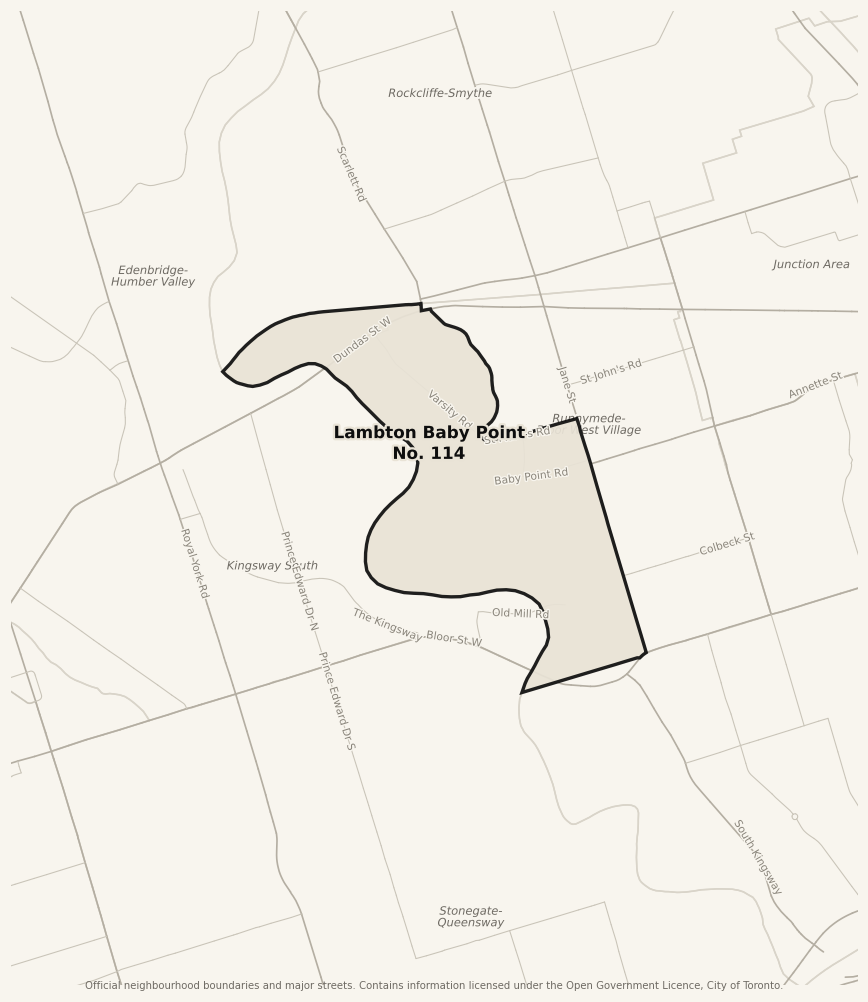
Official City of Toronto neighbourhood: Lambton Baby Point (No. 114).
The History
Baby Point’s story begins long before its current iteration. The land was originally home to the Seneca village of Teiaiagon, a thriving community of approximately 5,000 people that flourished along the Humber before European contact. In 1820, an English settler named James Baby (whose name came from the French “Jacques”) acquired 114 acres and established the area’s first European settlement, operating an orchard and maintaining fishing rights along the Humber River.
For nearly a century, the land remained relatively unchanged. But in 1910, the Canadian government purchased the property with ambitious plans to construct a military barracks complex. Those plans never materialized. Instead, the land was sold to Robert Home Smith, a visionary Toronto developer with grand ambitions for residential design. In 1912, Home Smith unveiled his masterstroke: a planned garden suburb laid out with meticulous attention to natural topography, sweeping vistas, and architectural harmony. Contemporary real estate promotions called it “one of the most ambitious and exclusive residential housing schemes in North America”, marketed not to Toronto’s general market, but specifically as “a bit of England far from England,” aimed at wealthy expatriate Canadian financiers and British-educated professionals.
The restrictive covenants Home Smith imposed for 30 years ensured architectural cohesion at a level Toronto had rarely seen. Between the 1920s and 1930s, residents constructed substantial Tudor Revival and Colonial Revival homes on generous lots, with streetscapes following the rolling contours of the ravine system rather than a rigid grid. The result was organic, intentional, and remarkably preserved. Today, Baby Point’s Heritage Conservation District status protects that vision as zealously as Home Smith himself did a century ago.
What You’ll Actually Find Here
Baby Point homes cluster into three primary architectural families. Tudor Revival dominates at approximately 34% of the housing stock, substantial brick and stone homes with steeply pitched roofs, arched doorways, and casement windows that reference medieval English manor houses. Colonial Revival comprises roughly 35%, featuring symmetrical facades, dormer windows, and the restrained elegance that defined late 18th-century American domestic architecture. The remainder consists of English Cottage and Arts & Crafts styles, all executed in brick, stone, or stucco with meticulous attention to period detail.
What unifies them visually is density: or rather, the profound lack of it. Baby Point contains single-family detached homes only. Period. No townhouses, no duplexes, no multi-family structures. Lots typically run 70-100+ feet wide, with mature trees, many original to Home Smith’s landscaping plan, creating a canopy that makes entire streets feel like private parks. The winding roads follow the natural ravine topography rather than Toronto’s typical grid, which creates the effect of a village rather than a neighbourhood within a city. Tree-lined avenues, stone and brick walls, the pair of iconic stone gates at Jane Street and Baby Point Road: these were not accidental charms, but deliberate design decisions that persist because the Heritage Conservation District designation makes them legally permanent.
What Homes Cost in Baby Point (W02)
Baby Point is part of the TRREB community of Lambton Baby Point, in District W02. From January 1 to November 2, 2026, detached homes in Lambton Baby Point sold at a median of $1,705,000 (41 sales) and semi-detached homes at a median of $1,027,500 (8 sales). Detached homes there sold in a median of 9 days (an average of 20) at an average of 100.4% of asking, and 37% sold over asking.
Luxury Homes: Baby Point’s Heritage District
The heart of Baby Point is the Teiaiagon-Baby Point Heritage Conservation District (City of Toronto By-law 1367-2024), along Baby Point Road, Baby Point Crescent, Baby Point Terrace, L’Estrange Place and part of Humbercrest Boulevard. From January 1 to November 2, 2026, 5 detached homes sold inside it, at a median of $3,000,000, and 3 of the 5 sold for $3 million or more. With so few homes trading, that median swings sharply from one sale to the next, depending on the price points of the homes that sell.
In TRREB District W02, all home types averaged $1,198,431 over the 12 months to October 2026 (692 sales) and $1,266,814 in October 2026 alone (71 sales) (TRREB Market Watch).
What makes Baby Point’s market genuinely distinctive is inventory: homes rarely come to market. The combination of long ownership tenure (most residents hold property for 10+ years), restrictive architectural guidelines that limit renovation and expansion possibilities, and an extremely selective buyer pool creates a market where scarcity is genuine rather than manufactured. From January 1 to November 2, 2026, 5 homes sold inside Baby Point’s heritage district, in a neighbourhood of approximately 1,461 residents.
What We Love About Baby Point
Baby Point’s appeal lies in what Toronto almost never offers: genuine exclusivity paired with architectural integrity. Fewer than 1,500 residents occupy an area that could house ten times that many. The iconic stone gates at Jane Street and Baby Point Road aren’t mere decoration, they are literal and psychological markers of entry into a fundamentally different residential experience. Walking from Bloor West Village’s bustle into Baby Point feels like stepping through a time portal: suddenly you’re on a quiet, tree-shaded avenue lined with 1920s-era mansions, with no sound except wind through mature maples and the distant murmur of the Humber.
The ravine system that defines Baby Point’s geography is not incidental to its appeal, it’s essential. Properties have direct access to Étienne Brûlé Park and the Humber River trail system, a 12.7-mile network of walking and cycling trails that connect to the broader Toronto ravine corridor. The historic Old Mill Bridge, constructed in 1916, sits within walking distance. This is one of the few Toronto neighbourhoods where “backyard” doesn’t metaphorically mean a concrete pad, but literally includes ravine trails, river views, and natural landscape virtually no urban development can touch.
The Heritage Conservation District designation, while restrictive, preserves something increasingly rare in Toronto: architectural cohesion. Homes that were designed to work together remain in visual and historical conversation with one another. You won’t see a home from 2015 sitting incongruously beside a 1925 Tudor. That consistency, the sense that the neighbourhood exists as a complete vision rather than accumulated individual decisions, creates a character that money alone cannot replicate in newly developed areas.
The Honest Take
Baby Point is not for everyone, and being honest about its genuine limitations is essential to understanding whether it’s right for you. First: there is no commercial strip, no main street with restaurants and shops. Baby Point itself is purely residential. To purchase groceries, visit a café, or dine out, you’re making a 15-minute walk to Bloor West Village or driving. If you need walkable urban retail within seconds of your home, this neighbourhood will frustrate you daily.
Second: Baby Point is decidedly car-dependent for typical errands, despite being within Toronto. You can walk for exercise and recreation thanks to the ravine system, but practical transportation to shops, services, and restaurants defaults to automobile use. Public transit access exists via Jane Station (Line 2, approximately 15 minutes on foot from the Baby Point gates), but the typical resident uses personal vehicles for weekday errands.
Third: with so few homes trading, averages swing sharply from one sale to the next, depending on the price points of the homes that sell. Value investors should look elsewhere. This is a market where you’re paying for scarcity, heritage designation, and exclusivity, intangible qualities that don’t appreciate in linear ways. If your primary motivation is real estate appreciation, Baby Point’s thin market and minimal inventory turnover offer no certainty.
Fourth: the buyer pool is genuinely small. In 2026, detached homes in Lambton Baby Point sold in a median of 9 days, but the average was 20 days, so some homes take considerably longer. Plan accordingly if you’re considering selling.
Who Lives Here
Baby Point is home to approximately 1,461 residents, a remarkably stable and demographically concentrated population. Seventy-nine percent of households are married couples, 55% of which include children at home. The median age is 41.2 years, older than Toronto’s average, reflecting both high ownership tenure and the life stage of residents who prioritize the neighbourhood’s stability and schools. Median household income stands at $160,206, approximately 110% above the national average.
Educational attainment is high: 58% of residents hold bachelor’s degrees or higher, with 80% completing postsecondary education. This is, statistically, one of Toronto’s most educated and affluent neighbourhoods. Residents are predominantly professionals, executives, physicians, lawyers, academics, and business owners who value privacy, stability, and architectural quality over urban walkability or cutting-edge amenities.
Perhaps most telling: Baby Point’s residential density is approximately 40% lower than Toronto’s average. People choose this neighbourhood specifically because they want space, quiet, and distance from urban intensity while maintaining access to Toronto’s institutions and cultural offerings. It is, by design and demographic reality, one of Toronto’s most exclusive residential communities.
Schools
Baby Point residents have access to a comprehensive selection of public and separate schools serving the W02 district. Primary school options include Humbercrest Public School, King George Junior Public School, Warren Park Junior Public School, Lambton Park Community School, and George Syme Community School. The secondary schools serving the neighbourhood are Runnymede Collegiate Institute and Humberside Collegiate Institute, both of which offer IB (International Baccalaureate) and French Immersion programs.
The neighbourhood benefits from proximity to 16 schools total, eight public and eight Catholic, within the catchment area. This breadth of choice, combined with strong academic profiles and specialized programs, makes Baby Point attractive to families prioritizing education. French Immersion and IB programs provide pathways beyond Toronto’s standard curriculum. The neighbourhood’s demographic concentration of families with children ensures active school communities and robust parent involvement.
Getting Around
Baby Point’s primary transit connection is Jane Station on Line 2 (Bloor-Danforth), approximately 15 minutes on foot from the neighbourhood’s stone gates. For residents willing to walk or cycle to Jane Station, the Line 2 connection provides direct access to Kipling Station (and Dundas West Streetcar), downtown Bloor (and connections to Line 1), and eastbound connections to Spadina Station and beyond. Bus routes serving the immediate area include Route 26 Dupont, Route 35 Jane, and Route 55 Warren Park, with service frequencies of every 2-3 minutes during rush periods and every 4-5 minutes off-peak.
That said, most Baby Point residents rely on personal vehicles for daily errands and transportation. The neighbourhood’s car-dependent character reflects both its location along the ravine system and its historical development as an automobile-era suburb. Parking is universally available on private property. The proximity to Jane Street provides direct automobile access to major city routes, Dundas West, and connections to the Gardiner Expressway.
Things to Do
Baby Point’s recreational foundation is the Humber River trail system and Étienne Brûlé Park. The broader Humber River trail network encompasses 12.7 miles of dedicated walking and cycling paths, connecting to the Toronto Islands and other major ravine corridors. The historic Old Mill Bridge, constructed in 1916, sits within Baby Point’s boundaries and remains one of Toronto’s most photographed heritage structures. Ravine trails offer hiking and nature walks without leaving the neighbourhood, with river views, mature forest, and seasonal wildflowers.
For shopping, dining, and entertainment, Bloor West Village is a 15-minute walk west along Bloor Street, offering independent restaurants, cafés, bookstores, and retail that maintains strong community identity distinct from downtown chains. The Junction neighbourhood, equally accessible, provides similar cultural and commercial offerings. Neither requires automobile access, though most Baby Point residents use personal vehicles for convenience. High Park, Toronto’s largest green space, lies approximately 20-25 minutes south by vehicle or transit.
Baby Point itself is intentionally designed as a residential preserve rather than a entertainment destination. The appeal is the neighbourhood experience, tree-lined streets, architectural heritage, and natural landscape, rather than commercial amenities. If you require walkable restaurants and shops within steps of your home, this neighbourhood is not appropriate for you.
Buying in Baby Point: What to Expect
Purchasing in Baby Point requires understanding that you’re entering a market governed by scarcity, not supply and demand in conventional terms. Homes listed in Baby Point generate intense interest from a small, highly selective buyer pool. Competition, when it exists, comes from buyers who have researched this specific neighbourhood and prioritize what it offers: heritage architecture, exclusivity, ravine access, and stability. Expect that listed homes will attract multiple serious offers, that appraisals may challenge the listed price (because comparable sales data is genuinely sparse), and that inspections reveal the reality of 90+ year old homes, charming, architecturally significant, but requiring ongoing attention to systems, roofing, and mechanical components.
Heritage Conservation District designation means that exterior modifications require architectural review. You cannot arbitrarily change rooflines, add second stories, or alter the streetface appearance of your home. This preserves neighbourhood character but constrains renovation possibilities. Interior renovations face no restrictions, but exterior visibility matters deeply in Baby Point’s aesthetic discipline.
Most owners in Baby Point hold their properties for 10+ years, many for 20 or 30. This is not a transactional neighbourhood where people flip homes or experiment with real estate. They move here to stay. As a buyer, work with a real estate professional who genuinely understands this micro-market, its history, its architectural nuances, and its buyer psychology. A generic Toronto agent will not serve you well. You need someone who recognizes Baby Point as a distinct marketplace with distinct rules.
If you’re prepared to be selective, patient, and willing to wait for the right property to appear, which may take years in a neighbourhood with 10-15 annual sales, Baby Point offers something North American residential markets rarely deliver: genuine permanence, architectural integrity, and an exclusivity rooted in design rather than marketing hype. This is a neighbourhood for people who know precisely what they want and are willing to wait for it.
Michael Ouzas and his team specialize in the most selective Toronto neighbourhoods. If you’re considering Baby Point or want to understand how it compares to adjacent communities like Bloor West Village, The Junction, High Park, or Swansea, we’re here to guide you with the expertise Baby Point demands. Our intimate knowledge of this micro-market, its pricing patterns, and its buyer psychology ensures you’re making decisions grounded in local expertise rather than generic real estate advice.
Explore similar Toronto neighbourhoods:
Bloor West Village Guide
The Junction Guide
High Park Guide
Swansea Guide
Weighing your options? Read our comparison: Swansea vs Baby Point: village living or the enclave?
Baby Point Sold Prices in 2026
Every MLS® sale from January 1 to November 4, 2026. TRREB counts Baby Point inside its Lambton Baby Point community, so these are the numbers for Lambton Baby Point. Price per square foot uses above-grade size; the basement is not included.
| Type | Sales | Median price | Per sq ft | Sold over asking |
|---|---|---|---|---|
| Detached houses | 42 | $1,690,000 | $1,128 | 36% |
| Semi-detached houses | 8 | $1,027,500 | $914 | 50% |
In Lambton Baby Point, the same house sells for about 52% more south of St John’s Road than north of St John’s Road.
See the full pocket-by-pocket numbers on the Bloor West Village stats page.
Related reading
- Baby Point and Lambton Schools: Rankings, Catchments, and What Families Need to Know
- Bloor West Village and High Park stats (TRREB W02)
- Toronto West market stats (W01 to W08), updated monthly
- Swansea vs Baby Point
- December 2024 Toronto Real Estate Market Update
- High Park: nearby guide
- High Park North: nearby guide
- The Junction: nearby guide