Roncesvalles is a neighbourhood that punches above its weight. Anchored by one of Toronto’s most iconic avenues, it’s a place where 11,000 years of history converge with contemporary urban living. The avenue itself, a Native trade route since ancient times, became a streetcar destination in the early 1900s, attracting waves of European immigrants and creating a distinct cultural identity that persists today. This is a neighbourhood where Victorian grandeur meets Polish heritage, where heritage Victorians still have their original stained glass, and where you’re genuinely within walking distance of real city life. It’s also a neighbourhood where character comes with a price, where streetcar noise is real, and where the market moves with quiet conviction.
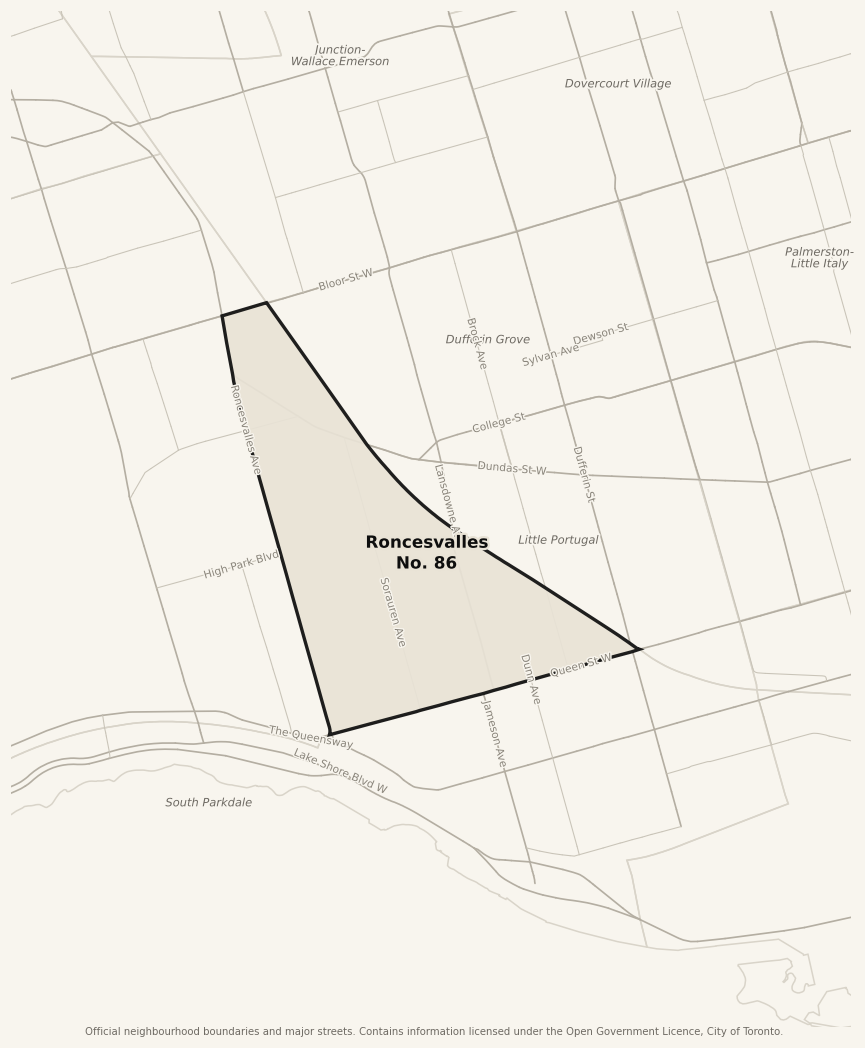
Official City of Toronto neighbourhood: Roncesvalles (No. 86).
The History
The story of Roncesvalles extends far deeper than most Torontonians realize. The avenue follows what Indigenous peoples used as a major trade route for over 11,000 years, a geography that dictated the area’s importance long before European settlement. By the early 1900s, the extension of the streetcar system opened the land to development, and what emerged was a neighbourhood built almost entirely of Victorian and Edwardian homes, constructed between roughly 1905 and 1930.
The physical layout reflects that era. Lot widths are generous by Toronto standards, many properties sit on 30+ foot-wide lots with substantial setbacks, creating front lawns and spacious backyards that feel almost suburban within an urban footprint. The homes themselves carry the hallmarks of the period: original wood trim, stained glass windows, working fireplaces, decorative turrets, and deep front porches designed for neighbourly conversation.
The neighbourhood’s character shifted dramatically after World War II, when a significant Polish community established itself here. The 1940s through 1950s saw an influx of Polish immigrants, many arriving as displaced persons after the war. They created institutions, churches, restaurants, shops, that transformed Roncesvalles Avenue into Toronto’s de facto Polish village. That legacy remains vital. Every September, the Roncesvalles Polish Festival draws approximately 300,000 visitors, making it one of Toronto’s most attended cultural events. On any given week, you’ll hear Polish spoken on the street, smell kielbasa and paczki from the bakeries, and witness a community that has preserved its identity across generations while also welcoming the broader city.
What You’ll Actually Find Here
Roncesvalles offers three main housing types, each with distinct character:
Victorian and Edwardian Detached and Semi-Detached Homes: These are the backbone of the neighbourhood. Single-family detached homes typically feature 3-4 bedrooms, are built on solid brick or stone, and offer original architectural details if you’re willing to search for them. Interiors vary wildly, some have been restored to period perfection, others are more lived-in. Lot depths are generous, meaning backyards often feel like actual retreats. Semi-detached homes share similar characteristics but with slightly tighter floor plans. These homes dominate the tree-lined residential streets (Garden Avenue, Perth Avenue, Wabash Avenue, Fern Avenue) that branch off the commercial avenue.
Townhouses and Walk-Ups: Scattered throughout the neighbourhood are newer or substantially renovated townhouse-style properties, some purpose-built condominiums, and converted walk-up apartments. These tend to appeal to young families or downsizers seeking the neighbourhood’s character without full home ownership.
Condominiums: There are fewer purpose-built condominiums here than in some Toronto neighbourhoods, this is still fundamentally a house neighbourhood. What condominium stock exists tends toward mid-rise or converted loft-style buildings, often clustered near High Park or on the periphery of the residential core.
Across all types, one constant emerges: condition and renovation quality matter more than raw square footage. A beautifully restored Victorian with authentic details commands a premium. A home requiring foundational work, even if it’s technically the same size, sells for considerably less and takes longer to move.
What Homes Cost in Roncesvalles (W01)
Roncesvalles is a TRREB community in District W01, which it shares with High Park-Swansea and South Parkdale. The figures below are for the community of Roncesvalles itself.
Home Prices: From January 2 to October 30, 2026, detached homes in Roncesvalles sold at a median of $1,850,000 (22 sales) and semi-detached homes at a median of $1,610,000 (39 sales).
Detached and Semi-Detached Homes: Within Roncesvalles, homes with original details or substantial recent renovations sell at the higher end.
Townhouses: A median of $1,521,749 (13 sales) for freehold townhouses in Roncesvalles from January 2 to October 30, 2026, though newly constructed or significantly upgraded townhouses can exceed this substantially. Three condo townhouses also sold.
Condominiums: A median of $720,000 (39 sales) in Roncesvalles from January 2 to October 30, 2026, though this varies significantly based on building age, location, and unit finishes.
Market Velocity: From January 2 to October 30, 2026, detached homes in Roncesvalles sold in a median of 8 days (an average of 12), semi-detached homes in a median of 7 days (an average of 11) and condo apartments in a median of 25 days (an average of 35). Those figures mask important nuance. Properties that are overpriced relative to condition or market perception sit for weeks or months. Properties that are realistically priced and presented well often move within days.
In TRREB District W01, all home types averaged $1,207,607 over the 12 months to October 2026 (457 sales) and $1,269,569 in October 2026 alone (51 sales) (TRREB Market Watch).
It’s worth noting that pricing has modulated in recent years. The neighbourhood experienced significant appreciation in the 2015-2021 window but has seen more modest year-over-year growth since. This is actually healthy, it suggests the market is maturing and becoming less speculative.
What We Love About Roncesvalles
Authentic Urban Character: This isn’t a neighbourhood trying to be something it isn’t. The architecture is genuine. The Polish community is genuine. The streetcar is genuine. Walk down Roncesvalles Avenue or garden-lined Perth Avenue, and you’re not walking through a developer’s vision of nostalgia, you’re walking through actual history.
Exceptional Walkability: With a Walk Score of 92, this is a place where you genuinely don’t need a car for daily life. The 501 Queen streetcar (which carries 12.8 million annual boardings, making it Toronto’s second-busiest streetcar line) runs the length of the neighbourhood and connects to major transit corridors. The 504 King streetcar runs along Roncesvalles Avenue itself. Dundas West Station, on the Bloor-Danforth line, is a 10-minute walk south. This is carless living that actually works.
Real Community Institutions: Sorauren Park Farmers Market operates every Monday from 3-7pm (May through October) at 50 Wabash Avenue, drawing neighbourhood regulars, not tourists. The Roncesvalles Polish Festival each September is not a manufactured event, it’s an authentic expression of the neighbourhood’s identity. Revue Cinema, a 1970s-era independent theatre at 400 Roncesvalles, still programs challenging and independent films alongside mainstream releases.
Restaurant and Retail with Soul: Chopin Restaurant at 165 Roncesvalles Ave serves Polish and Ukrainian food in an atmosphere that reflects decades of community loyalty. Cafe Polonez is a 30+ year staple for traditional Polish pastries and lunch. Barque Smokehouse offers legitimately excellent BBQ. The Ace is a restored 1950s diner that feels authentic, not designed. For retail, Muttonhead produces beautifully made Canadiana apparel, Likely General curates homewares with actual taste, and The Cookery offers serious kitchen equipment and advice. These aren’t chain operations, they’re locally owned institutions with real reputations.
Proximity to Green Space: High Park is a 10-minute walk from most residential areas. The park offers 38 hectares of green space, water features, trails, and seasonal botanical interest. In spring, the cherry blossoms draw crowds; year-round, it’s a genuine retreat.
Architectural Integrity: You cannot build a Mcmansion on a Victorian lot. The lot widths and existing streetscape simply won’t accommodate it. This constraint, which some view as limiting, actually protects neighbourhood character. The homes here maintain architectural continuity and human scale.
The Honest Take
Roncesvalles is not a neighbourhood without friction. The things you love come with trade-offs that deserve explicit acknowledgment.
Streetcar Noise: The High Park Loop at the corner of Dundas and Roncesvalles features sharp curves where streetcars brake and accelerate. The screech is real and it’s loud. Homes within 2-3 blocks can experience significant noise, particularly in the morning and evening when service is frequent. This is not speculative, it’s a genuine livability factor. Properties on quieter residential streets (Perth, Garden, Wabash) avoid this entirely.
Narrow Lot Widths Limit Renovation Scope: Many Victorian and Edwardian homes sit on 24-30 foot lots. This was perfect for the 1920s. For contemporary living, it means limited flexibility. You can’t easily add a second storey without height variance applications. You can’t widen the home. You can modify interiors, but external footprint changes are challenging. This limits renovation upside compared to larger suburban lots.
Parking is Competitive: The neighbourhood’s walkability comes at a cost if you own a car. On-street parking is limited and regulated. Most homes lack meaningful driveway space, Victorian architecture predates the automobile, and many properties have original narrow carriageways (now used as driveways) that fit one car, uncomfortably. If your household has two vehicles, parking becomes a genuine logistical challenge.
Infrastructure is Aging: Nineteenth-century systems underlie twentieth-century homes. Many properties have original or partially original plumbing, electrical, and heating. The neighbourhood has seen increasing water main breaks and street flooding during heavy rain, reflecting aging municipal infrastructure. Factor ongoing maintenance into any purchase, these homes will require regular attention.
Roncesvalles Avenue is Busy, Not Quaint: The avenue itself is a working commercial street. It’s loud. It has vehicle traffic, streetcar traffic, pedestrian traffic. You get authentic urban energy, not picturesque village quiet. Homes directly on the avenue need to accommodate this reality. The avenue is where you shop and eat; residential character lives on the side streets.
Demographic Change is Incremental but Evident: The Polish community remains significant, but newer residents are increasingly young professionals and families of diverse backgrounds seeking walkable urban living. This is natural neighbourhood evolution, but it means cultural institutions and businesses serve an increasingly diverse clientele. This isn’t a criticism, it’s just reality.
Who Lives Here
The current population is approximately 15,000. Demographically, 39.6% are immigrants, and 26% identify as visible minorities. The community skews younger, young families with children, young professionals seeking walkable urban living, and long-time residents with deep community ties. You’ll find multi-generational Polish families who have lived here since the 1950s, recent immigrants from various countries establishing themselves in affordable pockets of the city, and downtown professionals willing to trade commute time for neighbourhood character and space.
The predominant housing type, single-family homes, attracts families. You’ll see children on porches, parents at the farmers market, kids in the schools. Simultaneously, the proximity to downtown and strong transit connectivity attracts young professionals who might otherwise live in condominiums elsewhere. The result is a neighbourhood with genuine demographic diversity across age, ethnicity, and life stage, not performative diversity, but the actual heterogeneity that emerges when housing is affordable enough to attract different populations simultaneously.
Culturally, the Polish heritage community remains the dominant institutional force. The Polish church, Polish restaurants, the Polish festival, Polish schools and community centres, these provide genuine anchors. But newer residents engage these institutions or remain outside them; neither scenario is framed as wrong. The neighbourhood feels mature enough to hold multiple identities simultaneously.
Schools
Toronto Catholic District School Board and Toronto District School Board both operate here. Public elementary options include Garden Avenue Junior Public School (225 Garden Ave), Fern Avenue Public School (128 Fern Ave), and Howard Junior Public School. These schools serve the immediate neighbourhood and have dedicated staff relationships with families.
For Catholic education, St. Vincent de Paul Catholic Elementary School is located at 116 Fermanagh Avenue and offers French Immersion starting in Grade 5, a significant advantage if you’re seeking bilingual education within walking distance.
At the secondary level, Bishop Marrocco/Thomas Merton Secondary School (1515 Bloor St W) is the primary TDSB option, just south of the neighbourhood. It’s a well-regarded school with strong arts and academics programming.
School performance varies year to year, but the neighbourhood schools have long-standing community presence. Parents generally report positive experiences. The walkability means school commutes are manageable for younger children.
Getting Around
Transit is the defining feature of Roncesvalles mobility. The 501 Queen streetcar runs the full length of the neighbourhood on High Park Avenue and Queen West. It’s not just service, it’s a lifeline. With 12.8 million annual boardings, it’s Toronto’s second-busiest streetcar line. The 504 King streetcar runs directly on Roncesvalles Avenue, providing additional east-west connectivity.
Dundas West Station on the Bloor-Danforth subway line opened in 1966 and is approximately a 10-minute walk south. This connection gives residents direct access to the broader transit network.
Walk Score is 92, which means virtually all errands can be accomplished on foot. Grocery shopping, restaurants, healthcare, pharmacies, all are within walking distance. Parks, schools and entertainment are all within walking distance.
If you drive, understand that parking is constrained. Most homes have a single-car driveway (if that), and on-street parking is regulated. The neighbourhood’s design predates widespread car ownership, so it doesn’t accommodate multi-vehicle households particularly gracefully. This is intentional, the neighbourhood’s character depends on managing car volume.
Cycling is viable, though some streets are narrower and lack dedicated infrastructure. Dundas West has been gradually improved for cycling in recent years.
Things to Do
Within immediate walking distance: High Park (10-minute walk), which offers 38 hectares of trails, seasonal gardens, water features, and genuinely beautiful green space. The park serves as the neighbourhood’s outdoor living room.
Sorauren Park Farmers Market (50 Wabash Ave) operates Monday evenings, 3-7pm, May through October. It’s an institution. You’ll see the same vendors and customers every week. It’s not a tourist-oriented market, it’s a genuine neighbourhood gathering.
Revue Cinema (400 Roncesvalles) is an independent cinema programming independent, international, and mainstream films. It’s one of Toronto’s last neighborhood cinemas, and it maintains that identity fiercely.
The Roncesvalles Polish Festival (September) draws approximately 300,000 visitors. Polish cultural programming, food, music, and street activities make it one of Toronto’s most attended cultural events. Even if you’re not Polish, the festival is worth experiencing.
Restaurant dining is genuinely good. Chopin (Polish/Ukrainian), Cafe Polonez (Polish pastries), Barque Smokehouse (BBQ), The Ace (diner), Fantail (superfood muffins), none are chain operations. They have character and reputation built on years of consistent performance.
Shopping is curated. Muttonhead produces high-quality Canadiana apparel. Likely General offers beautiful homewares. The Cookery provides serious kitchenware and expertise. The avenue has retail density, but it’s retail with actual standards.
Within short transit distance: The Distillery District (10-15 minutes by streetcar), downtown cultural institutions (15-20 minutes), and broader Toronto amenities. The neighbourhood isn’t isolated, it’s connected but not overdeveloped.
Buying in Roncesvalles: What to Expect
First, understand that you’re buying in a high-demand market. Properties that are realistically priced relative to condition move quickly. This means:
Price Sensitivity: The market is detail-driven. Renovation quality matters more than raw square footage. A well-renovated 1,500-square-foot Victorian commands a premium over a 1,800-square-foot home requiring significant work. Buyers here understand the cost of deferred maintenance and price accordingly. Don’t assume size equals value.
Condition Matters Enormously: Foundation integrity, roof age, electrical and plumbing systems, window condition, these aren’t secondary considerations. They’re primary. Budget for home inspection, asbestos testing, and professional assessment. A home’s original character is an asset only if that character doesn’t mean neglected systems.
Lot Constraints Are Real: If your vision for renovation requires expanding footprint, widening the home, or substantial second-storey work, understand the variance process upfront. Many transactions have stalled because buyers discovered after purchase that their renovation dreams require complicated zoning processes.
Walkability and School Proximity Drive Pricing: Homes within walking distance of the farmers market, Revue Cinema, and schools command premiums. Corner properties and those on the quieter tree-lined residential streets (Perth, Garden, Wabash) trade at different premiums than avenue-facing properties. A home on Perth Avenue and Dundas is worth materially more than a similar home two blocks over on a less prominent street.
Parking and Car Ownership Are Liabilities: If you’re buying for a two-car household, expect friction. The neighbourhood’s charm depends on managing car volume. Factor parking reality into location selection.
Streetcar Proximity is a Pricing Factor: Homes within earshot of the High Park Loop pay a noise premium/discount. Properties three or more blocks away avoid this entirely. This is legitimate livability impact, not gossip, but physical reality that buyers price accordingly.
Community Connection Matters: The neighbourhood’s strength derives from people who engage its institutions and public spaces. If your vision is buying a home and remaining isolated within it, you’re missing what makes Roncesvalles function. The appeal is genuine community participation, the farmers market, the festival, the schools, the local restaurants. Buy here if you’re ready to be a participant, not a bystander.
Roncesvalles remains one of Toronto’s most authentic neighbourhoods, a place where history is visible in architecture, where community identity is expressed through institutions and public life, and where the scale is still fundamentally human. The market is disciplined, pricing reflects reality, and homes move in serious markets. This is not a neighbourhood for speculation, it’s a neighbourhood for people who want to live here.
Michael Ouzas and his team have worked this neighbourhood’s core market for years. We understand the Victorian architecture, the lot constraints, the school dynamics, the transit reality, and the community institutions that make Roncesvalles function. If you’re considering buying here, sell here, or just want to understand the neighbourhood at depth, we’re based here and work here constantly.
Related Neighbourhood Guides: Bloor West Village | The Junction | High Park | Swansea
Weighing your options? Read our comparison: High Park vs Roncesvalles: which should you buy in?
Roncesvalles Sold Prices in 2026
Every MLS® sale from January 2 to October 30, 2026. Price per square foot uses above-grade size; the basement is not included.
| Type | Sales | Median price | Per sq ft | Sold over asking |
|---|---|---|---|---|
| Detached houses | 22 | $1,850,000 | $947 | 68% |
| Semi-detached houses | 39 | $1,610,000 | $978 | 67% |
| Condo apartments | 39 | $720,000 | $990 | 10% |
In the Garden and Fern school zone (between Roncesvalles Avenue and Sorauren Avenue, from Marion Street up to Grenadier Road), the same house sells for about 22% more than in the rest of W01.
See the full pocket-by-pocket numbers on the Roncesvalles stats page.
Related reading
- Roncesvalles market stats: 2026 sold prices by pocket
- Roncesvalles Schools: Rankings, Catchments, and What Families Need to Know
- Toronto West market stats (W01 to W08), updated monthly
- High Park vs Roncesvalles
- Why Toronto’s West End Housing Market Is Still So Competitive in 2026
- Bloor West Village: A Complete Neighbourhood Guide for Buyers
- December 2024 Toronto Real Estate Market Update
- Swansea: nearby guide
- High Park Swansea: nearby guide
- Parkdale: nearby guide