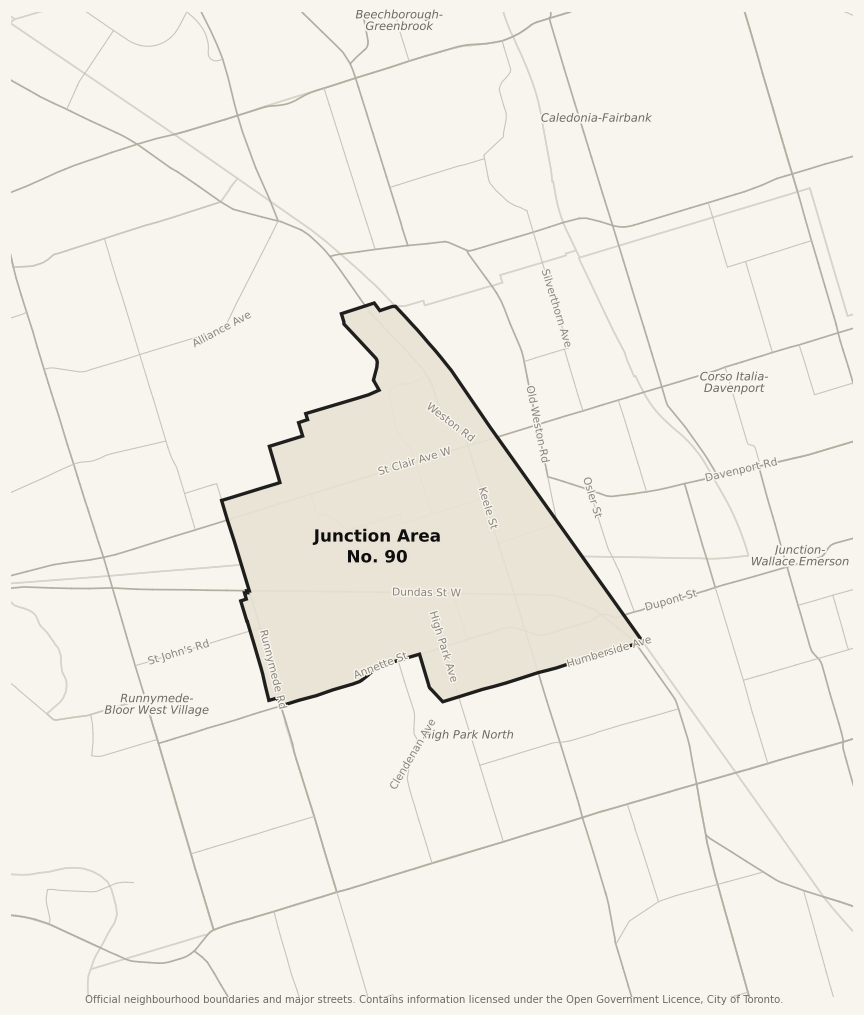
The Junction is the neighbourhood that wasn’t supposed to happen. A century of prohibition, decades of industrial grit, and a location that most of Toronto ignored, and then suddenly everyone wanted in. Centred on Dundas Street West between Keele and Runnymede, The Junction occupies the northwest pocket of Toronto’s West End where five railway lines once converged, giving the neighbourhood its name. What you’ll find today is a strip that’s become one of the city’s strongest food and drink destinations, surrounded by Victorian and Edwardian residential streets that still carry the bones of a working-class neighbourhood but now command serious prices. It’s authentic in a way that can’t be manufactured, because it was genuinely overlooked for a hundred years before anyone decided it was cool.
Official City of Toronto neighbourhood: Junction Area (No. 90).
The History
The Junction’s story starts with railways. By 1883, five rail lines converged here: the Grand Trunk, Toronto Grey & Bruce, CP Railway, Credit Valley, and Ontario & Quebec railways, creating the junction that gave the neighbourhood its name. Developer Daniel Webster Clendenan subdivided 240 acres of the Keele estate in 1883 and marketed it as “West Toronto Junction Property.” By 1887, the Village of West Toronto Junction was incorporated with 879 residents. By 1889 it was a town of 4,000. The CP Railway shifted its locomotive shops here, employing up to 1,000 workers, and the Ontario Stockyards opened in 1903 as Canada’s largest livestock market.
Then came the event that defined The Junction for a century. On December 30, 1897, a murder in the railway underpass near Keele Street, linked to a nearby hotel, triggered a prohibition vote in 1904. Residents banned alcohol sales, and The Junction stayed dry for nearly 100 years, the last dry neighbourhood in Toronto. The ban was finally lifted around 2000, and that single change, combined with streetscape improvements and the burial of overhead electrical lines, catalyzed the transformation you see today. The craft breweries, cocktail bars, and restaurant scene that now defines Dundas West exist because of a century-long hangover that kept commercial rents low and chains away.
What You’ll Actually Find Here
The housing stock in The Junction is predominantly red brick Victorian and Edwardian homes, detached and semi-detached, built between 1885 and 1920 for the railway and factory workers who built this neighbourhood. You’ll see turrets, arched entryways, decorative front porches, and the whimsical Victorian details that make these streets photograph well. The construction is solid, built with the same materials and care you find in Bloor West Village, because it was the same era and the same builders.
Lot sizes vary significantly by location within the neighbourhood. North of Annette Street, you’ll find larger properties with lot depths reaching 170 feet or more. Near Dundas West, the lots are narrower and more modest, reflecting the working-class origins. Typical lot widths range from 19 to 25 feet with depths of 80 to 170 feet. Many homes have been renovated to varying degrees, from full gut-jobs with modern finishes to careful restorations that preserve original character.
Condo development is limited compared to other west-end pockets. This is still primarily a single-family residential neighbourhood, which is part of its appeal and part of why pricing has held firm. The housing stock rewards buyers who appreciate character and are willing to invest in renovation, because what you get in return is a home with genuine history on streets that feel lived-in.
What Homes Cost in The Junction (W02)
The Junction is the TRREB community of Junction Area, in District W02. From January 1 to November 2, 2026, here’s what homes sold for in Junction Area:
- Detached homes: a median of $1,650,000 (11 sales), depending on condition, size, and exact location. Fully renovated detached homes on quieter streets north of Annette sell at the higher end; unrenovated properties with good bones sell for less, though they move fast.
- Semi-detached homes: a median of $1,227,500 (32 sales). Semis outnumber detached homes here (32 semi-detached sales against 11 detached), making the Junction more accessible for first-time buyers in the west end. Well-presented semis near Dundas West trade briskly.
- Smaller homes and workers’ cottages: The more modest Victorian workers’ homes near Dundas offer entry points into the neighbourhood.
- Townhouses and condos: freehold townhouses sold at a median of $1,347,500 (6 sales), condo townhouses at $841,500 (10 sales) and condo apartments at $589,944 (34 sales).
In TRREB District W02, all home types averaged $1,198,431 over the 12 months to October 2026 (692 sales) and $1,266,814 in October 2026 alone (71 sales) (TRREB Market Watch).
What We Love About The Junction
The Dundas West strip is the draw. This is one of Toronto’s most exciting food and drink corridors, and it happened organically rather than being developed by a marketing team. Indie Alehouse at 2876 Dundas West brews award-winning craft ales on-site. Hole in the Wall is a narrow cocktail bar in a century-old building that used to be a toy store. Vesuvio Pizzeria has been operating since 1957 and was Toronto’s first pizzeria, opened by the Pugliese family, who famously fought for decades to lift the alcohol ban so customers could enjoy wine with their pizza. These aren’t chains. They’re stories.
The food scene extends well beyond those anchors. Imanishi serves consistently excellent Japanese. Isaan Der does authentic Thai. When The Pig Came Home makes some of the best smoked meat sandwiches in the city. Luna Junction draws weekend brunch crowds. The strip supports the kind of density and variety that usually requires a much larger commercial corridor.
Beyond the restaurants, Pandemonium is one of Toronto’s largest used book and record stores. Nova Era Bakery does pastel de nata and coconut tarts. Nosso Talho is the butcher shop locals swear by. The West Toronto Railpath, a 2.1-kilometre car-free trail built on an abandoned railway line, runs through the Junction Triangle and connects to larger cycling networks. The independent character of this strip is self-reinforcing: the businesses that thrive here thrive because they’re interesting, not because they’re convenient.
The Honest Take
The Junction is louder and grittier than Bloor West Village, and that’s by design. If you want manicured quiet, this isn’t your neighbourhood. Dundas West has energy, foot traffic, and the occasional bar crowd. The railway corridor that gave this place its name still carries freight trains, and you’ll hear them. Some blocks are beautifully maintained; others are still in transition. That unevenness is part of what keeps the neighbourhood interesting, but it also means you need to know exactly which streets you’re buying on.
The Stockyards area north of St. Clair has big-box retail (Home Depot, Canadian Tire, Best Buy, Metro) which is useful but not pretty. The industrial heritage means some pockets still have commercial or light-industrial uses adjacent to residential streets. Do your homework on what’s next door before you buy.
Transit is decent but not as convenient as BWV. Keele Station on the Bloor-Danforth line is the main subway access point, and bus routes serve Dundas West, but you’re not right on top of the subway the way you are in Bloor West Village. Most households have a car. The Walk Score hits 95 around the Dundas strip itself, but drops as you move into the quieter residential blocks.
Who Lives Here
The Junction has a younger demographic. You’ll find young professionals and couples who priced out of downtown but want walkable urban culture. Young families who want character homes. Artists and creatives drawn by the neighbourhood’s independent streak. Long-time residents who’ve been here since before the transformation, many of Portuguese and Latin American descent, reflected in the bakeries and butcher shops that anchor the strip. It’s a neighbourhood in transition but one where the transition has been happening long enough that it feels settled rather than speculative.
Schools
The Junction is served by several schools across both the TDSB and TCDSB boards. The school landscape here is solid without matching the concentration of top-ranked schools you find in Bloor West Village.
- St. Cecilia Catholic School (JK-8) at 355 Annette Street serves approximately 635 students with both English and French Immersion programs. EQAO results show 88% meeting standards in English. St. Cecilia has been operating since 1914 and has deep roots in the neighbourhood.
- Indian Road Crescent Junior Public School (JK-6) at 285 Indian Road Crescent has about 285 students with strong EQAO performance: 95% in English and 74% in Math. A smaller, well-regarded school.
- Annette Street Public School (K-6) at 265 Annette Street shares facilities with High Park Alternative School, including a library, gym, pool, and playground. The school has been part of the neighbourhood since 1886.
- Western Technical-Commercial School (Grades 9-12) is the main secondary school serving the area with approximately 1,430 students. Western Tech offers academic and gifted programming and has a strong technical education tradition.
French Immersion is available through St. Cecilia (TCDSB) and through the broader TDSB network. For families prioritizing top-ranked secondary schools, the proximity to Humberside Collegiate Institute’s catchment in neighbouring Bloor West Village is worth exploring, though catchment boundaries should be confirmed directly with the TDSB.
Getting Around
Keele Station on the Bloor-Danforth subway line is the primary rapid transit connection, located at the southern edge of the neighbourhood. The 40 Junction bus runs along Dundas West connecting to both Dundas West Station and points west. Additional bus routes serve Keele Street and Annette Street.
The neighbourhood has a Walk Score of 95 around the Dundas strip, meaning daily errands don’t require a car. The West Toronto Railpath provides a dedicated cycling and walking corridor through the Junction Triangle. For drivers, the neighbourhood connects to major arteries including Dundas West, Keele Street, and access to the Gardiner Expressway via South Kingsway.
Downtown commute time is under 30 minutes via subway from Keele Station. The UP Express at Mount Dennis GO and Weston GO provides Pearson Airport access in under 30 minutes.
Things to Do
The Dundas West strip is the main event. The concentration of independent restaurants, bars, and shops between Keele and Runnymede creates the kind of walkable commercial corridor that makes a neighbourhood feel complete. From craft beer at Indie Alehouse to wood-fired pizza at Vesuvio, from used vinyl at Pandemonium to fresh pastries at Noctua Bakery, the strip rewards exploration. The Junction BIA keeps the commercial area active with events and street festivals throughout the year.
The West Toronto Railpath is a 2.1-kilometre car-free multi-use trail built on a former railway corridor, running north-south through the Junction Triangle. It connects to the broader city cycling network and features public art, indigenous plantings, and restored historical rail bridges. Three Bike Share stations are located along the path.
Rennie Park is a 31-acre green space with baseball courts, tennis courts, ice rinks, a swimming pool, playground, and picnic areas. High Park is accessible from the southern portions of the neighbourhood, adding 400 acres of ravine trails, gardens, and the city zoo to the neighbourhood’s outdoor options.
Buying in The Junction: What to Expect
The Junction rewards buyers who know where to look. Unlike Bloor West Village, where the entire neighbourhood commands premium pricing, The Junction has meaningful price variation block by block. The streets north of Annette and away from the commercial strip tend to be quieter with larger lots. The blocks closer to Dundas are more urban in feel, with smaller homes but direct access to the strip’s energy. Understanding which micro-location matches your lifestyle is the difference between finding value and overpaying.
Renovation potential is a real factor here. Many homes still have original layouts that can be opened up, basements that can be finished, and additions that are feasible given the lot sizes. If you’re comfortable with a project, The Junction can deliver more house for the money than BWV. If you want turnkey, expect to pay a premium for homes that have already been updated.
Michael Ouzas and his team work The Junction as part of their core West End practice. The knowledge that matters here is street-level: which blocks are appreciating fastest, where the next commercial development is planned, and how the neighbourhood’s transformation is likely to evolve. That local intelligence is the difference between a good purchase and a great one.
For how The Junction compares to neighbouring areas, explore our guides to Bloor West Village, High Park, and Roncesvalles.
Weighing your options? Read our comparison: Bloor West Village vs The Junction: an honest comparison
The Junction Sold Prices in 2026
Every MLS® sale from January 1 to November 4, 2026. TRREB counts The Junction inside its Junction Area community, so these are the numbers for Junction Area. Price per square foot uses above-grade size; the basement is not included.
| Type | Sales | Median price | Per sq ft | Sold over asking |
|---|---|---|---|---|
| Detached houses | 11 | $1,650,000 | $898 | 64% |
| Semi-detached houses | 32 | $1,227,500 | $846 | 53% |
| Condo apartments | 35 | $591,888 | $768 | 9% |
In Junction Area, the same house sells for about 45% more south of Dundas than north of Dundas.
See the full pocket-by-pocket numbers on the Junction stats page.
Related reading
- The Junction market stats: 2026 sold prices by pocket
- The Junction Schools: Rankings, Catchments, and What Families Need to Know
- Bloor West Village and High Park stats (TRREB W02)
- Toronto West market stats (W01 to W08), updated monthly
- Bloor West Village vs The Junction
- Why Toronto’s West End Housing Market Is Still So Competitive in 2026
- Toronto’s West End Is Outperforming the Market in 2026
- Return to Office: What It Means for Toronto Real Estate
- High Park: nearby guide
- High Park North: nearby guide
- Baby Point: nearby guide