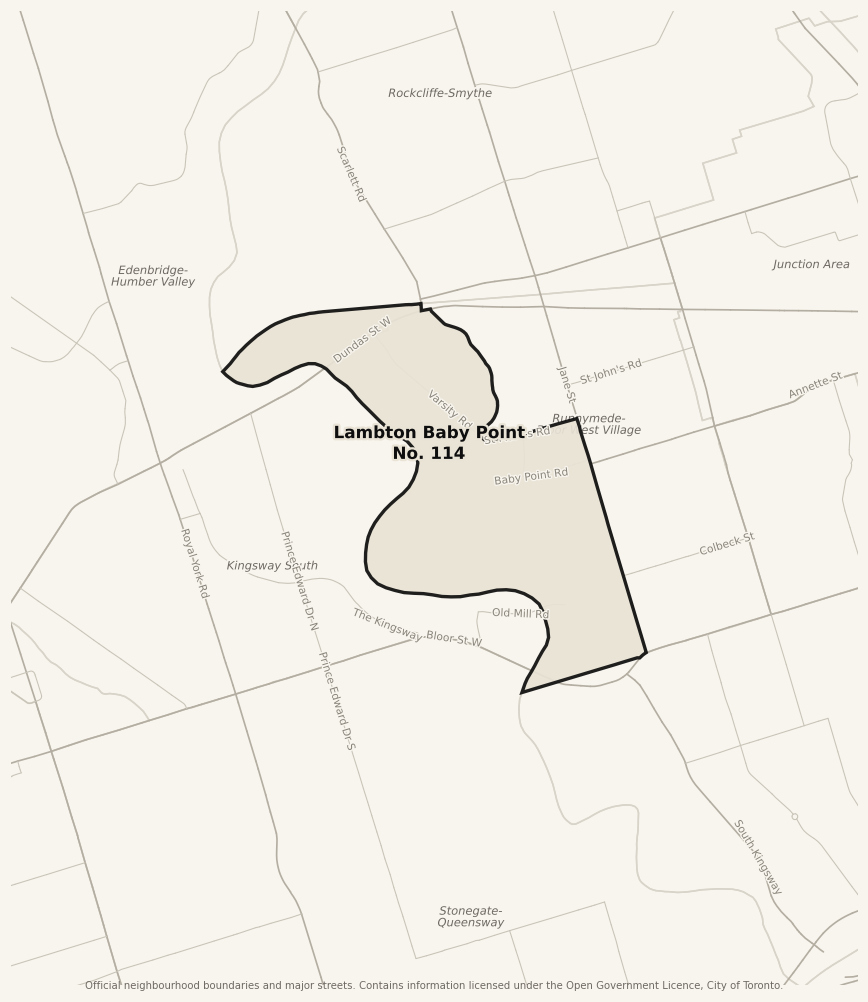
Lambton is one of Toronto’s quietest, most family-oriented west-end neighbourhoods, a place where tree-lined streets, golf course views, and post-war architecture create an almost suburban feel while remaining firmly urban. Bounded by the Humber River to the west, St. Clair Avenue West to the north, Jane Street to the east, and Dundas Street West to the south, Lambton is part of the TRREB community of Lambton Baby Point, in District W02. It’s the kind of neighbourhood where people actually know their neighbours, kids play street hockey, and property values stay measured while everyone else in the city talks about million-dollar bungalows. If you want solid residential living without the hype, Lambton deserves serious consideration.
Official City of Toronto neighbourhood: Lambton Baby Point (No. 114).
The History
Lambton has roots deeper than most Torontonians realize. Originally settled as a small village west of the city proper, Lambton was incorporated into Toronto in 1909 during the city’s territorial expansion. The neighbourhood takes its name from John Graves Simcoe’s father-in-law, reflecting the historical landholding patterns of early Upper Canada. The area’s trajectory shifted significantly when the Lambton Golf and Country Club was established in 1902, a prestigious private club that has defined the neighbourhood’s character for over 120 years. The golf course became the geographical and social anchor that distinguished Lambton from neighbouring areas, attracting a demographic of established families and professionals.
The post-World War II building boom shaped the Lambton you see today. Between the 1950s and 1970s, the neighbourhood filled in with bungalows, split-level homes, and modest detached houses built on generous lots, larger than you’d find in many other Toronto neighbourhoods. This wasn’t speculative development; it was purposeful suburban-style residential construction designed for families. The result is an architectural cohesion that older, more mixed Toronto areas lack. Streets like Dundas West, Jane Street, and High Park Avenue developed as modest commercial corridors supporting the residential core, never becoming fashionable destinations but always reliable.
Today, Lambton remains remarkably unchanged from that post-war vision, which is precisely why it appeals to people seeking stability and actual community rather than constant reinvention. While adjacent neighbourhoods like Bloor West Village have been gentrified and repackaged as destinations, Lambton has quietly resisted the trend, maintaining its character as a neighbourhood that exists for residents, not Instagram visitors.
What You’ll Actually Find Here
Post-War Bungalows: The defining housing type in Lambton, these single-storey brick bungalows date primarily from the 1950s and early 1960s. They typically sit on 40-50-foot lots with modest setbacks and side driveways. Most feature 2-3 bedrooms, single bathrooms (though many have been updated), and basements offering potential for additional living space or finishing. The construction is solid, wood frame, brick exterior, asphalt shingles, nothing fancy, but built to last. Renovation potential exists, particularly in the basement and kitchen areas, though you’re often constrained by the lot size and municipal regulations around height and footprint.
Split-Level and Bi-Level Homes: A secondary but significant housing type, particularly in the eastern portions of Lambton near Jane Street. These mid-century homes (1960s-1970s) offer more interior volume than bungalows, typically with 3-4 bedrooms spread across two levels. They present interesting renovation challenges and opportunities, the split design can feel awkward in their original configuration, but creative gut renovations have transformed many into desirable modern family homes. These tend to be slightly pricier than comparable bungalows due to the additional square footage.
Detached Two-Storey Homes: More modest than the sprawling Victorians of Bloor West Village, Lambton’s two-storey detached homes are straightforward residential architecture, typically 4-5 bedrooms, built in the 1960s-1980s. They’re often set back further from the street than bungalows and feel more private as a result. Many have been tastefully updated while others remain in original condition, creating a wide range of pricing within this category.
Lot Sizes and Density: What makes Lambton distinctive is that most lots exceed what you’d find in more densely developed neighbourhoods. You’re getting 4,000-6,000 square feet of land regularly, which means space between houses, room for actual yards, and garages rather than driveways crowded to the property line. This isn’t sprawling, you’re still in the city, but it’s noticeably more spacious than Bloor West Village or Junction properties, and that space comes at a significant price advantage.
What Homes Cost in Lambton (W02)
Lambton sits with Baby Point in the TRREB community of Lambton Baby Point, which most buyers simply call Baby Point. From January 1 to November 2, 2026, detached homes there sold at a median of $1,705,000 (41 sales) and semi-detached homes at a median of $1,027,500 (8 sales). By style:
Bungalows: No bungalows were among the 41 detached homes that sold in Lambton Baby Point in that time, so there is no 2026 median for them. Renovation-ready properties sell at the lower end; updated kitchens and bathrooms push toward the higher range.
Split-Level Homes: No split-level homes were among them either. The split design remains divisive, some buyers see potential, others see awkwardness.
Detached Two-Storey Homes: a median of $1,690,000 (34 sales), depending on condition and location within the neighbourhood. The eastern portions near Jane Street tend slightly lower; homes closer to the Humber River views or Dundas West amenities drift higher.
Market Reality: Lambton has appreciated steadily but not explosively, reflecting stable demand from families rather than speculative investment. This predictability appeals to buyers seeking stable long-term housing rather than quick equity gains, and it means you’re buying a home to live in, not a financial instrument.
In TRREB District W02, all home types averaged $1,198,431 over the 12 months to October 2026 (692 sales) and $1,266,814 in October 2026 alone (71 sales) (TRREB Market Watch).
What We Love About Lambton
Actual Family Community: Walk Lambton on a Saturday afternoon and you’ll see kids playing in driveways, families watering gardens, neighbours chatting across property lines. This isn’t manufactured community from a new development; it’s organic, multi-generational settlement. Parents know other parents from the local schoopty-nesters, retirees, and young families seeking a calmer residential environment.
The Lambton Golf and Country Club Prestige: Even if you don’t golf, the presence of one of Canada’s oldest private golf clubs creates a subtle tone-setting effect. The club’s history, architecture, and maintained grounds influence the entire neighbourhood’s character. Property values near the golf course (roughly between Dundas W, St. Clair W, and the Humber) benefit from proximity and views. Being near, not necessarily in, an established institution carries intangible appeal.
Easy Access to Multiple Poles of Activity: While Lambton itself is quiet, you’re minutes from the commercial vitality of Dundas West (which has developed into a genuine destination), Bloor West Village (shopping, restaurants, nightlife), and the Runnymede commercial corridor. You can maintain residential peace while having access to urban amenities. The Jane-Dundas intersection and St. Clair Avenue West commercial areas provide daily shopping and dining without requiring a car ride across the city.
Schools With Genuine Track Records: Lambton Park Community School and Lambton Kingsway Junior Middle School serve stable, engaged communities. These aren’t trendy new schools; they’re established institutions where staff turnover is low and families stay long-term. The stability translates to better student outcomes, strong parent involvement, and genuine sense of institutional mission rather than constant administrative churn.
The Honest Take
Post-War Aesthetic Isn’t for Everyone: Lambton’s housing stock, while well-built, is fundamentally modest in appearance. If you’re drawn to heritage Victorian charm, Victorian terraces, or distinctive architectural character, Lambton will feel anonymous. The bungalows and split-levels were built to be functional, not beautiful. Even well-renovated examples maintain a straightforward residential quality. This is intentional, the neighbourhood trades architectural distinctiveness for affordability and practicality, but it’s a meaningful trade-off for some buyers.
Limited Entertainment and Dining Destinations Within the Neighbourhood: Lambton itself doesn’t have restaurants, breweries, boutique shops, or nightlife venues. The commercial corridors (Dundas W, Jane St intersections) are utilitarian, grocery stores, pharmacies, basic services. If you’re seeking walkable entertainment and dining, you’re heading to Bloor West Village or elsewhere. The neighbourhood’s quietness comes from being primarily residential, which means you’re relying on adjacent areas for nightlife and casual entertainment.
Dated Infrastructure in Many Blocks: While the neighbourhood is stable, some streets feel genuinely aging. Sidewalk conditions vary, street tree canopy has gaps (tree-lined doesn’t mean uniformly canopied), and some sewer/water infrastructure is original 1950s-60s vintage requiring future replacement. This isn’t decay, it’s the reality of aging infrastructure that municipalities eventually upgrade. But if you’re seeking the freshness of newer development, Lambton’s infrastructure feels appropriately vintage.
Transit is Good, Not Great: Bus routes run along Jane Street and Dundas West, and you’re within walking distance of Old Mill Station and Jane Station subway access. Commutes to downtown Toronto are manageable but not swift, typically 30-40 minutes by transit depending on your destination and starting point. If you’re transit-dependent for daily commuting, you’ll spend meaningful time on buses. The neighbourhood isn’t remotely car-dependent, but it’s not a quick-transit hub either.
Renovation Costs Matter Significantly: Renovation and modernization costs are no lower here than anywhere else in the city. An outdated kitchen still costs $50K-80K to update; a basement finishing still requires professional contractors. Lower purchase price doesn’t mean lower total acquisition cost if your property requires significant work. Budget carefully and assume that any property more than 15 years old will need modern kitchens, updated electrical, and basement assessment. Handy owners who can do finishing work themselves find better value here.
Who Lives Here
Lambton attracts a specific demographic: established families with children, long-term homeowners prioritizing stability over trend-chasing, and empty-nesters seeking quietness without leaving the city. The neighbourhood skews toward 40+ age groups, multi-generational families who have lived here 20+ years, and young families (30s) seeking affordable entry into Toronto’s west side without the expense of trendier areas. You’ll find lower rates of young professionals and renters compared to other Toronto neighbourhoods, this is owner-occupied family territory.
The socioeconomic profile is solidly middle to upper-middle class. People here are professionals, trades-people, business owners, and retirees with stable income rather than high-income earners. Median household incomes (roughly $130K-150K) are comfortable but not wealthy. The demographic diversity is lower than central Toronto, skewing toward established Canadian families with deep roots, though immigration from Asia and South Asia has increased significantly over the past 15-20 years, particularly with recent property turnover bringing younger immigrant families seeking affordable space.
What unites the demographic is shared priority of stability, space, and community over prestige, trendiness, and status signalling. Lambton residents generally aren’t motivated by Instagram-ability of their neighbourhood or proximity to the latest restaurants. They’re motivated by being able to afford a decent home, having space for families, knowing their neighbours, and maintaining a calm residential environment. It’s a deliberate choice away from neighbourhoods organized around impression management.
Schools
Lambton Park Community School serves the western portions of the neighbourhood (JK-8), with a strong reputation for engaged parent involvement and stable administrative leadership. The school maintains active French immersion programming, community-oriented events (think neighbourhood carols, street festivals), and genuine sense of belonging among families. Zoning brings most Lambton families here, and multi-generational family presence means younger siblings often attend the same school their older siblings did years prior. As with any public school, classroom composition varies year-to-year, but the overall institutional culture emphasizes community integration.
Lambton Kingsway Junior Middle School (grades 6-8, though officially covering the neighbourhood’s junior middle school years) serves eastern portions and feeds into High School options beyond the neighbourhood (typically Bloor Collegiate, Central Technical, or Earl Haig depending on zone). The school operates successfully but slightly less prominently in neighbourhood conversation than Lambton Park. Secondary education options extend beyond Lambton, with families having real choices rather than single zoned high school.
Catholic school option exists through the Toronto Catholic District School Board (typically St. Augustine, serving the west side), which provides alternative for families seeking Catholic education. Public and Catholic options both draw families into Lambton, meaning schools serve as genuine community anchors rather than afterthoughts. Waitlisting is less severe than trendy neighbourhoods, and you’re not competing for limited spots, that said, popular programs (French immersion) do attract interest from beyond immediate catchment areas.
Getting Around
Transit connectivity centers on bus routes (TTC routes 40/40A along Dundas West, 77A along Jane Street, and local coverage along St. Clair Avenue West) providing regular service to downtown and across the west side. Jane Station (Bloor-Danforth Line) and Old Mill Station (Dundas Line) are both accessible within walking distance (15-20 minutes), making subway access realistic though not immediate. Downtown commutes typically run 30-40 minutes depending on specific origin/destination and transfer requirements. For car-free living, it’s entirely manageable but requires actual transit knowledge and patience rather than the convenience of central Toronto subway proximity.
Car-dependent living in Lambton is low necessity but high convenience. Many families maintain vehicles primarily for suburban trips (cottages, family visits outside the city) rather than daily commuting. Street parking is available throughout most residential areas with occasional overnight permit requirements increasing near Dundas West corridors. Parking is not a constant stress as it is in downtown neighbourhoods, you can reliably find street parking or utilize your driveway/garage. Major car-centric destinations (suburbs, airports, regional shopping) are accessible via the Gardiner Expressway (10-15 minutes), making automotive access reasonable when needed.
Walkability for daily needs is good. Local commercial corridors provide grocery stores, pharmacies, basic services within reasonable walking distance. Neighbourhood streets themselves are safe, quiet walking environments with minimal traffic stress, genuinely pleasant for families with children. Cycling infrastructure is moderate (some painted bike lanes) but not continuous; cyclists navigate residential streets effectively but occasionally must share road space without dedicated infrastructure. The neighbourhood’s quiet streets make cycling practical for shorter trips without requiring protected bike lanes.
Things to Do
Within Lambton itself, recreational focus centers on James Gardens (24 acres of managed ravine parkland featuring walking trails, gardens, and natural areas), Lambton Woods (ravine park system), and Lambton Arena (community recreation facilities including swimming, skating, and programming). The proximity to Humber River provides additional natural recreational access, trails, views, and seasonal activities. For families with young children, the neighbourhood prioritizes neighbourhood parks (Dundas Park, High Park Avenue green space), community programs, and school-based activities rather than destination entertainment.
The Lambton Golf and Country Club remains the neighbourhood’s institutional anchor, though it’s private membership (limiting general access). The golf course itself, visible from many properties, provides visual amenity and sense of established permanence even for non-members. Community facilities like Lambton Arena and local schools host neighbourhood events (concerts, festivals, seasonal celebrations) that create genuine community gathering throughout the year.
For dining and entertainment beyond the neighbourhood, Bloor West Village (5-10 minute walk or short bus ride) has developed into a legitimate destination with multiple restaurants, bars, boutique shops, and neighbourhood gathering spaces. Dundas West (particularly further east toward Ossington) has emerged as a creative hub with galleries, restaurants, and entertainment venues. The neighbourhood benefits from proximity to these poles of activity while maintaining its own residential quietness, you have urban amenities nearby without them being in your backyard.
High Park (west of the neighbourhood, accessible by short walk or bike) provides larger recreational destination with playground facilities, sports fields, and seasonal attractions (cherry blossoms, accessible forest). The network of ravine parks (Humber, James, Lambton Woods) creates interconnected recreational opportunity for walking/hiking without requiring car travel. Cultural attractions (museums, galleries, major venues) require downtown trips but are accessible within 20-30 minutes by transit.
Buying in Lambton: What to Expect
Market Dynamics, Stability Over Appreciation: Lambton appreciates steadily, without speculative volatility. This works against buyers seeking quick equity gain but benefits buyers seeking stable, predictable investment. Competition is moderate: in 2026, 37% of detached homes in Lambton Baby Point sold over asking, at an average of 100.4% of asking, with consistent buyer interest from families prioritizing value and space. Expect professional competition from other owner-occupants (families), not primarily from investors or speculators.
Realistic Timeline: Properties typically stay listed 2-4 weeks, depending on condition and price positioning. Bidding wars are rare; homes may have multiple offers but aggressive overbidding is uncommon. If you’re prepared with pre-approval and have a realistic offer, you’re likely to succeed in getting a property at or near asking. This pace is relaxed compared to trendier west-side neighbourhoods where 48-hour offer deadlines are standard.
Condition Assessment Critical: Have thorough home inspections completed and budget for identified issues. Older homes (1950s-70s) may have cast-iron plumbing, original knob-and-tube electrical, asbestos insulation in basements, and aging roof systems. These aren’t dealbreakers but they’re budget requirements. Moisture in basements is common in any older Toronto neighbourhood; assume professional assessment and potential remediation costs. A $1.4M purchase price becomes $1.6M when you factor realistic renovation and system upgrades.
Resale Consideration: Lambton’s steadiness is both feature and constraint. You won’t make a fortune, but you won’t lose one either. Subsequent buyers will be similar families seeking stability, which limits your potential buyer pool to relatively consistent demographic. The neighbourhood is unlikely to suddenly become trendy (the market has moved beyond the post-war bungalow aesthetic for speculation purposes), so you’re buying for long-term living, not quick exit. This actually appeals to families planning to stay 10+ years.
Mortgage Approvals and Down Payment Reality: Standard mortgage qualification applies; no exotic financing is necessary. The neighbourhood’s stability means conventional lenders view properties favourably.
Thinking About Making a Move?
Lambton represents genuine opportunity for families prioritizing stability, space, and financial sense over trendiness and status. The neighbourhood’s quietness, established community, and value proposition attract intelligent buyers who have researched rather than followed hype. If you’re considering the west side of Toronto and value community over Instagram appeal, realistic school options, and the ability to afford your mortgage comfortably, Lambton deserves serious consideration before defaulting to trendier (and substantially more expensive) alternatives. Our team lives here, knows the streets, understands the schools, and can connect you with properties and neighbourhoods matching your specific family needs. Reach out, we’re happy to discuss whether Lambton or nearby alternatives align with your goals.
Related Neighbourhood Guides: Bloor West Village | The Junction | Runnymede | Baby Point | High Park North
Lambton Sold Prices in 2026
Every MLS® sale from January 1 to November 4, 2026. TRREB counts Lambton inside its Lambton Baby Point community, so these are the numbers for Lambton Baby Point. Price per square foot uses above-grade size; the basement is not included.
| Type | Sales | Median price | Per sq ft | Sold over asking |
|---|---|---|---|---|
| Detached houses | 42 | $1,690,000 | $1,128 | 36% |
| Semi-detached houses | 8 | $1,027,500 | $914 | 50% |
In Lambton Baby Point, the same house sells for about 52% more south of St John’s Road than north of St John’s Road.
See the full pocket-by-pocket numbers on the Bloor West Village stats page.
Related reading
- Bloor West Village and High Park stats (TRREB W02)
- Toronto West market stats (W01 to W08), updated monthly
- High Park: nearby guide
- High Park North: nearby guide
- The Junction: nearby guide