Swansea is one of Toronto’s most underrated and genuinely livable neighbourhoods. Perched on a hillside overlooking the Humber River, with tree-lined streets, affordable family homes, and direct waterfront access, Swansea offers authentic urban living without the premium price tag of nearby Bloor West Village or High Park. It’s a neighbourhood with real character, historic roots, a tight-knit community, and local spots residents actually use. Whether you’re hunting for your family home, an investment property, or simply exploring west-end options, Swansea deserves serious consideration.
Official City of Toronto neighbourhood: High Park-Swansea (No. 87).
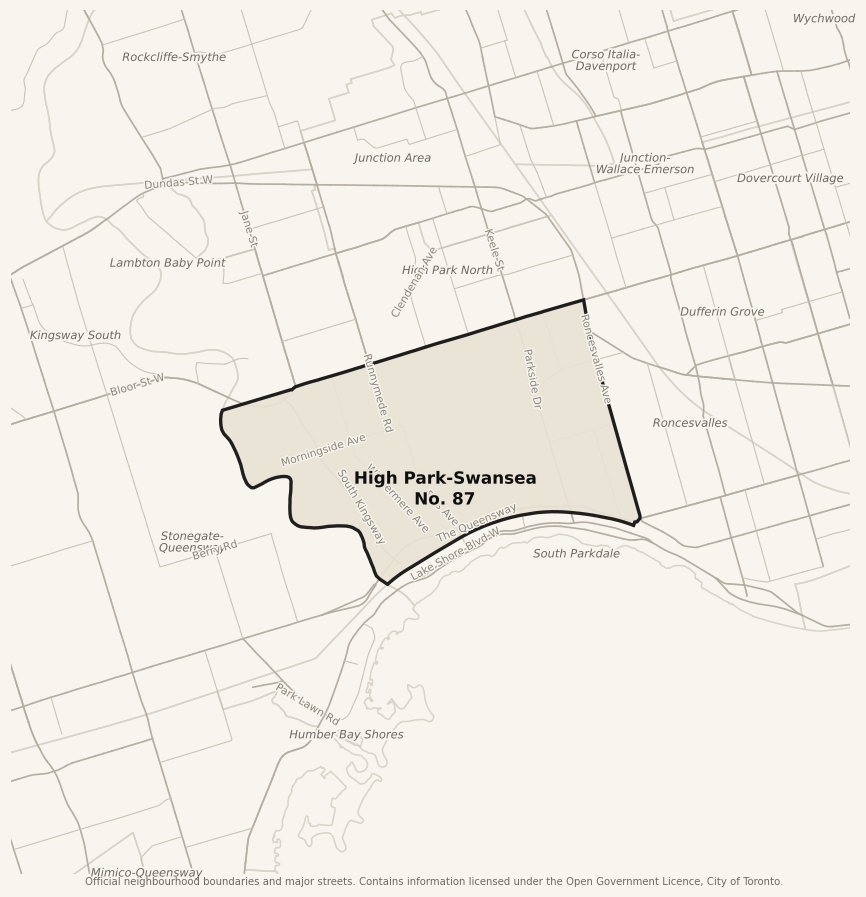
The History
Swansea has deep roots in Toronto’s real estate and cultural landscape. Incorporated as an independent village in 1926, it remained its own municipality for nearly 40 years before being absorbed into Metro Toronto in 1953 and finally annexed by the City of Toronto in 1967, making it one of the last two independent villages to join the city (alongside Forest Hill). This relatively recent independence helps explain the neighbourhood’s strong sense of identity and tight community bonds that persist today.
The neighbourhood’s heritage runs deeper still. The Swansea seal features Étienne Brulé, the first documented European to reach the area in 1615. In 1793, King’s Mill sawmill was built at the Humber River, becoming an important industrial landmark until it was destroyed by fire in 1881. Rather than disappear into history, the site was reimagined: the Old Mill Tea Garden was developed there in 1914 and remains a beloved destination for Torontonians seeking riverside charm and heritage hospitality. The neighbourhood’s cultural legacy also includes Lucy Maud Montgomery, the author of Anne of Green Gables, who lived at 210 Riverside Drive. The Swansea Town Hall, built as the community’s civic centre, continues to operate as a vibrant community centre, hosting everything from swimming lessons to neighbourhood events.
What You’ll Actually Find Here
Swansea’s housing stock tells the story of a neighbourhood built for families with strong bones and character. The typical home was constructed between 1905 and 1935 in the Craftsman style, solid masonry, thoughtful architectural details, and genuine craftsmanship that holds up remarkably well. You’ll find semi-detached homes, single-family bungalows, and classic detached houses scattered across hilly, winding streets shaded by mature trees. Many lots run deep, 190 feet or more, giving homeowners actual yards in the city.
The geography matters here. North of Queensway, you’re in true single-family territory with a distinctly family-oriented character. South of Queensway, the neighbourhood shifts: there’s a pocket of newer townhomes and condos developed since 2000, reflecting modern demand for different housing types. Apartment buildings account for roughly 45% of Swansea’s residential units, offering rental and ownership options for those seeking lower-maintenance living without leaving the neighbourhood.
The terrain itself is distinctive. Swansea sits on elevated land with significant topography, hills, valleys, and winding streets that create natural separation from traffic and a more village-like feel than flat neighbourhoods. Mature trees have been established for decades, providing the kind of canopy coverage that takes years to build and can’t be bought at any price.
What Homes Cost in Swansea (W01)
From January 3 to October 30, 2026, detached homes in Swansea (from Ellis Avenue west to the Humber River, and from the lake up to Bloor Street West) sold at a median of $1,750,000 (45 sales), semi-detached homes at a median of $1,614,000 (4 sales) and condo apartments at a median of $618,000 (87 sales). For condo buyers, the Swansea condo median works out to $718 per above-grade square foot. Detached homes sold in a median of 8 days and condo apartments in a median of 20 days. Swansea is part of the TRREB community of High Park-Swansea, in District W01. In TRREB District W01, all home types averaged $1,207,607 over the 12 months to October 2026 (457 sales) and $1,269,569 in October 2026 alone (51 sales) (TRREB Market Watch).
If you’re serious about buying west-side Toronto, Swansea deserves to be on your shortlist: you’re getting established family homes in a historic neighbourhood with waterfront proximity.
What We Love About Swansea
Ask any Swansea resident or savvy Toronto buyer what makes this neighbourhood special, and the water access comes up first. Humber Bay Park East and West offer a continuous 2.5-kilometre loop trail along the river, one of the city’s finest urban walks. The Martin Goodman Trail, that legendary 56-kilometre waterfront path connecting the entire Toronto shoreline, runs directly through Swansea, making it accessible from your front door. The iconic Humber Bay Arch Bridge, a stunning 430-foot pedestrian crossing that spans the Humber, has become a must-visit landmark and a genuine architectural jewel.
Beyond the water, Swansea sits adjacent to genuine neighbourhood retail and services. The Bloor West Village BIA shops and restaurants are a short walk away, offering everything from independent bookstores to family-run restaurants. The Queensway commercial corridor adds practical retail and service options. Within the neighbourhood itself, the Swansea Town Hall functions as an active community centre, hosting swimming lessons at its indoor pool, community events, and programming that keeps the neighbourhood connected. The Grenadier Café in nearby High Park, legendary among west-end residents, is easily accessible, as is the broader High Park network with its ravine trails, cherry blossoms in spring, and genuine urban green space.
Sunnyside Gus Ryder Outdoor Pool, the seasonal public pool that serves the broader west end, operates just outside the neighbourhood and draws families all summer long. The Air India Memorial in Humber Bay Park stands as a solemn, moving tribute within a beautiful setting. Add the Humber River itself, designated a Canadian Heritage River, and you have a neighbourhood where water, trees, and community infrastructure combine to create genuine quality of life.
The Honest Take
No neighbourhood is perfect, and Swansea has real limitations worth understanding before you buy. The Gardiner Expressway creates a significant barrier to the south, visual and acoustic. If you’re south of Queensway near the Gardiner, you’ll contend with traffic noise and the visual reality of a major highway. There are also industrial pockets scattered south of Queensway that don’t fit the quiet residential image many buyers imagine. This is where the neighbourhood transitions from residential to mixed-use, and it’s not for everyone.
Transit has gaps. The 77 Swansea bus is the primary internal route, but for Line 2 subway access, you’re walking to either Jane Station or Runnymede Station, doable but not immediate. If you’re east of the neighbourhood, High Park Station is within walking distance. For drivers, the Gardiner and QEW provide expressway access, but local traffic on hilly, winding streets can feel congested during peak hours. The neighbourhood’s topography, while charming, means hills on foot or bike depending on where you live.
Market conditions matter too. Across TRREB District W01, the average sale price of all home types over the 12 months to October 2026 was $1,207,607 (457 sales), 1.4% below the $1,224,840 of the 12 months before (462 sales) (TRREB Market Watch). Not catastrophic, but worth noting if you’re thinking short-term. The dominant narrative among some market watchers is that Swansea is “yet to reach full potential,” which can feel both encouraging (upside possible) and unsettling (stability questions). This is a neighbourhood in transition, with waterfront revitalization on the horizon but not yet realized. Buy here for the present reality, a good family home at reasonable value in an established neighbourhood with real character, not for speculative future appreciation.
Who Lives Here
Swansea’s population is approximately 11,133 residents, with an average household income of $58,681. The neighbourhood has a notable Eastern European ethnic minority presence, reflecting immigration patterns and community history. You’ll find a genuine mix here: long-time residents with decades of neighbourhood tenure living alongside younger families, young professionals, and newcomers discovering what established west-side living actually offers. It’s not a neighbourhood of extremes, neither ultra-wealthy nor struggling, but solidly middle-class and family-oriented. The streets feel genuinely lived-in, with families walking kids to school, neighbours sitting on stoops, and real community presence rather than transient residents or investor-owned units.
Schools
Swansea Junior and Senior Public School, located at 207 Windermere Avenue, serves the neighbourhood with approximately 970 students in grades JK through 8. The school has operated since 1891, giving it genuine institutional roots in the community. The school offers both an English stream and French Immersion programming, accommodating different family preferences. On the practical side, the school includes an indoor swimming pool, a genuine asset for physical education and community programming.
Academic performance is solid: EQAO results show 88% of students meeting or exceeding expectations in English and 72% in Mathematics. These aren’t spectacular numbers, but they’re respectable and reflect a school serving a diverse neighbourhood with real economic variety. For families prioritizing school choice, Swansea’s main option is this single public school, so proximity and philosophy fit matter more here than in neighbourhoods with multiple institutional options.
Getting Around
Transit in Swansea requires modest adjustment if you’re coming from downtown or the Yonge corridor. The 77 Swansea bus serves as the neighbourhood’s primary internal route, connecting residents to major intersections and shopping areas. For subway access, Jane Station and Runnymede Station on Line 2 are the nearest options, both walkable but requiring a 15-20 minute walk from much of the neighbourhood. From the eastern edge of Swansea, High Park Station is also accessible on foot. This means daily transit users typically walk to a station rather than enjoy door-to-door service, which is fine for most but worth factoring into commute calculations.
For drivers, the Gardiner Expressway and QEW provide direct highway access to downtown or the airport, making commuting straightforward if you have a car. Locally, the hilly terrain and winding streets mean driving can feel slower than grid-based neighbourhoods, but parking is generally available and not a crisis point like downtown or even closer-in west-end neighbourhoods.
Things to Do
Swansea’s recreation and leisure options punch above its weight because of waterfront access. Humber Bay Park East and West form the recreational spine of the neighbourhood, the 2.5-kilometre loop trail is genuinely beautiful, with river views, native plantings, and the air and light you crave when you need to escape urban density. The Martin Goodman Trail, which runs through Swansea, connects you to 56 kilometres of uninterrupted waterfront from the Scarborough Bluffs to the Etobicoke Creek, one of North America’s finest urban trails.
The Humber Bay Arch Bridge is more than functional; it’s become an iconic destination where locals and visitors gather for photos, sunset views, and the simple pleasure of a well-designed pedestrian crossing. The Butterfly Habitat within Humber Bay Park offers quiet observation space and genuine ecological interest. The Air India Memorial provides a contemplative space with significant cultural importance. The Old Mill historic site, developed from the 1793 sawmill location, now operates as a restaurant and event venue with genuine heritage character.
Sunnyside Gus Ryder Outdoor Pool, just outside the neighbourhood boundary, operates seasonally and serves the broader west end. High Park, true High Park, not just the station, is adjacent and offers ravine trails, sports facilities, and urban green space that’s genuinely used and genuinely good. The Grenadier Café has become legendary among west-end residents for casual dining and local gathering. For families, the Swansea Town Hall community centre offers programming, swimming lessons, and community events throughout the year.
Buying in Swansea: What to Expect
If you’re serious about buying in Swansea, here’s the realistic picture: you’re getting genuine value relative to adjacent neighbourhoods like High Park and Bloor West Village. The homes are older (mostly 1905-1935 construction), which means you’re buying character and solidity but also accepting potential mechanical upgrades, updated wiring, and foundation realities that come with century-old houses. Some properties have deep lots, 190+ feet, which is genuinely rare in Toronto and valuable if outdoor space matters to your lifestyle.
The neighbourhood is mixed-use with residential pockets adjacent to industrial areas, particularly south of Queensway. This isn’t necessarily negative, mixed-use neighbourhoods often become more vibrant, but it’s not a purely residential enclave. The Gardiner Expressway creates a barrier and acoustic presence that doesn’t affect everyone equally depending on your exact location.
Future appreciation potential exists, particularly if waterfront revitalization accelerates and transit connections improve. The neighbourhood is well-positioned: established, historic, genuinely livable, and priced below premium west-side locations. For primary residence buyers seeking family homes with character and reasonable pricing, Swansea makes authentic sense. For investors, it’s a longer-term hold with moderate upside rather than a speculation play.
Michael Ouzas and his team have deep expertise in Toronto’s west-side neighbourhoods, including Swansea’s specific market dynamics, property values, and family-friendly potential. If you’re considering Swansea seriously, whether your first home, family upgrade, or investment purchase, working with someone who knows the neighbourhood intimately rather than just Toronto broadly makes genuine difference in navigating market realities and finding the right property fit.
Explore other west-side neighbourhoods: Bloor West Village | The Junction | High Park | Roncesvalles
Weighing your options? Read our comparison: Swansea vs Baby Point: village living or the enclave?
Swansea Sold Prices in 2026
Every MLS® sale from January 3 to October 30, 2026. Swansea here means from Ellis Avenue west to the Humber River, and from the lake up to Bloor Street West. Price per square foot uses above-grade size; the basement is not included.
| Type | Sales | Median price | Per sq ft | Sold over asking |
|---|---|---|---|---|
| Detached houses | 46 | $1,787,500 | $1,099 | 46% |
| Semi-detached houses | 4 | $1,614,000 | $1,103 | 75% |
| Townhouses | 2 | $1,150,000 | $824 | 50% |
| Condo apartments | 89 | $618,000 | $722 | 6% |
| Condo townhouses | 14 | $782,500 | $696 | 14% |
The same house sells for about 18% more north of Morningside than south of Morningside.
See the full pocket-by-pocket numbers on the Swansea stats page.
Related reading
- Swansea market stats: 2026 sold prices street by street
- High Park market stats: 2026 sold prices by pocket
- Toronto West market stats (W01 to W08), updated monthly
- Swansea vs Baby Point
- Why Toronto’s West End Housing Market Is Still So Competitive in 2026
- What Condo Buyers Are Really Looking for in 2026
- What You Should Never Do When Selling Real Estate in Toronto
- Roncesvalles: nearby guide
- High Park Swansea: nearby guide
- Parkdale: nearby guide