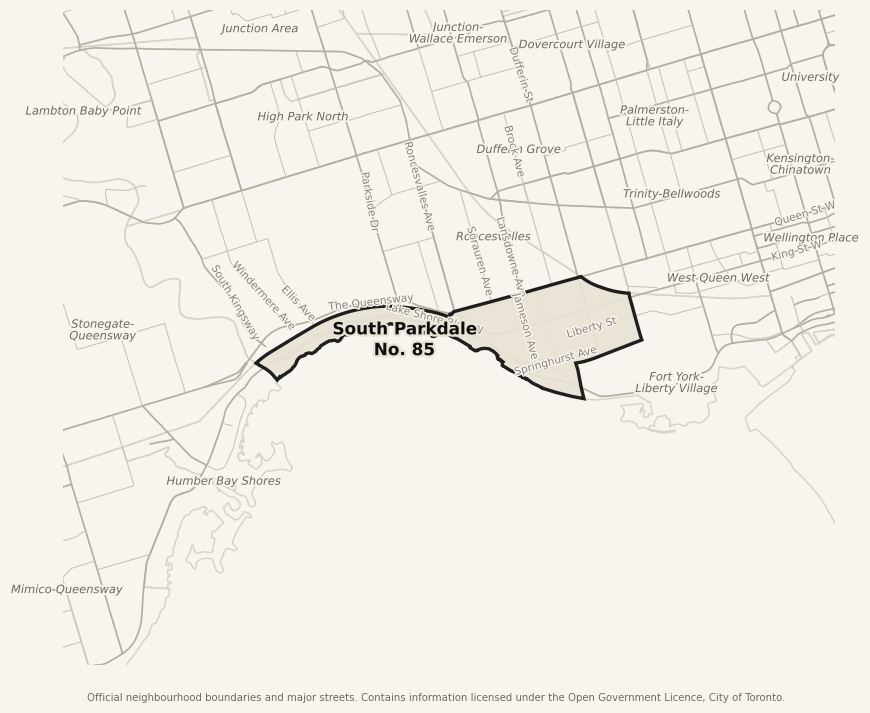
Parkdale represents one of Toronto’s most dramatic neighbourhood transformations. Parkdale began as a wealthy Victorian suburb, later became known for its rooming houses, and over the past two decades has drawn young professionals, artists and new development. This is a neighbourhood in flux, exciting, sometimes unsettling, and undeniably changing faster than almost anywhere else in the city. Located in the TRREB community of South Parkdale, in west Toronto’s District W01, bounded by Dufferin Street to the east and Roncesvalles Avenue to the west, Parkdale offers walkable streets, cultural diversity, transit access, and waterfront proximity, but at a price tag that’s climbing steeply. Whether you’re buying, renting, or just exploring, Parkdale demands a clear-eyed assessment of what the neighbourhood actually is versus what it’s becoming.
Official City of Toronto neighbourhood: South Parkdale (No. 85).
The History
Parkdale was incorporated as “The Village of Parkdale” in 1879 and annexed by Toronto in 1889, during a period of explosive suburban growth around the city. The neighbourhood was designed as an exclusive enclave for Toronto’s Victorian elite, wealthy merchants, industrialists, and professional families who built grand mansions on tree-lined avenues with generous lots. Streets like Durie Road, Ossington Avenue south of King, and the blocks near what is now Parkdale Library showcase the architectural remnants of this era: three and four-storey Victorian and Edwardian homes with ornate brickwork, wraparound porches, and period details that still command attention despite decades of conversion and subdivision.
The neighbourhood’s character began to shift significantly in the mid-20th century. As wealthier residents moved further from downtown, many of the grand mansions were subdivided into rooming houses to maximize rental income. By the 1970s and 1980s, Parkdale had become a home for recent immigrants, low-income renters, people experiencing homelessness, and those seeking affordable housing in the city. The area accumulated social services, shelters, addiction services, mental health supports, creating both a safety net and visible challenges. Throughout the 1990s and 2000s, Parkdale had a rough reputation, with higher crime rates and disorder concentrated on certain streets, particularly around the Dundas-King corridor.
The past decade has rewritten Parkdale’s trajectory entirely. Rising land values, a growing arts scene, and strategic retail development, particularly along King West, have triggered rapid gentrification. Young professionals, creatives, and families seeking walkable west-end neighbourhoods with authentic character have flooded in. Property values have more than tripled in many areas since 2015. New condo developments, boutique restaurants, galleries, and craft breweries have emerged alongside the old institutional fabric. This speed of change is both the neighbourhood’s defining feature and its central tension: Parkdale is becoming wealthier, more desirable, and less accessible to the communities who built its character in earlier decades.
What You’ll Actually Find Here
Victorian and Edwardian Mansions: The backbone of Parkdale’s housing stock. Most are three to four storeys, built between 1880 and 1920, with original brick facades, high ceilings, large windows, and period details. Many have been restored to single-family homes by new owners; others remain subdivided into multiple units. These homes typically sit on larger lots than comparable properties elsewhere in the city. Price and condition vary enormously, from meticulously restored heritage showpieces to rough conversions. The best examples are concentrated south of King West and around Ossington Avenue.
Semi-Detached and Detached Cottages: Scattered throughout, particularly north of King and in pockets near Dufferin. These are often more modest than the grand mansions but still substantial, typically built 1900-1930. They appeal to buyers seeking single-family homes without the price premium or scale of Victorian mansions. Many have small yards and updated interiors, popular with young families priced out of Roncesvalles proper.
Low-Rise Apartment Blocks and Walk-Ups: Built mostly from the 1960s onward, these 4-6 storey buildings are scattered across the neighbourhood, often housing rental units. Some are rental-only; others have been converted to condos. These buildings tend to feel dated but offer relatively affordable entry points for renters and first-time buyers. Quality varies significantly depending on ownership and maintenance.
New Condo Development: The most visible recent change. Several mid-rise condominium projects have been completed or are underway, particularly along King West near Ossington and near Dufferin. These are modern, amenity-rich buildings attracting downsizers, young professionals, and investors. They represent the “new Parkdale” aesthetic and pricing, often comparable to or higher than established condos in more affluent neighbourhoods. Not everyone embraces these developments, but they’re reshaping the skyline and bringing younger demographics into the neighbourhood.
What Homes Cost in Parkdale (W01)
From January 2 to October 30, 2026, here’s what homes sold for in South Parkdale, the TRREB community that covers Parkdale:
Semi-Detached Homes: A median of $1,400,000 (5 sales), depending on size, condition, and exact location. Smaller, unrenovated examples on secondary streets sell at the lower end; those with recent updates or prime locations command premiums.
Detached Victorian/Edwardian Homes: A median of $1,255,000 (9 sales). Well-restored heritage homes with period details and good square footage sell at the top of the market; a poorly maintained conversion or early-stage restoration sells for less, but requires realistic assessment of costs ahead.
Condo Apartments: A median of $546,000 (37 sales); condo townhouses sold at a median of $696,250 (14 sales), and 1 freehold townhouse also sold. New construction premiums are significant, identical square footage in a 1970s rental conversion will be cheaper than a gleaming 2024 condo two blocks away.
Rental Market: In TRREB District W01, one-bedroom condo apartments leased for an average of $2,355 a month (88 leases) and two-bedrooms for $3,123 (45 leases) in the second quarter of 2026 (TRREB quarterly rental report). Newer buildings command the top of the range. Purpose-built rentals are increasingly scarce as more buildings are converted to condos. The rental market remains competitive but offers somewhat more availability than neighbourhoods further east.
Market Trajectory: Parkdale has been one of the hottest appreciating neighbourhoods in Toronto in recent years. While the market has moderated from 2021-2022 peaks, prices remain at historically elevated levels compared to just five years ago. The neighbourhood has transcended its “value play” status and now trades as a premium west-end location.
What We Love About Parkdale
Authentic Architectural Character: Few Toronto neighbourhoods offer as much cohesive Victorian and Edwardian architecture. The streets lined with heritage homes, the grand scale, the stone and brick details, this is Toronto’s most intact period neighbourhood. Even newly renovated homes respect the existing fabric, and the visual continuity creates genuine neighbourhood identity.
Walkability and Livability: Everything essential is accessible on foot: groceries, transit, restaurants, schools, parks. King West has evolved into a genuinely lively commercial corridor with independent restaurants, bars, galleries, and shops. Queen West offers similar energy. You can live here without a car if you choose, a luxury in much of the city.
Waterfront and Park Access: Sunnyside Boardwalk and the lake are genuinely accessible, not a destination, but a regular amenity. Sunnyside Park offers sports fields, a pool, and green space. Exhibition Place is adjacent. High Park (technically just east in Roncesvalles) is one of the city’s best parks with extensive trails and natural areas. For a neighbourhood this close to downtown, the outdoor access is exceptional.
Transit Connectivity: Queen streetcar (501) and King streetcar (504) run through the neighbourhood providing downtown access. Dufferin Station (opens 2025/2026) will add significant rapid transit capacity. Exhibition GO Station is walkable. For drivers, the Gardiner Expressway is close by. You have multiple ways to get around without being transit-dependent.
Cultural Diversity and Community Energy: Unlike increasingly homogenized neighbourhoods, Parkdale retains genuine diversity. A strong Tibetan community centred on Ossington Avenue brings culture, restaurants, and institutions. South Asian residents, artists, service workers, and young professionals coexist, creating interesting cross-currents. Street festivals, independent galleries, independent restaurants, there’s creative energy that doesn’t feel manufactured or themed.
In TRREB District W01, all home types averaged $1,207,607 over the 12 months to October 2026 (457 sales) and $1,269,569 in October 2026 alone (51 sales) (TRREB Market Watch).
The Honest Take
Gentrification and Displacement Are Real: This isn’t theoretical, Parkdale is actively displacing long-term residents. Rent increases, property tax assessments, and pressure on landlords to convert rental buildings to condos are pushing out people who’ve lived here for decades. Community organizations and social services are under pressure to relocate. Some see this as necessary neighbourhood evolution; others see it as the erasure of a community that served vulnerable populations. Both perspectives have validity. If you buy here, you’re participating in a process with human costs, regardless of your personal intentions.
Institutional and Social Challenges Remain: Despite gentrification, Parkdale still concentrates addiction services, mental health supports, and shelters. You will see evidence of this on certain blocks, Dundas between Ossington and Dufferin, parts of King near Ossington. This creates genuine livability challenges for some residents, with disorder, noise, and safety concerns on certain streets. New residents sometimes expect these issues to simply vanish with property value increases; they won’t. The question is whether the city will continue to provide these services and to whom, a critical issue that remains unresolved.
Uneven Renovation Quality and Hidden Costs: Not every Victorian conversion or semi-renovation is what it appears. Historic plumbing, outdated wiring, foundation issues, asbestos, and poor earlier renovations are common. The fact that a house looks pleasant doesn’t mean the systems are sound. Expect to budget for surprises. Conversely, aggressively over-renovated properties sometimes lose original character to the point of pastiche. Know what you’re actually buying.
Infrastructure Strain and Construction Disruption: Infrastructure hasn’t kept pace with population increase and new development. Sewer systems back up during heavy rain. King West is increasingly congested with pedestrian and vehicle traffic. Major transit construction (Dufferin Station, streetcar work) means ongoing disruption for several more years. Traffic on Dundas and Ossington during rush hours has become noticeably heavier. The neighbourhood’s walkability sometimes feels compromised by sheer congestion.
School Capacity Issues: The surge in young families has strained local schools. Top schools are oversubscribed. French immersion spots are highly competitive. If school quality is a major priority, you cannot assume proximity equals access to excellent programming. Research carefully and visit schools in person.
Who Lives Here
Parkdale is increasingly dominated by young professionals (25-40), established families with children, empty-nesters drawn to walkability, and creatives attracted to the neighbourhood’s character and emerging cultural scene. The demographic has shifted significantly toward higher-income residents in the past seven years. You’ll still find long-term residents, immigrant communities (particularly Tibetan and South Asian populations), service workers, and people relying on social services, but their proportion has declined. The neighbourhood is becoming economically segregated in ways it wasn’t a decade ago.
This demographic transition creates interesting tensions. New residents often fall in love with Parkdale’s authenticity and character, sometimes without fully grasping that much of that character derives from communities and histories they’re actively displacing through market forces. Young families move here for the schools and walkability but express concern about social issues blocks away. There’s little overt hostility, but there is a latent cultural distance between long-term and new residents that manifests in how people perceive shared public spaces.
Schools
Parkdale is served by several public schools including Lord Dufferin Public School and Parkdale Public School. Both are solid, well-regarded institutions but face enrollment pressures from the neighbourhood’s rising young family population. French Immersion is available at Lord Dufferin but spots are competitive. For high school, students feed to Westview Secondary, which has a strong academic reputation and diverse student body. Roncesvalles Collaborative School, a free alternative school, also serves the area and attracts families seeking non-traditional approaches.
Private options include private schools accessible across the city. Many Parkdale families use Montessori and Waldorf options in neighbouring areas. The key reality: you cannot assume automatic access to top school programming based on address. Popular programs fill; wait lists are common. Research specific schools early in your decision-making if education is a priority.
Getting Around
Parkdale is one of Toronto’s most transit-accessible neighbourhoods without being downtown. The Queen streetcar (501) runs east-west along Queen West, providing direct service to Queen West, Yonge, and the streetcar loop. The King streetcar (504) parallels King West, offering similar connectivity. Both streetcars connect to subway at Osgoode Station downtown and Kipling or Dundas West stations. Dufferin Station, opening in 2025-2026, will add a major O-Train (subway) connection at Dufferin, dramatically improving rapid transit access, a game-changer for the neighbourhood.
Dundas and Ossington avenues provide important cross-town bus corridors. Exhibition GO Station is walkable from much of the neighbourhood, offering GO Transit connections throughout the Greater Toronto Area. For drivers, Gardiner Expressway access (via Ossington or Dufferin) and Lakeshore Boulevard provide routes to highways. Parking is increasingly tight as the neighbourhood densifies; many new residents live carfree. Bike infrastructure has improved, and many residents use cycling for local transportation.
Things to Do
King West has emerged as a genuinely vibrant commercial corridor with independent restaurants spanning cuisines, from Korean to Italian to Tibetan to contemporary Canadian, galleries, design shops, and bars. It’s not a theme park version of a neighbourhood; these are mostly real businesses serving real residents. Walk King between Ossington and Dufferin and you’ll encounter legitimate neighbourhood activity rather than chain stores. Ossington Avenue offers similar character with Tibetan businesses, South Asian groceries, and longtime independent establishments mixed with newer spots.
Sunnyside Boardwalk is a major summer destination, a genuinely nice place to walk, bike, or sit along the lake. Sunnyside Park, adjacent to the boardwalk, has pools (seasonal), sports facilities, and green space. The area has a relaxed, accessible vibe quite different from more manicured waterfront areas. Exhibition Place, just north, hosts the Canadian National Exhibition (CNE) in late summer, plus numerous smaller events, conventions, and attractions year-round. For many residents, the Exhibition and waterfront provide enough recreational amenities that you don’t need to travel far for weekend activity.
Arts and culture are integrated into the neighbourhood rather than confined to institutions. Gallery spaces, artist studios, and performance venues are scattered across the area, smaller, more experimental than formal institutions, but genuine. The Tibetan Institute of Arts and Culture, community centers, and independent shops all contribute to neighbourhood cultural texture. Trinity Bellwoods Park (just east on the Roncesvalles border) is one of Toronto’s best parks for sports, swimming, and socializing. High Park, also accessible, offers trails and more traditional park experience.
Buying in Parkdale: What to Expect
Acknowledge Gentrification’s Complexity: If you’re buying in Parkdale, you’re buying into a neighbourhood undergoing rapid transformation. This isn’t a neutral economic transaction, your purchase contributes to property value escalation and, ultimately, displacement pressures on lower-income residents. Many new owners feel conflicted about this; others don’t think about it. Either way, it’s worth understanding what you’re participating in.
Home Inspection Is Critical: Don’t skip professional inspection. Historic homes have real costs. Get detailed assessment of foundation, structural integrity, plumbing, electrical systems, roof condition, and environmental factors (asbestos, lead paint, radon). Factor realistic renovation costs into your offer price. A “lovely Victorian” at first glance might need $100K-$400K in systems work depending on previous renovations and condition.
Expect Competition and Bidding: Desirable properties attract multiple offers. Properties in good condition at reasonable prices are bid up aggressively. Don’t overbid purely on emotion, the neighbourhood will still be there if you don’t get this specific house. Over-leverage is real, and Parkdale prices are at historic highs relative to long-term norms.
Location Within Parkdale Matters Significantly: South of King West is noticeably more expensive and desirable than north. Proximity to the lake, Sunnyside Boardwalk, and better-condition mansions pushes prices higher. East of Ossington commands premiums over west of Ossington. Blocks with concentrated social services have lower valuations despite neighbourhood pride in that infrastructure. Be clear about what matters to you in a specific location.
Rental Investment Appeal Is Strong but Watch Regulations: Parkdale’s appreciation has attracted investors seeking rental conversions. However, rental regulations, potential rent control reimplementation, and changing City policy toward second units mean you should carefully model rental economics rather than assuming unimpeded appreciation and yield. A property purchased as a future multi-unit rental might face regulatory restrictions.
Work With a Local Agent: This neighbourhood moves quickly and requires knowledge of microlocation pricing, school catchments, future development plans (especially around Dufferin Station), and community issues. Don’t rely on algorithms or agents unfamiliar with Parkdale’s particular context.
Parkdale is genuinely a neighbourhood worth considering if you value walkability, character, waterfront access, and community energy. But go in with clear eyes about gentrification, appreciation rates, and realistic home inspection expectations. The neighbourhood’s trajectory is steeply upward, but steepness creates risk alongside reward.
Want a deeper dive on Parkdale or other Toronto neighbourhoods? The MORE Toronto team has spent years mapping property values, school performance, transit infrastructure, and genuine neighbourhood character across the city. We help buyers and sellers navigate not just the transaction, but the genuine complexities of where to live in Toronto. Reach out for an honest assessment.
Related Neighbourhood Guides: Roncesvalles | High Park | Swansea | Liberty Village | Queen West
Parkdale Sold Prices in 2026
Every MLS® sale from January 2 to October 30, 2026. TRREB counts Parkdale inside its South Parkdale community, so these are the numbers for South Parkdale. Price per square foot uses above-grade size; the basement is not included.
| Type | Sales | Median price | Per sq ft | Sold over asking |
|---|---|---|---|---|
| Detached houses | 9 | $1,255,000 | $625 | 44% |
| Semi-detached houses | 5 | $1,400,000 | $681 | 0% |
| Condo apartments | 37 | $546,000 | $795 | 5% |
The same house sells for about 28% less here than across TRREB district W01 as a whole.
See the full pocket-by-pocket numbers on the Roncesvalles stats page.