Queen West is Toronto’s arts, music, and culture corridor, a neighbourhood where independent galleries, vintage shops, live music venues, record stores, and bohemian energy converge. The C01 district stretches Queen Street West from Bathurst to Gladstone/Dufferin, creating a neighbourhood that feels fundamentally different from King West despite their proximity. Where King West pulses with predictable nightlife and expensive restaurants, Queen West throbs with artistic experimentation, DIY culture, independent businesses, and people who chose the neighbourhood for creative possibility rather than convenience. This is where visual artists, musicians, independent business owners, and people skeptical of mainstream commercial culture actually live. It’s also a neighbourhood in active gentrification, vintage shops are being replaced by chain retailers, authentic artist culture is being displaced by aspirational young professionals, and independent businesses are struggling against rising rents. You’re buying into a neighbourhood with genuine character that’s actively disappearing, which creates both opportunity and moral complexity.
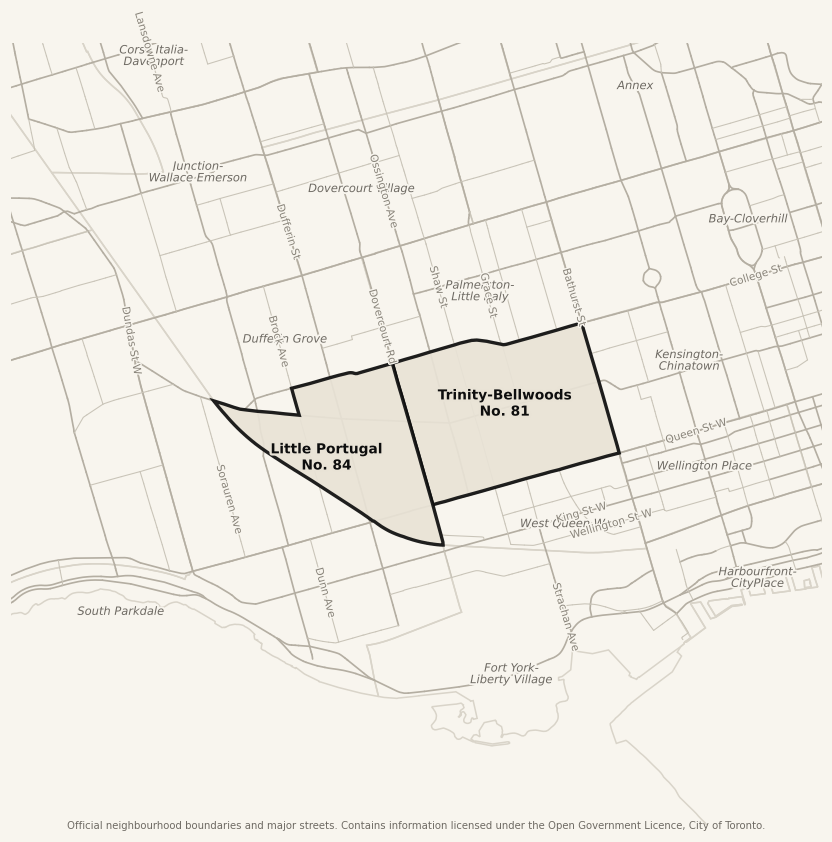
Official City of Toronto neighbourhoods: Trinity-Bellwoods (No. 81) and Little Portugal (No. 84).
The History
Queen West’s cultural identity emerged gradually through the late twentieth century. The street was industrial and residential through much of its history, with working-class and immigrant families occupying Victorian and Edwardian row houses and tenements. In the 1960s and 1970s, as manufacturing declined and housing became affordable, artists and creative workers discovered Queen West. The combination of cheap rent, large studio spaces, and a critical mass of artistic neighbour created organic cultural emergence. By the 1980s, Queen West had established itself as Toronto’s arts neighbourhood, galleries, artist collectives, independent music venues, independent bookstores, and experimental theatre consolidated. The neighbourhood was explicitly counter-cultural, anti-establishment, artistically driven, skeptical of commercialism.
By the 1990s, Queen West’s coolness became commercial. Chain retailers recognized the foot traffic and cultural energy. Boutiques and restaurants saw opportunity. Today, Queen West is in tension between authentic independent culture (which still exists but is increasingly displaced) and commercial gentrification (which dominates visible business landscape). The historic heart, from Bathurst to McCaul, remains more arts and culture oriented. East of McCaul toward University, it shifts toward commercialization and student-focused retail. West of Bathurst, gentrification is reshaping the character as young professionals and families upgrade from King West or the Entertainment District. The neighbourhood retains authentic cultural DNA but increasingly struggles to maintain it against commercial pressure.
What You’ll Actually Find Here
Victorian and Edwardian Row Houses: The majority of Queen West’s residential stock is 3-storey Victorian and Edwardian row houses, built 1880-1920. These are smaller and narrower than detached homes, typically 18-22 feet wide and 25-35 feet deep. They feature original brick, high ceilings, hardwood floors, and period details. Many have been extensively renovated with modern kitchens and bathrooms while maintaining exterior character. Some remain in original condition with worn plaster, outdated mechanical systems, and deferred maintenance. These homes are the neighbourhood’s soul, they’re walkable urban living with genuine character. A good 3-storey row house with modern updates offers exceptional urban living; a poorly maintained one is a renovation project requiring $100K-$200K+ work.
Semi-Detached Homes: Less common than row houses but present, particularly on secondary streets and the western edge of the neighbourhood. These offer more space and privacy than row houses at moderately higher prices. Many have been converted to multi-unit rental properties, creating cash-flowing investments that appeal to landlords.
Converted Multi-Units: Some original single-family homes have been legally subdivided into 2-3 rental units, creating income-generating properties. Quality varies, some are professionally managed with legal conversions; others are informal and may have licensing issues. Understanding the legal status and financial structure is critical before buying.
Low-Rise Apartment Buildings: Scattered throughout the neighbourhood are 4-8 storey apartment buildings from the 1960s-1980s. These offer updated mechanical systems and lower maintenance than Victorian homes but less character. They appeal to renters and investors seeking reliable cash flow.
Newer Condo Buildings: As gentrification accelerates, particularly west of Bathurst, some older buildings are being demolished for purpose-built condos. These are less common than in King West but increasingly visible. They’re smaller-scale (often 8-10 storeys) than downtown condos and less intensely developed.
What Homes Cost in Queen West (C01)
Row Houses - Good Condition: From January 12 to November 3, 2026, freehold townhouses in Queen West (Bathurst Street to Dufferin Street, along Queen Street West and up to Dundas Street West) sold at a median of $1,255,000 (39 sales), depending on exact location and finishes. Larger homes or those with exceptional finishes or larger gardens sell at the top of the market.
Row Houses - Renovation Required: Original condition homes needing substantial work sell for less. Budget additional $100K-$200K for modern kitchen, updated bathrooms, and mechanical system upgrades. These appeal to investors and people willing to live in construction for equity gain.
Semi-Detached Homes: A median of $1,435,000 (27 sales) over the same months, depending on condition and location. Larger, better-maintained examples command the top range.
Over the same months, detached homes in Queen West sold at a median of $1,665,000 (12 sales), condo apartments at $595,000 (112 sales) and condo townhouses at $948,000 (35 sales).
In TRREB District C01, all home types averaged $808,987 over the 12 months to October 2026 (3,022 sales) and $815,185 in October 2026 alone (272 sales) (TRREB Market Watch).
Multi-Unit Rental Properties: Legal duplexes and triplexes are priced on unit configuration and market rent. These appeal to investors seeking rental income.
Condo and Apartment Rentals: In TRREB District C01, condo apartments leased for an average of $2,475 a month for one bedroom (2,575 leases) and $3,494 for two bedrooms (1,114) in the second quarter of 2026 (TRREB quarterly rental report). Vacancy is lower than downtown but higher than purely residential neighbourhoods. Rental availability has tightened as more units are purchased by owner-occupants.
What We Love About Queen West
Authentic Character and Independence: Queen West remains genuinely independent-business-oriented. Walk Bathurst to McCaul and you’ll find working galleries, independent bookstores, vintage shops, independent record stores (Rotate This), live music venues (The Drake, Phoenix Concert Theatre), and restaurants owned by people with vision rather than corporate chains. This character is fading but still real. You’re supporting actual artists and independent business owners, not shareholders.
Arts and Culture Integration: If you work in or care about visual art, music, or independent cultural production, Queen West is the neighbourhood where this is happening. Galleries are genuinely active, artist open studios, emerging artist shows, experimental work. Live music venues range from intimate bars to larger clubs. Independent press and bookstores persist. You’re living in a neighbourhood organized around creative culture, not commerce.
Walk-able Urban Living with Lower Intensity: You get King West’s walkability, restaurants, bars, shops, cafes, without King West’s chaos. Queen West is active but not overwhelming. You can walk to dinner, stay out late, and still retreat to quieter blocks where you know neighbours and regular business owners recognize you. The pace and intensity feel human-scaled rather than frantic.
Better House Value than East Toronto: Compared to Leslieville, Distillery, or the Beaches, Queen West row houses offer similar character at 15-25% lower prices. You’re getting authentic Victorian urban living at better value because the gentrification wave is slightly behind. This is smart buying if you believe Queen West will continue appreciating toward East Toronto prices (it probably will) while not yet at that peak.
Bathurst Corridor Density: Bathurst Street between King and Bloor is one of Toronto’s most vibrant main streets, independent retail, restaurants, galleries, bars, cultural venues. Walking Bathurst from Queen to Dundas is a genuinely engaging experience. You have access to this corridor’s energy without living directly on the busy street.
Established Residential Integration: Unlike King West or Liberty Village, which are transient young professional neighbourhoods, Queen West has actual long-term residents and family communities. You’ll find multi-generational families, artists who’ve lived in the neighbourhood 20+ years, and genuine community relationships. There’s neighbourhood identity and permanence, not just transient renters and investors.
The Honest Take
Gentrification is Actively Destroying the Character You’re Buying: This is the hardest truth about Queen West. The artistic character and independent culture that make the neighbourhood desirable are being systematically displaced by the gentrification process that drives property values. Independent bookstores close; chains move in. Artist galleries become boutiques. Working artists are priced out and move elsewhere. Music venues close due to rising rents and increased residential density. You’re buying into a character that’s actively disappearing. In 5-10 years, Queen West will likely feel more like King West than it does today. The character premium you’re paying for is temporary.
Victorian Housing Requires Serious Maintenance Commitment: Row houses built 1880-1920 have genuine structural and mechanical issues. Clay sewer lines need replacing ($8K-$15K). Roofs need reshingling every 20-25 years ($8K-$12K). Masonry needs pointing and deteriorated mortar repair ($5K-$20K depending on scope). Interior plaster cracks as foundations settle. Windows and doors need restoration. Budgeting $1,000-$2,000/year in deferred maintenance is realistic. This is not an investment in a stable asset, it’s a commitment to ongoing stewardship of a heritage building.
Noise from Queen Street Traffic: Queen Street is busy. Units directly on Queen experience significant traffic noise, buses, delivery trucks, and activity until late. One block north or south, noise decreases substantially. But buy directly on Queen without accepting this reality and you’ll regret it. The noise also includes occasional street disorder, loud pedestrians, street performers, emergency vehicles.
Bathurst Corridor Congestion: While the Bathurst corridor is vibrant and great for walking, the street itself is genuinely congested. Parking is difficult. The streetcar is unreliable in winter. Travel along Bathurst is slow. If Bathurst is your primary commute corridor, budget extra time and accept variability.
Gentrification Displacement Anxiety: If you value independent culture and authentic character, watching it be displaced by commercialization while you’re benefiting from property appreciation creates genuine moral dissonance. You’re both preserving and destroying the neighbourhood simultaneously. Long-term residents, artists, and small business owners are being priced out while property owners profit. This is the nature of gentrification, but it’s worth being honest about the reality.
Financing Older Homes Can Be Complex: Lenders are increasingly skeptical of financing homes with known issues, asbestos, outdated wiring, aging roofs. Getting financing approval requires due diligence and sometimes inspections that reveal expensive problems. Budget extra time for financing and be prepared for lenders to require inspection and repairs before finalizing mortgages.
Who Lives Here
Queen West attracts a diverse demographic relative to King West or Liberty Village. You’ll find artists and creative professionals who chose the neighbourhood explicitly for cultural opportunity. Musicians, visual artists, designers, and people in independent creative work concentrate here. You’ll also find young families who bought into the neighbourhood’s character but are navigating child-rearing in a dense urban environment. Established residents and artists who’ve lived here 15+ years create continuity and neighbourhood identity. There are genuine renters, working artists, people who can’t afford to buy, students, who create economic and ethnic diversity.
Income is more mixed than King West, some residents have significant professional income, but others are lower-income artists and working-class people. You’ll find South Asian, Portuguese, Latin American, and other immigrant communities alongside white, educated professionals. There’s real economic and ethnic diversity, though gentrification is gradually whitening and professionalizing the neighbourhood. The average age is slightly higher than King West (30s-40s rather than 20s-30s) because families and established artists stay longer. Many residents explicitly chose Queen West and intend to stay, unlike King West transience. There’s actual neighbourhood commitment and identity.
Schools
Queen West has stronger family presence than King West, so neighbourhood schools get more attention. Students are zoned to Ryerson Elementary (near Spadina and College) and Central Technical or University of Toronto Schools. There are also Catholic school options. Because the neighbourhood has actual families, there’s functional community around schools, parent groups, school events, neighbourhood identity. Quality varies, Central Technical has strong academic reputation; other schools are competent but not exceptional.
The neighbourhood has established tutoring services, extracurricular activity providers, and family-oriented businesses. Unlike King West, you’re not planning to move when children arrive, there are families here, schools function, and it’s viable for children to attend neighbourhood schools. This creates an entirely different residential calculus than young professional neighbourhoods. You can realistically raise a family here, though you’re navigating urban density and congestion for schooling and recreation.
Getting Around
Transit access is excellent. The Streetcar 504 Queen runs directly along Queen Street West and connects to the St. Lawrence (eastbound) and westbound to Dundas and beyond. The Bathurst streetcar (505) runs north-south on the eastern edge and connects Dundas and Bloor corridors. The Spadina streetcar (510) is accessible nearby. Multiple streetcars mean reliable transit to downtown, the Annex, and streetcar corridors. The Osgoode subway station is on Dundas at McCaul, accessible walking distance. You can reach most of Toronto within 20-35 minutes via transit. Many residents don’t own cars.
With a car, Queen and Bathurst create navigation challenges, both are active transit streets with frequent stops and traffic. Parking is available but competitive and street parking is permit-required on many blocks. Garages and private parking command premium prices. If you’re commuting via car, budget 15-25 minutes to reach the Gardiner Expressway or downtown core. Accessibility is viable but not optimal. This is a neighbourhood optimized for transit and walking, not driving.
Things to Do
The artistic and cultural infrastructure is the primary attraction. Working galleries are scattered throughout, artist collectives, independent galleries, emerging artist spaces. Bathurst hosts multiple galleries and artist-run spaces. Independent bookstores (Gladstone Hotel has artist bookstore focus) exist alongside commercial retailers. Live music venues range from intimate bars (The Drake, Sneaky Dee’s) to larger clubs (Opera House). Record stores and vintage shops line the streets. Queen West hosts Street Festival in summer with community celebration, art, music, and performance.
Walk Queen West and you’re constantly discovering, coffee shops with art installations, vintage shops with unexpected inventory, galleries hosting experimental work, murals and street art. The neighbourhood’s character is in the details and discoveries, not in destination attractions. This rewards walking, exploring, and being present. For entertainment, you can walk to Bathurst for dinner and drinks, wander galleries, attend live music, or simply spend time in engaged browsing. Trinity Bellwoods Park is 10 minutes walk north and offers recreation and green space. The Annex is immediately north for bookstores and university-oriented culture. The Entertainment District and St. Lawrence are accessible via transit.
Buying in Queen West: What to Expect
Market Timing Awareness: Queen West has appreciated consistently but is not experiencing the intensity of King West speculation. Prices have risen 4-6% annually on average, which is solid but not frenzied. This creates buying opportunity, you’re not in a bidding war frenzy like King West, but you’re paying for genuine desirability. Take time to make thoughtful offers rather than rushing due to competition anxiety.
Inspection Requirements: Older row houses require detailed home inspection by someone experienced with Victorian homes. Budget discovery often uncovers: foundation issues, outdated wiring, plumbing problems, roof aging, masonry deterioration. Budget 5-10% of purchase price for discoveries. A $1.2M home that needs $100K in work is really a $1.3M commitment. Be realistic about this.
Renovation Opportunity and Reality: Many row houses appeal partly because renovation creates equity. However, renovation of Victorian homes is complex, heritage exterior preservation requirements, planning approval for additions, managing contractors, living through construction. Renovation often takes longer and costs more than projected. If you’re buying partially for renovation equity, budget 20% more time and cost than you think you need.
Character Longevity Questions: Be thoughtful about gentrification trajectory. You’re buying partly for character and artistic culture. If the neighbourhood loses that character as gentrification completes (which it likely will), is the property still desirable to your next buyer? You’re betting on either: (a) character persistence despite gentrification, or (b) the property appreciating for neighbourhood location regardless. Make sure you’re comfortable with both scenarios.
Ready to Find Your Queen West Home?
Buying in Queen West requires someone who understands the neighbourhood’s authentic character and cultural significance, can properly assess Victorian row house condition and renovation requirements, and can help you navigate a genuinely complex market. Michael Ouzas and his team have deep Queen West knowledge, we understand what makes the neighbourhood special, which properties offer best value, and how to position yourself strategically. Whether you’re an artist, young family, or creative professional drawn to Queen West’s character, we’ll help you find the right home and navigate the authentic complexity of this genuinely authentic neighbourhood. Contact us to explore Queen West.
Related Neighbourhood Guides
Interested in similar character-filled, arts-oriented neighbourhoods? Check out our guides to Trinity Bellwoods (similar loft/artistic culture, slightly quieter), King West (similar walkability, different character orientation), Ossington (similar gentrification trajectory, more residential), The Annex (character and culture, university-focused), and Parkdale (emerging character, more affordable). For established neighbourhoods with solid character and stability, explore Leslieville, The Beaches, or Distillery District.
Queen West Sold Prices in 2026
Every MLS® sale from January 12 to November 3, 2026. Queen West here means Bathurst Street to Dufferin Street, along Queen Street West and up to Dundas Street West. Price per square foot uses above-grade size; the basement is not included.
| Type | Sales | Median price | Per sq ft | Sold over asking |
|---|---|---|---|---|
| Detached houses | 12 | $1,665,000 | $968 | 50% |
| Semi-detached houses | 27 | $1,435,000 | $909 | 37% |
| Townhouses | 39 | $1,255,000 | $915 | 49% |
| Condo apartments | 112 | $595,000 | $899 | 11% |
| Condo townhouses | 35 | $948,000 | $734 | 17% |
The same condo sells for about 9% more east of Ossington than west of Ossington. The age and finish of the building are not held equal.
See the full pocket-by-pocket numbers on the Queen West stats page.
Related reading
- Queen West market stats: 2026 sold prices street by street
- Queen West Schools: Rankings, Catchments, and What Families Need to Know
- Toronto condo stats, updated monthly
- Further Exploring Toronto’s Top Neighbourhoods
- King West: nearby guide
- Liberty Village: nearby guide
- Palmerston Little Italy: nearby guide