King West has transformed from an industrial warehouse district into Toronto’s most energetic downtown neighbourhood, a corridor of condos, conversion lofts, restaurants, bars, and nightlife that pulses with young professional energy. The C01 district, running along King Street West from Bathurst to Dufferin, represents Toronto’s most active urban living market. This is where people move when they want walkability, nightlife accessibility, restaurant culture, and proximity to work without commuting. It’s also where you’ll pay premium prices, accept traffic noise as neighbourhood character, and deal with the chaos of being in one of the city’s most active social districts. King West isn’t for everyone, but for young professionals, established couples without children, and people who want city living at maximum intensity, it’s unmatched.
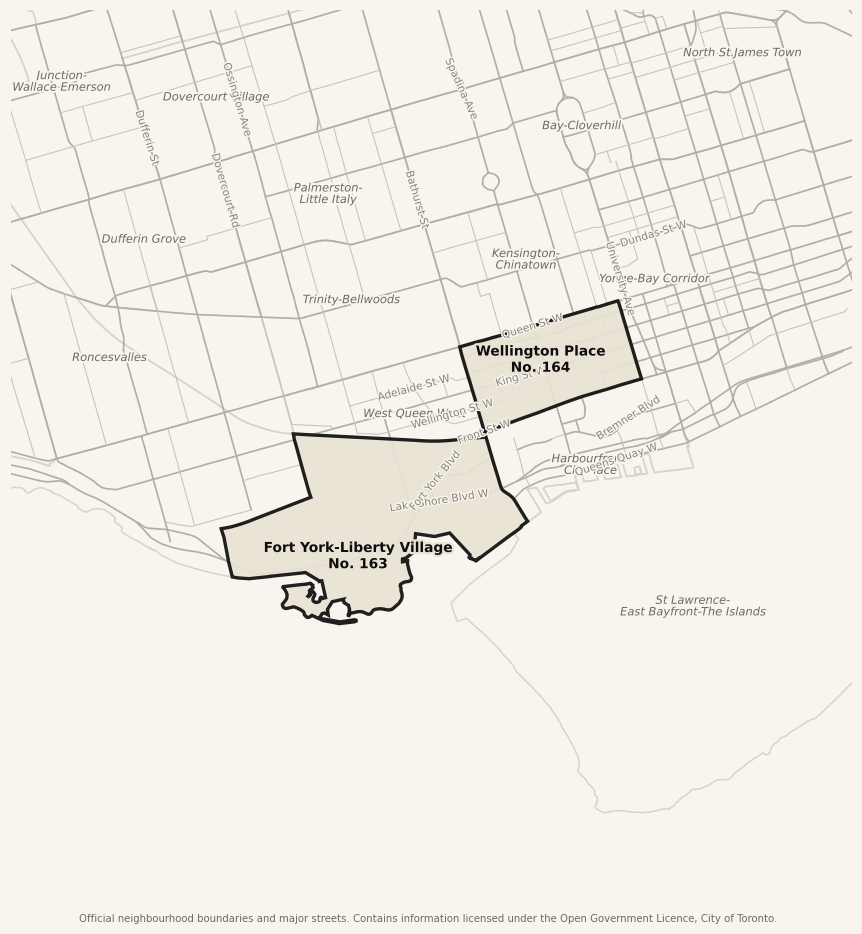
Official City of Toronto neighbourhoods: Wellington Place (No. 164) and Fort York-Liberty Village (No. 163).
The History
King West’s transformation from industrial to residential is recent and dramatic. The area was Toronto’s manufacturing and warehouse district through the twentieth century, buildings designed for heavy industry, processing, and manufacturing, not human habitation. Breweries, textile mills, furniture makers, and food processors occupied massive brick structures along King Street. Throughout the 1960s-1980s, as manufacturing moved elsewhere, these buildings sat underused, cheap real estate in a city that was losing industrial capacity. In the late 1990s and early 2000s, developers and loft enthusiasts saw opportunity. The first wave converted warehouses into residential lofts, open-concept spaces with soaring ceilings, exposed brick, large windows, and raw character that appealed to artists, young professionals, and people seeking authentic urban living. Trinity Bellwoods was the early epicentre, but King West, being closer to downtown and with more developable land, became the larger conversion story.
By the mid-2000s, developers recognized that King West had become genuinely desirable. Rather than converting remaining warehouses (a complex, expensive process), they began demolishing older buildings and constructing purpose-built condominiums. Between 2005 and 2015, King West saw explosive growth, dozens of mid-rise and high-rise condominium projects. Simultaneously, the restaurant and bar scene exploded. Bars and nightclubs opened on nearly every block. The area went from quiet industrial landscape to Toronto’s most vibrant nightlife district in less than a decade. This rapid transformation created a neighbourhood that feels more like an intentional urban destination than a historically evolved community. The character is energetic and contemporary, not heritage and nostalgia.
What You’ll Actually Find Here
Purpose-Built Condominiums: The majority of newer housing stock is mid-rise (8-15 storeys) and high-rise (20+ storeys) condominium buildings. These feature units ranging from bachelor/one-bedroom studios designed for young professionals to 2-3 bedroom units for couples and small families. Units are typically 500-1,200 square feet. Amenities are standard: fitness centres, common lounges, rooftop patios. Quality varies significantly, buildings completed in the 2010s are generally better constructed and finished than early-2000s conversions that sometimes feel like they’re aging badly. Expect floor-to-ceiling windows overlooking King Street (great views, terrible for sound-deadening), exposed concrete ceilings, and modern finishes.
Converted Warehouse Lofts: Older conversion lofts, particularly around Trinity Bellwoods and the northern edge of the district, retain characteristics of original warehouse conversions, soaring 14-16 foot ceilings, exposed brick, large industrial windows, concrete and wooden beams, open-concept living. These are increasingly owned by investors or people who bought early and are now sitting on significant equity. They’re less common as inventory now but remain the neighbourhood’s most character-filled residential option. These lofts are often in older buildings where mechanical systems are aging, elevator reliability, boiler quality, and electrical capacity can be concerns.
Heritage Conversions and Mixed-Use: Some original brick heritage buildings have been converted to residential with ground-floor retail/restaurant (common in the core King Street corridor). You’re living above restaurants and bars, which means noise and vibrancy, but also means rent and resale buyers who understand and accept the trade-off.
Rental Supply: A significant percentage of King West housing is rental, investors own condos and lease them as short or long-term rentals. This creates a transient resident population and makes the neighbourhood feel less cohesive than owner-occupied areas. Renting in King West is viable but expensive (in TRREB District C01, condo apartments leased for an average of $2,475 a month for one bedroom (2,575 leases) and $3,494 for two bedrooms (1,114) in the second quarter of 2026 (TRREB quarterly rental report)) and largely intermediary, people rent here for 2-5 years before moving elsewhere.
What Homes Cost in King West (C01)
Condominiums - Bachelor/One Bedroom: From January 1 to November 3, 2026, condo apartments in King West (Spadina Avenue to Strachan Avenue, along King Street West, between the rail corridor and Queen West) sold at a median of $640,000 (205 sales). West of Bathurst the median was $610,000 (76 sales) and east of Bathurst $670,250 (114 sales). Older buildings or units facing noisy King Street are cheaper. These smaller units are the staple of King West, they’re what young professionals actually buy.
Condominiums - Two Bedroom: Prices depend on building quality, unit size, and location. Larger units are rarer and command premium pricing.
Lofts and Converted Warehouses: Larger, older conversion lofts with authentic industrial character are priced on condition and building quality. These are sought-after by people specifically wanting raw, authentic space, and pricing reflects that desirability.
In TRREB District C01, all home types averaged $808,987 over the 12 months to October 2026 (3,022 sales) and $815,185 in October 2026 alone (272 sales) (TRREB Market Watch).
Rental Market: In TRREB District C01, condo apartments leased for an average of $1,934 a month for a bachelor (365 leases), $2,475 for one bedroom (2,575) and $3,494 for two bedrooms (1,114) in the second quarter of 2026 (TRREB quarterly rental report). Vacancy rates are low, landlords have no incentive to reduce rent.
What We Love About King West
Restaurant and Bar Culture: This is legitimate. Within a five-minute walk, you have dozens of serious restaurants, bars, cafes, and food options. Thai, Portuguese, Italian, Canadian, sushi, vegetarian, the concentration and quality is unmatched in Toronto. You could eat dinner at a different quality restaurant every night for months. Nightlife is genuinely vibrant, bars, clubs, live music venues, comedy clubs. Unlike neighbourhoods where restaurants close at 10pm, King West is calibrated for people who want to stay out late.
Walkability to Downtown Employment: If you work at Bay and King, the Entertainment District, or anywhere along the downtown core, King West is 5-15 minutes walking. You can leave work and walk home. Most other downtown-focused neighbourhoods require transit. The ability to not commute is transformative, you add 30-60 minutes to your day, every day.
City Energy and Density: There’s genuine excitement here. Streets are active until late. Patios are full. New businesses open constantly. If you’re energized by urban density and activity, King West delivers it. There’s no quiet nights here, but that’s the point.
Liberty Village Adjacent: Just west of King West (across Dufferin), Liberty Village offers similar condo living with slightly less intensity. The two neighbourhoods blend and create a larger vibrant district. You have option-rich nightlife, dining, and recreation spanning both areas.
Young Professional Ecosystem: You’ll meet other young professionals at bars, restaurants, condos, and social spaces. If you’re single, coupled, or in that phase of life, the social infrastructure is optimized for meeting people. Rooftop patios have become de facto social clubs. Bars host networking events. This is a neighbourhood engineered for people in their 20s and 30s.
Access to the Arts: Toronto’s theatre district is immediately south at King and Simcoe. The Art Gallery of Ontario is walking distance. Galleries, artist studios, and cultural spaces are integrated throughout the neighbourhood. If you want cultural engagement without having to plan ahead, you have it.
The Honest Take
Noise is Relentless: King Street West is noisy. Delivery trucks, streetcars, construction, bar noise, late-night crowds, it never stops, and it’s especially bad Thursday-Saturday after 10pm. Units on King itself are unbearable on upper floors unless you’re someone who genuinely enjoys ambient noise. Even one block north on Adelaide or Wellington, noise is substantially better. Soundproofing windows help but don’t eliminate it. If you’re a light sleeper or someone who values quiet, this neighbourhood is a mistake.
Transient Population Reduces Community: Because many units are investor-owned rentals and because people use King West as an intermediary life phase, turnover is high. You don’t develop neighbourhood relationships. You don’t know your neighbours. There’s no community Facebook group or street association. You’re living in an apartment building with hundreds of rotating residents, not a neighbourhood with a social fabric.
Condo Quality and Maintenance Issues: The early-2000s condo boom included buildings that are aging poorly. Spalling concrete (the concrete exterior is literally crumbling), leak issues, poor electrical infrastructure, and aggressive special assessments are common. If you’re buying an older condo here, get a condo status certificate and review the reserve fund study carefully. You could buy a $600K unit that hits a $40K special assessment for facade repairs within two years.
Limited Family Appeal: Schools are difficult, there’s limited family housing density to support strong neighbourhood schools. Families with children who stay in King West send kids elsewhere or move. There are no playgrounds, few parks, and minimal family-oriented services. If you’re planning to have kids in the next 5-10 years, this neighbourhood becomes impractical.
Weekends Become Inaccessible: King West is best experienced as a resident during weekdays. Weekends bring crowds from across the city, the sidewalks are packed with people coming for nightlife and dining. Parking becomes impossible. Noise escalates. Many residents leave the neighbourhood on weekends. If you value weekend quiet or want to enjoy your neighbourhood peacefully, you’ll be frustrated.
Who Lives Here
King West residents are predominantly young professionals (25-40 years old), with significant representation of single people, couples without children, and LGBTQ+ households. Many are in finance, law, tech, hospitality, or entertainment industries. Household incomes are solid (averaging $100K-$200K+) because condo prices require purchasing power, though many units are rented. The neighbourhood feels transient because it is, the average resident tenure is 3-5 years. After that, people typically move to family-friendly neighbourhoods like High Park North or the Annex, or relocate to other cities. This is a life-phase neighbourhood, not a forever-home neighbourhood. There’s less diversity (both economic and ethnic) than many Toronto neighbourhoods, condominiums filter for wealth, and the nightlife culture appeals to a specific demographic.
What unites King West residents is a desire for urban living, walkability, proximity to employment, and active nightlife. Many are new to Toronto or in transition professionally. Few have deep roots in the neighbourhood or expect to stay long-term. This creates energy but also a lack of permanence that some people find alienating.
Schools
King West proper has minimal family housing, so school support is limited. Students are zoned to Garrison Elementary (further west in Parkdale) and Harbord Collegiate in the Annex. Many families with children use private schools or the French Immersion option at De La Salle. However, the reality is that most families don’t stay in King West through the school-age years, they buy here as young professionals and move when children arrive. This is not a neighbourhood that thinks about schools as a primary residential consideration. If you have school-age children and are considering King West, you’re essentially accepting that you’ll move within 5-10 years, or you’ll send children to private schools that are not geographically convenient.
There are tutoring services, extracurricular activity providers, and educational services available, but they’re not concentrated in the neighbourhood, you’re accessing services elsewhere. The orientation is genuinely toward young professionals without children.
Getting Around
Without a car, you’re exceptionally served. The Streetcar 504 runs directly on King West and connects to the Dundas streetcar eastbound (toward downtown) and westbound (toward Trinity Bellwoods and High Park). The 505 Dundas streetcar is two blocks north. The King Station subway (Line 2) is immediately available south of King at Bay/King. You can reach downtown, the Annex, or anywhere on the streetcar lines within 15-25 minutes. Many residents don’t own cars, transit genuinely works here.
With a car, parking is expensive and complicated. Street parking is possible but competitive and likely requires a permit. Most buildings include parking (often $150-$300/month in the condo fee), but spots are scarce and often in poor condition (small, hot in summer, flooding in heavy rain). If you drive regularly for work, King West requires budget discipline around parking. The Gardiner Expressway is accessible via Bathurst (10 minutes south) and the DVP is accessible via Jarvis/Bayview (15-20 minutes east). Commuting by car is possible but not optimal.
Things to Do
The restaurants and bars are the primary recreational infrastructure, you have extraordinary options for dining, drinking, and nightlife. King West hosts live music (Phoenix Concert Theatre, Opera House), comedy (Laugh Factory), theatre (Theatre Passe Muraille, smaller productions), and art galleries. Within a 10-minute walk, you’ll find multiple galleries, artist studios, and pop-up galleries. The Art Gallery of Ontario is accessible, and the Distillery District (15-minute walk) offers heritage buildings, galleries, restaurants, and weekend markets.
St. Lawrence Neighbourhood extends east with the St. Lawrence Market (excellent for weekend browsing, fresh food, live entertainment), historic cobblestone streets, and a slightly quieter vibe than core King West. Trinity Bellwoods Park is a 10-minute walk west and provides genuine green space, sports, and recreation. The Waterfront and Toronto Islands are accessible by bike or short transit ride. Summer brings street festivals, outdoor patios, and rooftop gatherings. Winter is quieter but the restaurant and bar scene compensates. This is a neighbourhood where your entertainment is external, restaurants, bars, venues, not internal community activities.
Buying in King West: What to Expect
Resale Velocity: Units in King West sell quickly when appropriately priced. Bachelor and 1-bedroom units move within days of listing if priced fairly. 2-bedroom units take slightly longer but are still quicker than equivalent units in residential neighbourhoods. Market competition is real but based on actual buyer demand, not speculation, this neighbourhood genuinely appeals to its target demographic.
Due Diligence on Building Status: Condo status certificates and reserve fund studies are critical. Early-2000s buildings particularly need scrutiny. Expect to pay for a professional review of the status certificate if you’re buying anything older than 2010. Special assessments are real and can be substantial. Buildings with concrete facade issues, window seal failures, or extensive reserve fund backlogs are less desirable than newer or well-maintained alternatives.
Noise Acceptance: Buyers who get frustrated by noise after purchase create regret. Make sure you genuinely accept King West’s noise and activity level before committing. Visit at different times, weekday mornings, weekday evenings, Saturday nights. Talk to existing residents. Some people adapt to noise; others can’t. Know yourself.
Pricing Trajectory: King West has appreciated consistently (3-5% annually) as the neighbourhood has matured and quality-of-life improvements (sewer separations, street improvements) have been implemented. It’s not a speculation neighbourhood, appreciation reflects the genuine desirability of urban living and walkability. Don’t buy expecting rapid gentrification; buy expecting solid, reliable appreciation.
Ready to Find Your King West Home?
Buying in King West requires someone who understands the neighbourhood’s specific appeal, walkability, nightlife, young professional culture, and can help you navigate condo buildings, status certificates, and noise realities. Michael Ouzas and his team specialize in helping young professionals and couples find their ideal King West condos. We know which buildings are well-maintained and hold value, which streets have tolerable noise levels, and how to position you competitively in a fast-moving market. Whether you’re buying your first place or upgrading from a smaller unit, we’ll help you navigate King West strategically. Let’s find you the right home.
Related Neighbourhood Guides
Exploring other vibrant, walkable neighbourhoods? Check out our guides to Liberty Village (similar condo culture, slightly less intensity), Queen West (similar arts and restaurant scene, lower-rise, more character), Trinity Bellwoods (converted lofts, slightly quieter), and The Annex (walkable, younger demographic, university culture). Or if you’re considering downtown living but want established neighbourhood character, explore St. Lawrence or Old Town Toronto.
King West Sold Prices in 2026
Every MLS® sale from January 1 to November 3, 2026. King West here means Spadina Avenue to Strachan Avenue, along King Street West, between the rail corridor and Queen West. Price per square foot uses above-grade size; the basement is not included.
| Type | Sales | Median price | Per sq ft | Sold over asking |
|---|---|---|---|---|
| Detached houses | 2 | $1,905,000 | $1,145 | 0% |
| Semi-detached houses | 2 | $1,855,000 | $1,224 | 50% |
| Townhouses | 11 | $1,275,000 | $900 | 55% |
| Condo apartments | 205 | $640,000 | $891 | 9% |
| Condo townhouses | 11 | $990,000 | $864 | 36% |
The same condo sells for about 16% more east of Bathurst than west of Bathurst. The age and finish of the building are not held equal.
See the full pocket-by-pocket numbers on the King West stats page.
Related reading
- King West market stats: 2026 sold prices street by street
- King West Schools: Rankings, Catchments, and What Families Need to Know
- Toronto condo stats, updated monthly
- Toronto Neighbourhoods Bucking the 2025 Market Slowdown
- Queen West: nearby guide
- Liberty Village: nearby guide
- Palmerston Little Italy: nearby guide