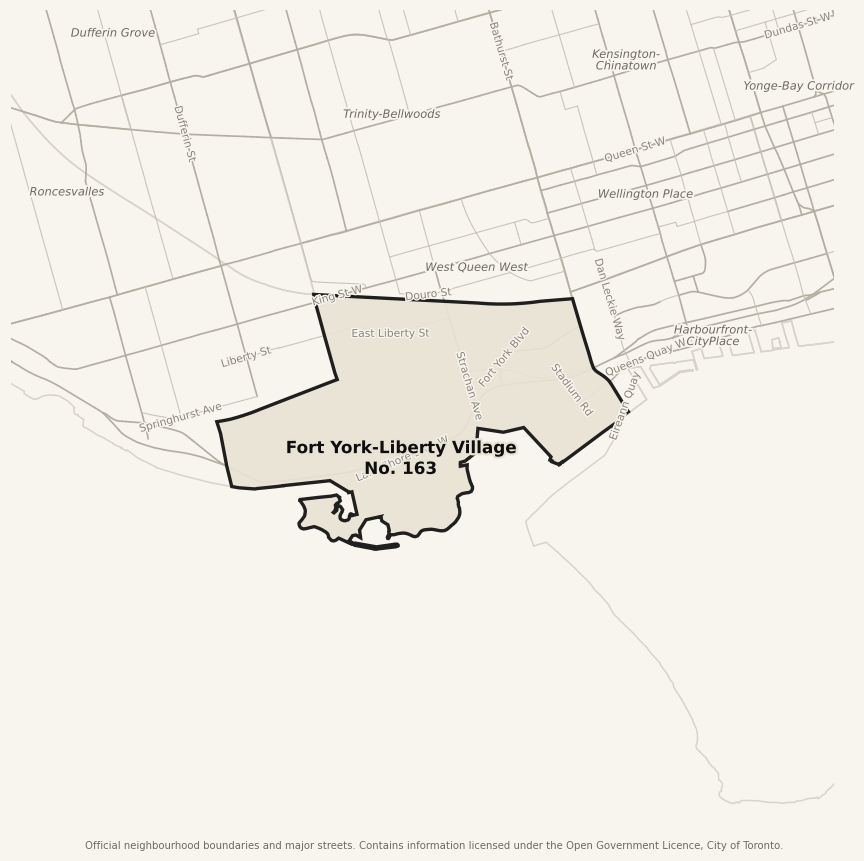
Liberty Village represents urban living with a slightly different character than its neighbour King West. Bounded by King Street to the north, Dufferin Street to the east, the Gardiner Expressway to the south, and the Strachan Avenue corridor to the west, Liberty Village is a neighbourhood of converted brick industrial buildings, mid-rise condominiums, and emerging tech companies. The C01 district attracts young professionals, creative industries workers, and people seeking authentic urban living with slightly more breathing room than King West’s frantic energy. The neighbourhood is actively gentrifying, you’ll find legitimate industrial heritage alongside new condo construction, working artists alongside tech startups, and authentic character alongside aspirational development. It’s a neighbourhood in active transformation, which means opportunity for buyers and investors, but also means understanding what you’re actually buying into.
Official City of Toronto neighbourhood: Fort York-Liberty Village (No. 163).
The History
Liberty Village’s industrial heritage is genuine and still visible. The neighbourhood was Toronto’s manufacturing engine, breweries (Dominion Brewery, among others), soap factories, food processing, metalworking, and textile production occupied the brick buildings that still line streets like Liberty Street, Simcoe Street, and Shaw Street. The neighbourhood remained industrial through the mid-twentieth century, with minimal residential use beyond housing for factory workers. Like King West, the industrial decline of the 1980s left Liberty Village with underutilized large brick buildings and cheap real estate. In the 1990s, artists and loft enthusiasts discovered Liberty Village, the combination of space, light, affordability, and authentic character attracted photographer collectives, dancers, musicians, and creative workers. Early conversions created live-work studio spaces and artist cooperatives.
By the early 2000s, developer interest grew significantly. The neighbourhood is less constrained than King West, larger parcels, lower density residential pressure, and the Gardiner Expressway creating a natural southern boundary. The first major condominium wave created “Libary Village” (as it became branded), mid-rise buildings with ground-floor retail positioned the neighbourhood as the next emerging cool area. However, Liberty Village developed differently than King West: it’s remained somewhat less intense, with better preserved industrial buildings, more visible artist presence, and emerging tech company culture (Shopify had major offices in the area). The neighbourhood still has visible working industrial use alongside residential conversion. It hasn’t fully gentrified into pure nightlife and restaurants like King West.
What You’ll Actually Find Here
Converted Warehouse Lofts: The most character-filled housing is genuine warehouse conversion, original brick exposed, soaring 14-16 foot ceilings, large factory windows, concrete floors, and open-concept layouts. These conversions range from legal, professionally converted units to owner-renovated DIY conversions in condo and rental buildings. Legal conversion lofts in managed condominium buildings are most desirable; they’re often larger (1,200-2,000+ sq ft) and have solid mechanical systems. Illegal or poorly managed conversions may offer lower prices but carry risks around building safety, financing availability, and resale complications. These lofts are the neighbourhood’s soul, when people talk about Liberty Village’s authentic character, they mean these spaces.
Purpose-Built Condominiums: Newer buildings (2005-2015) are mid-rise brick buildings designed to match neighbourhood aesthetic. Units are smaller than lofts (500-1,200 sq ft) and include bachelor to 2-bedroom options. They offer modern amenities (fitness, common spaces, rooftop patios) but less authentic industrial character than conversions. Newer buildings tend to have better mechanical systems than early conversions. These buildings are the neighbourhood’s evolution, they’re part of gentrification, but they’re also well-designed, often quite attractive in their brick heritage-evoking aesthetic.
Mixed-Use Ground Floor: Many residential units have ground-floor retail, galleries, restaurants, or studios. You’re living above working creative spaces or small businesses. This creates energy and walkability but also means noise, foot traffic, and activity below. Depending on the use, this ranges from charming (artist studio below) to disruptive (late-night bar below).
Rental and Work-Live Space: Artist-oriented buildings and cooperatives offer more affordable rental options and work-live spaces where artists have studio and residential components. These are often non-standard (high ceilings, industrial layout, shared facilities) and appeal to people prioritizing affordability and space over traditional amenities. Some operate as intentional artist communities with shared values and practices.
What Homes Cost in Liberty Village (C01)
Warehouse Conversion Lofts: Larger, professionally converted lofts in managed buildings are priced on size, condition, and building quality; older conversions with building issues or poor finishes are cheaper. These represent the best value for authentic space and character in the King West/Liberty Village corridor.
Newer Condo Buildings: From January 7 to November 2, 2026, condo apartments in Liberty Village (Dufferin Street to Strachan Avenue, south of King Street West) sold at a median of $565,000 (175 sales) and condo townhouses at $700,000 (21 sales). These buildings offer reliability and modern amenities but less character than conversions.
In TRREB District C01, all home types averaged $808,987 over the 12 months to October 2026 (3,022 sales) and $815,185 in October 2026 alone (272 sales) (TRREB Market Watch).
Artist and Co-operative Housing: Work-live spaces and artist-oriented housing is significantly cheaper. Ownership options are rare but available in some buildings as cooperative shares. These represent dramatic affordability for creative workers but come with non-standard financing and resale complications.
Rental Market: In TRREB District C01, condo apartments leased for an average of $1,934 a month for a bachelor (365 leases), $2,475 for one bedroom (2,575) and $3,494 for two bedrooms (1,114) in the second quarter of 2026 (TRREB quarterly rental report); artist and cooperative spaces rent for less. Rental availability is more abundant than King West, partly because the neighbourhood still has lower investor density and partly because artist-oriented buildings prioritize affordability and community.
What We Love About Liberty Village
Authentic Industrial Character: Unlike King West, which has been heavily redeveloped, Liberty Village still has visible industrial heritage and active maker culture. You’ll walk past artist studios, see working industrial uses, encounter galleries with genuine work (not Instagram backdrops). The neighbourhood feels like it’s in active creative and cultural development, not purely commodified. Walking Liberty Street or Simcoe feels like you’re in a real working neighbourhood that’s being transformed, not a completely redeveloped zone.
Space and Value: Converted lofts offer generous square footage with soaring ceilings. The space difference is genuine. Young professionals and creative workers get actual living space, not just bedrooms and bathrooms.
Creative Ecosystem: If you work in creative industries (design, music, film, digital), Liberty Village has a functioning creative community. You’re surrounded by other creative workers, galleries, artist studios, and people engaged in making things. Networking happens naturally. Collaboration is possible. There’s genuine cultural activity beyond bars and restaurants.
Tech Company Presence: Major tech companies have chosen Liberty Village for offices, Shopify, other software companies, digital agencies. This creates a slightly different young professional demographic (tech workers rather than finance/law) and brings energy around development, growth, and innovation.
Dufferin Access Without King Street Intensity: You’re genuinely close to King West (Dufferin separates them) but without King Street’s overwhelming noise and chaos. You have access to King West’s restaurants and bars for entertainment but can retreat to slightly quieter, more authentic Liberty Village for living. The hybrid appeal attracts people who want urban living but not constant intensity.
Emerging Character: Liberty Village is actively developing its own identity separate from King West. Galleries, independent restaurants, maker spaces, and artist collectives are creating a distinct character. If you’re interested in being part of a neighbourhood’s evolution rather than just settling in an established area, Liberty Village offers that dynamic. You’re buying into potential and authentic transformation.
The Honest Take
Gardiner Expressway Proximity and Noise: Liberty Village’s southern boundary is the Gardiner Expressway. Anywhere within 2-3 blocks of Gardiner experiences genuine traffic noise, continuous background roar, especially during rush hours. Units with southern exposure to Gardiner see ongoing traffic, dust, and environmental concern. This is less intense than being directly on King Street, but it’s not quiet. If noise sensitivity is high, stay north of King Street or west of Strachan.
Industrial Heritage is Fading: As gentrification advances, actual industrial use is declining. Artist studios are being replaced by restaurants. Working factories are being converted to lofts. The genuine industrial character that gives Liberty Village its soul is being transformed by the same gentrification that makes the neighbourhood desirable. You’re buying character that’s actively disappearing. In 5-10 years, Liberty Village will feel more like King West than it does today.
Building Quality Variance is High: Early conversion buildings vary wildly in quality and maintenance. Some have beautiful, meticulously maintained original brick and windows; others have deteriorating exteriors, failing roof systems, and outdated mechanical infrastructure. Condo status certificates are critical. Buildings with poor reserve funds, concrete spalling, water intrusion, or significant deferred maintenance can hit buyers with $30K-$80K special assessments. Due diligence is non-negotiable.
Rental-Heavy Ownership Creates Transience: Like King West, a significant percentage of units are investor-owned and rented short-term or to rotating tenants. Building communities are fragmented. You don’t know your neighbours. Common areas feel like shared commercial space, not residential community. If you value neighbourhood cohesion, this can be disappointing.
Still Gentrifying, Not Fully Established: Liberty Village is in active transformation, which creates uncertainty. You’re betting on the neighbourhood’s continued appeal and development. If gentrification stalls, if tech companies move out, if artist communities are fully displaced, neighbourhood stability could suffer. It’s not as established as High Park North or Leslieville. There’s more risk in being part of an emerging neighbourhood than an established one.
Who Lives Here
Liberty Village attracts a specific demographic that overlaps with but differs from King West. You’ll find tech workers, designers, artists, creative professionals, and young professionals in growing industries. There’s a higher proportion of people who work in creative fields or tech compared to finance/law. Many residents are entrepreneurs or in growing companies. There’s an intentional creative culture that draws people specifically choosing the neighbourhood for authenticity and community. Average age is 28-42, skewing slightly older than King West. You’ll find more established couples, some with children, and people at slightly later career stages than pure King West professionals.
Ethnically and economically, Liberty Village is less diverse than many Toronto neighbourhoods, condo prices and the gentrification process filter for wealth and, unfortunately, tend to filter for white, educated, upper-middle-class residents. However, there’s authentic effort in some building communities and artist collectives to maintain mixed-income housing and resist pure gentrification. These efforts exist but aren’t the dominant force. Many residents explicitly moved to Liberty Village to be in a neighbourhood with creative culture and have left King West’s purely commercial energy behind. There’s more intentionality in residence choice here than in King West.
Schools
Liberty Village has similar school limitations as King West, minimal family housing means limited neighbourhood school infrastructure. Students are zoned to schools outside the immediate neighbourhood. The area is not designed for families with school-age children, and most families move out before children reach school age. However, the neighbourhood’s emerging character attracts some young families who value the authenticity and space. Those families typically accept that they’ll move elsewhere when children reach school age or use private school options.
The neighbourhood has lower family housing density than residential neighbourhoods, so you won’t find the same school-focused community infrastructure. There are tutoring services and extracurricular activity providers in the nearby Parkdale, Ossington, and downtown areas, but not concentrated locally. Families in Liberty Village are making an intentional choice to live in a less family-optimized neighbourhood, usually during pre-child or early-child phases.
Getting Around
Transit access is excellent. The Streetcar 504 King runs along the northern boundary of Liberty Village and connects to downtown, St. Lawrence, and westward to Trinity Bellwoods and beyond. The Dufferin streetcar (505) runs north-south on the eastern edge of the neighbourhood and connects to the Dundas streetcar and subway. The King Station subway (Line 2) is accessible at the northern edge. You can reach downtown, the Annex, or any streetcar corridor in 15-30 minutes via transit. Many residents don’t own cars.
With a car, parking is available in many buildings (often included in condo fees at $100-$200/month) and street parking is more abundant than King West. The Gardiner Expressway is accessible via Strachan or Bathurst (8-12 minutes south). The DVP is 15-20 minutes east via Bathurst and Jarvis. Commuting by car to downtown or the airport is viable but not optimized. Most residents treat Liberty Village as a pedestrian and transit neighbourhood, with cars available for weekend trips and longer commutes.
Things to Do
Liberty Village offers a growing restaurant and bar scene, though less intensive than King West. There are galleries throughout the neighbourhood, artist collectives, independent galleries, and emerging commercial galleries. Maker spaces, studios, and artist cooperatives operate throughout, some open for studio visits and events. The neighbourhood hosts events like Liberty Art Festival, pop-up markets, and community events celebrating creative culture. Ground-floor spaces often feature local art, independent designers, and small producers.
King West is immediately adjacent (across Dufferin), so you have access to that neighbourhood’s full restaurant and bar infrastructure without living in its intensity. Trinity Bellwoods Park is a 15-minute walk northwest and offers green space, sports, and community gathering. The Waterfront is accessible south via Strachan. St. Lawrence and the Distillery District offer heritage architecture and weekend activities accessible via transit. The Gardiner Expressway limits immediate southern exploration, but west towards Parkdale and Ossington, there’s emerging restaurant and bar culture. If you want active entertainment, you walk to King West; if you want creative cultural engagement, you experience it locally in studios and galleries.
Buying in Liberty Village: What to Expect
Building Inspection Criticality: Condo status certificates and building inspections are absolutely essential. Early conversion buildings may have significant deferred maintenance, aging mechanical systems, or structural issues from conversion work. Budget for a detailed inspection by someone experienced with conversion lofts. Hidden costs from HVAC failures, electrical upgrades, or roof work are common in older buildings.
Authentic vs. Aspirational Appeal: Different buyers want different things here. Some are attracted by authentic industrial character and creative community; others are purely investing based on gentrification trajectory. Be clear about what draws you and make sure the specific building/unit delivers it. A brand-new building that copies industrial aesthetics doesn’t deliver the same value as a genuinely converted warehouse if authenticity is your priority.
Development Trajectory Matters: Liberty Village is being actively rezoned and developed. Plans for new buildings, parks, and community spaces are in motion. This can affect your neighbourhood quality positively (new parks, improved transit) or negatively (construction, increased density, changed character). Research neighbourhood development plans before committing. Buying a property that backs onto a construction site for three years is different from buying in an established area.
Pricing Positioning: Liberty Village units typically trade at 5-15% discounts to equivalent King West units, partly due to perceived location and partly due to Gardiner proximity. This creates value for smart buyers but also means you’re betting that the discount will narrow as the neighbourhood matures. Historically, this bet has paid off, but it’s not guaranteed.
Ready to Explore Liberty Village?
Buying in Liberty Village requires someone who understands the neighbourhood’s emerging character, can evaluate conversion loft buildings specifically, and can help you navigate development changes and building quality issues. Michael Ouzas and his team specialize in emerging neighbourhoods and creative communities. We understand what authentic conversion lofts offer, which buildings are well-maintained, and how gentrification is reshaping the area. Whether you’re drawn by character, space, creative community, or investment potential, we’ll help you find the right property and position yourself strategically in this active market. Contact us to explore Liberty Village.
Related Neighbourhood Guides
Interested in similar emerging, character-filled neighbourhoods with authentic culture? Check out our guides to King West (similar market stage but more intense), Trinity Bellwoods (conversion lofts, slightly quieter), Parkdale (emerging gentrification, more affordable), Ossington (similar gentrification trajectory), Queen West (arts and character, slightly residential), and The Junction (established character, more affordable). Or if you’re seeking fully established neighbourhoods with less uncertainty, explore High Park North or Leslieville.
Liberty Village Sold Prices in 2026
Every MLS® sale from January 7 to November 2, 2026. Liberty Village here means Dufferin Street to Strachan Avenue, south of King Street West. Price per square foot uses above-grade size; the basement is not included.
| Type | Sales | Median price | Per sq ft | Sold over asking |
|---|---|---|---|---|
| Condo apartments | 175 | $565,000 | $850 | 11% |
| Condo townhouses | 21 | $700,000 | $789 | 24% |
See the full pocket-by-pocket numbers on the Liberty Village stats page.
Related reading
- Liberty Village market stats: 2026 sold prices street by street
- King West market stats: 2026 sold prices street by street
- Liberty Village Schools: Rankings, Catchments, and What Families Need to Know
- Toronto condo stats, updated monthly
- Toronto Neighbourhoods Bucking the 2025 Market Slowdown
- Queen West: nearby guide
- King West: nearby guide
- Palmerston Little Italy: nearby guide