Trinity Bellwoods is where Toronto’s creative energy meets genuine neighbourhood life. Anchored by the park that gives it its name, this pocket neighbourhood south of Dundas and west of Bathurst has evolved from a working-class area into one of the city’s most desirable addresses for young professionals, artists, and families who want urban energy without suburban compromise. The Victorian housing stock, independent shops along Dundas West, and the park’s magnetic social scene create a neighbourhood that feels effortlessly cool, though the real estate prices suggest the market takes it very seriously.
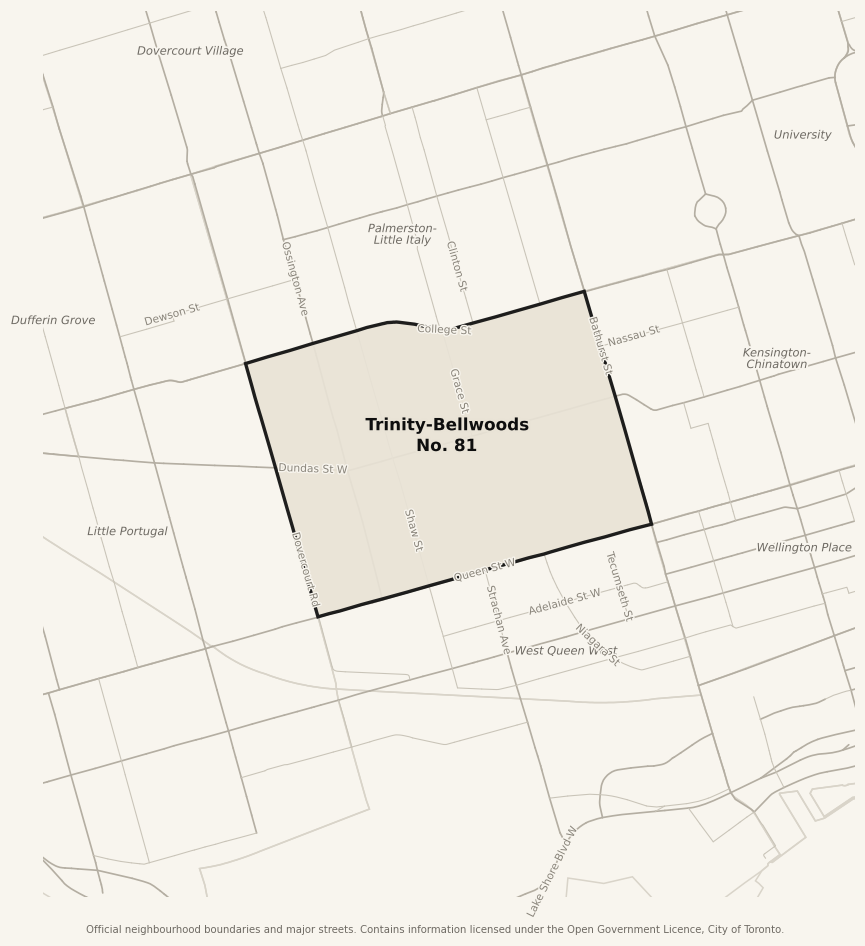
Official City of Toronto neighbourhood: Trinity-Bellwoods (No. 81).
The History
Trinity Bellwoods takes its name from Trinity College, which stood on the park grounds from 1852 until its move to the University of Toronto campus in 1925. The gates at the park’s Queen Street entrance are remnants of that era. The surrounding neighbourhood developed as working-class housing in the late 1800s, with rows of Victorian and Edwardian homes built for factory workers and tradespeople employed in the nearby industrial areas along King Street.
Through the mid-20th century, the neighbourhood was home to successive waves of immigrants, Portuguese, Italian, and later Vietnamese and Chinese families who established businesses along Dundas. The area remained affordable and ethnically diverse through the 1990s, when artists and musicians began gravitating to the cheap rents and Victorian character.
The transformation accelerated rapidly in the 2000s. Dundas West between Ossington and Dovercourt became a strip of galleries, restaurants, and boutiques. The park’s social scene, particularly the famous white squirrel sightings and summer gatherings, gained cultural cachet. By the 2010s, Trinity Bellwoods had fully gentrified, with property values reflecting its status as one of Toronto’s most sought-after neighbourhoods.
What You’ll Actually Find Here
Victorian Row Houses and Semis: The neighbourhood’s signature housing. Two- and two-and-a-half-storey Victorian row houses and semi-detached homes on narrow lots (typically 15-20 feet wide). Many feature original brick facades, bay windows, and decorative millwork. Interior layouts tend to be narrow and deep, the classic Toronto shotgun layout. Sizes range from 1,000-1,800 sq ft. Renovated examples are the most competitive segment of the market.
Edwardian Detached Homes: Less common but present on wider lots, particularly on the blocks north of Dundas. These are larger (1,500-2,500 sq ft) with more generous proportions than the row houses. They represent the top of the market in the neighbourhood and rarely come up for sale.
Loft Conversions: Former industrial and commercial buildings converted to residential lofts, particularly along the southern edge near King Street. These offer open-concept layouts, high ceilings, and industrial character. Popular with creative professionals and couples who don’t need traditional room layouts.
New Condos: Mid-rise developments (typically 6-12 storeys) have appeared along Queen Street West and Dundas. These provide the neighbourhood’s more affordable entry points but lack the character that makes Trinity Bellwoods distinctive. Purpose-built condos in the area tend to be smaller units targeted at young professionals.
What Homes Cost in Trinity Bellwoods (C01)
Victorian Row Houses (Renovated): From January 1 to November 3, 2026, freehold townhouses in the TRREB community of Trinity-Bellwoods sold at a median of $1,253,000 (38 sales). Homes with modern kitchens, finished basements, and maintained heritage details command the upper end. Premium for homes directly facing the park.
Victorian Row Houses (Original): Unrenovated homes with original systems and layouts sell for less. The discount reflects the renovation investment required, budget $150K-$350K depending on scope. Foundation work is common and expensive in this area’s housing stock.
Edwardian Detached: Detached homes sold at a median of $1,569,000 (19 sales) over the same months, and semi-detached homes at $1,560,500 (40 sales). These are rare listings and command significant premiums. Bidding wars are common for well-maintained detached homes in the neighbourhood.
Loft Conversions: Prices depend on size, building character, and amenities. Authentic industrial conversions command premiums over purpose-built units styled to look like lofts.
Condos: Condo apartments sold at a median of $742,478 (29 sales) and condo townhouses at $1,025,000 (5 sales) over the same months; the median maintenance fee on the condo apartments that sold was $742 a month. The condo market here is less distinctive than the freehold market, you’re paying for location rather than unique architecture.
In TRREB District C01, all home types averaged $808,987 over the 12 months to October 2026 (3,022 sales) and $815,185 in October 2026 alone (272 sales) (TRREB Market Watch).
What We Love About Trinity Bellwoods
The Park Itself: Trinity Bellwoods Park is genuinely one of Toronto’s best urban parks. It’s not just green space, it’s a social institution. The hill, the dog bowl, the community centre, the tennis courts, the farmers’ market, the park functions as the neighbourhood’s living room. In summer, the western slope becomes one of the city’s great gathering places. Living within walking distance of this park genuinely improves quality of life.
Dundas West’s Independent Character: The Dundas West strip between Ossington and Dovercourt maintains a strong independent retail character. Small boutiques, galleries, restaurants, and cafés dominate, chain stores are largely absent. The retail mix changes regularly, keeping the strip interesting for long-term residents. This is one of the few Toronto shopping streets where browsing is genuinely enjoyable.
Walkability That Actually Works: This isn’t just walkable on paper. Groceries, restaurants, transit, parks, schools, shops, everything is within a genuine 10-minute walk. The neighbourhood is compact enough that daily life doesn’t require a car. Ossington Avenue, Queen Street West, College Street, and Dundas West all provide different retail and dining options within easy reach.
Architectural Consistency: The Victorian housing stock creates visual coherence that many Toronto neighbourhoods lack. Walking the residential streets is genuinely pleasant, mature trees, consistent building heights, front porches, and maintained heritage details create an urban environment that feels intentional rather than haphazard.
The Honest Take
You’re Paying Peak Prices: Trinity Bellwoods is fully gentrified and priced accordingly. There are no hidden deals or undiscovered streets. You’re buying into an established premium neighbourhood, and values reflect that. If you’re looking for value appreciation potential, the upside is more limited than emerging neighbourhoods. You’re paying for quality of life, not speculative growth.
The Homes Are Small: Victorian row houses on 15-18 foot lots are charming but compact. If you’re a growing family, you’ll feel the constraints, narrow hallways, small bedrooms, limited storage. Basements help but aren’t a full solution. Many families eventually outgrow these homes, which is why the neighbourhood skews younger. Be realistic about whether the space actually works for your life.
Noise and Density: This is an urban neighbourhood with urban realities. Queen Street and Dundas are busy. The park generates significant foot traffic and noise on summer evenings. If you value quiet suburban-style living, Trinity Bellwoods will feel intense. The trade-off for walkability and energy is that you’re surrounded by it.
Parking Is Nearly Impossible: Street parking is permit-only and competitive. Most Victorian row houses lack driveways or garages. If you own a car, you’ll spend meaningful time managing parking. This is a neighbourhood designed for walking, cycling, and transit, car ownership is a genuine inconvenience here.
Who Lives Here
Trinity Bellwoods attracts Toronto’s creative professional class. Graphic designers, writers, tech workers, marketing professionals, and small business owners who value aesthetic environment and walkable urbanism. The neighbourhood skews younger, lots of couples in their late 20s to early 40s, many with young children. There’s a visible arts community, though rising prices have pushed many working artists further west to Parkdale, Bloordale, and Junction.
Dog owners are disproportionately represented thanks to the park’s excellent off-leash areas. The neighbourhood has a strong community identity, people who live here tend to be actively engaged with local businesses, park events, and neighbourhood initiatives.
Schools
Givins/Shaw Junior Public School serves much of the neighbourhood and has a strong reputation. It’s a diverse, community-oriented school with active parent involvement. For older students, Central Technical School is nearby and offers specialized programs. Alternative schools in the area include Montessori and various progressive education options that appeal to the neighbourhood’s demographics.
The neighbourhood’s central location provides good access to private schools across the city via transit. Bishop Strachan School, Upper Canada College, and various downtown independent schools are all accessible within 20-30 minutes.
Getting Around
Trinity Bellwoods is exceptionally well-connected by transit. The 501 Queen streetcar and 505 Dundas streetcar provide east-west transit along both commercial corridors. Ossington Station on the Bloor-Danforth line is a 10-15 minute walk north. The 63 Ossington bus connects the neighbourhood to the subway. Cycling is excellent, the neighbourhood’s flat terrain and proximity to the waterfront trail make bikes a practical daily transportation option.
Walking is the dominant mode of transport for residents. The neighbourhood’s compact layout means most daily needs are within a 10-minute walk. For highway access, the Gardiner Expressway is accessible via Strachan Avenue or Dufferin Street, though reaching either during rush hour requires patience.
Things to Do
Trinity Bellwoods Park is the obvious centrepiece, sports, socializing, farmers’ markets, and seasonal events. Beyond the park, Dundas West offers a dense strip of restaurants, bars, and shops. Ossington Avenue provides additional dining options, with some of the city’s best cocktail bars and restaurants concentrated in a few blocks.
Queen Street West, south of the park, offers a different character, more established retail, galleries, and the legendary Horseshoe Tavern and Drake Hotel for live music and cultural events. The Museum of Contemporary Art (MOCA) at Sterling Road is a short bike ride west. The waterfront and Exhibition grounds are accessible for longer walks or bike rides south.
For groceries and daily errands, the neighbourhood is well-served by independent shops, and No Frills at Dundas and Ossington provides affordable grocery options. The Dundas West farmers’ market operates seasonally and adds to the local food culture.
Buying in Trinity Bellwoods: What to Expect
Move Quickly on Good Properties: Well-renovated Victorian homes in Trinity Bellwoods generate immediate interest. If you find a property that checks your boxes, be prepared to make a competitive offer within days. Hesitation costs opportunities in this market. That said, don’t let competition anxiety override due diligence, inspect thoroughly and understand what you’re buying.
Understand Victorian Home Realities: These homes are 100+ years old. Even renovated properties may have underlying issues, settling foundations, aging plumbing behind new walls, outdated electrical in areas the renovation didn’t reach. A thorough home inspection by someone experienced with Victorian construction is essential. Budget 5-10% of purchase price for unexpected discoveries in the first few years.
Consider Your Space Needs Realistically: Visit during different times of day and week. Imagine your furniture in the rooms. Measure doorways and staircases. Victorian row houses look charming but can feel constraining with modern furniture and family needs. If you need more than two bedrooms, you’ll likely need a finished basement or attic conversion, which adds cost and complexity.
Factor In Lifestyle Costs: Trinity Bellwoods is an expensive neighbourhood to live in beyond the mortgage. Restaurants, shops, and services are priced for the demographic. Property taxes reflect high assessments. If your budget is stretched by the purchase price, the ongoing lifestyle costs may create financial pressure.
Ready to Explore Trinity Bellwoods?
Finding the right home in Trinity Bellwoods requires understanding the neighbourhood’s Victorian housing stock, knowing which streets and blocks offer best value, and being prepared to move quickly in a competitive market. Michael Ouzas and his team have deep Trinity Bellwoods knowledge, we understand the difference between a well-renovated Victorian and one hiding problems, and we can help you navigate the market strategically. Whether you’re looking for a character row house, a loft conversion, or a modern condo near the park, we’ll help you find your place in one of Toronto’s most vibrant neighbourhoods. Contact us to explore Trinity Bellwoods.
Related Neighbourhood Guides
Looking at similar vibrant, walkable neighbourhoods? Check out our guides to Queen West (adjacent with similar character and arts culture), Palmerston-Little Italy (similar Victorian housing, Italian heritage), King West (more modern, similar walkability and dining), Liberty Village (more condo-oriented, similar demographics), and Parkdale (emerging character neighbourhood, more affordable). For established family-friendly alternatives with similar walkability, explore Roncesvalles or Bloor West Village.
Trinity Bellwoods Sold Prices in 2026
Every MLS® sale from January 1 to November 3, 2026. Price per square foot uses above-grade size; the basement is not included.
| Type | Sales | Median price | Per sq ft | Sold over asking |
|---|---|---|---|---|
| Detached houses | 19 | $1,569,000 | $851 | 32% |
| Semi-detached houses | 40 | $1,560,500 | $914 | 45% |
| Condo apartments | 29 | $742,478 | $998 | 14% |
The same house sells for about 5% more here than across TRREB district C01 as a whole.
See the full pocket-by-pocket numbers on the Toronto C01 stats page.
Related reading
- Little Italy market stats: 2026 sold prices street by street
- Queen West market stats: 2026 sold prices street by street
- Trinity Bellwoods Schools: Rankings, Catchments, and What Families Need to Know
- Toronto condo stats, updated monthly
- Return to Office: What It Means for Toronto Real Estate
- Best Toronto Neighbourhoods for Hockey Players
- Queen West: nearby guide
- King West: nearby guide
- Liberty Village: nearby guide