Walk Bloor West between Jane and High Park, and you’re walking one of Toronto’s most established neighbourhoods. Bloor West Village occupies roughly 50 square blocks of West End real estate, anchored by the Bloor strip with its independent shops and restaurants, bounded by Jane to the west and High Park to the east. What you’ll feel here is stability mixed with character. This isn’t new development trying to be cool. It’s old development that already is cool, solid Victorian and Edwardian homes on tree-lined streets, mature oaks and maples casting shade over brick sidewalks, and a neighbourhood vibe that pulls people in and makes them stay.
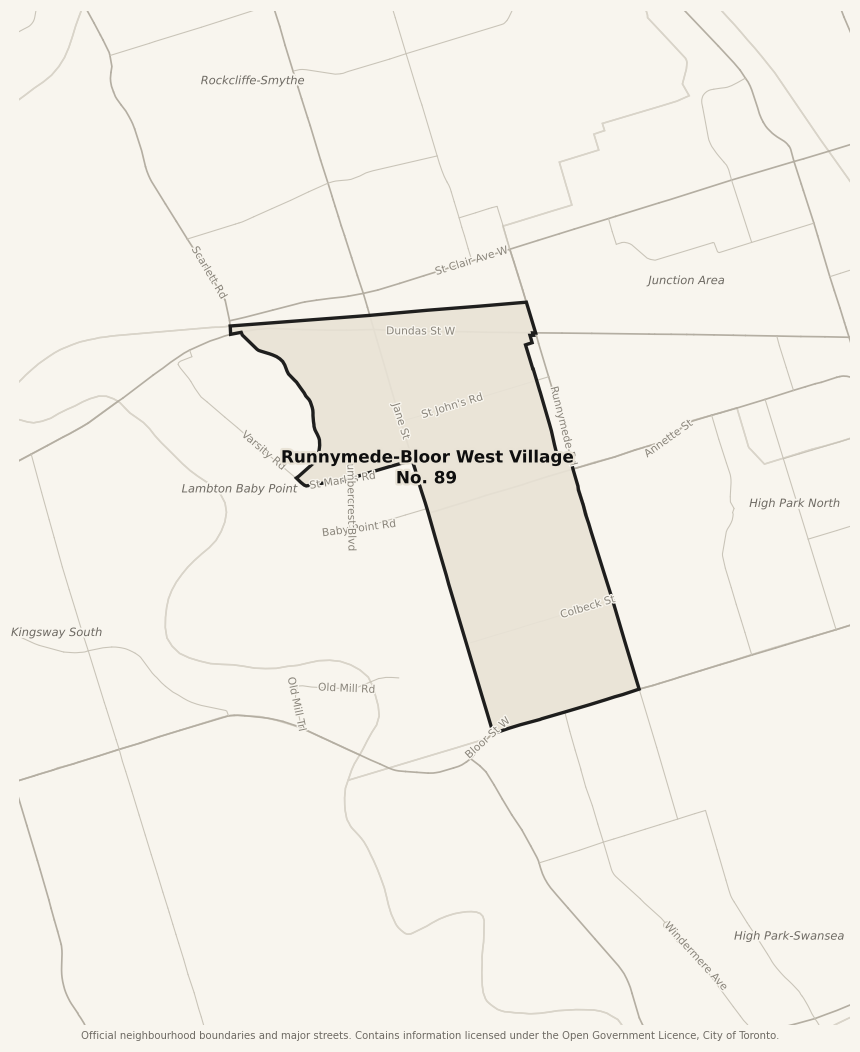
Official City of Toronto neighbourhood: Runnymede-Bloor West Village (No. 89).
The History
Bloor West Village holds a distinction few neighbourhoods can claim: it was home to Canada’s first Business Improvement Area, established in 1970. That decision didn’t happen by accident. The area’s commercial character was already well-established by then, built by the tight-knit communities who settled here in the early 1900s. You can still see that heritage in the building stock, the festivals, like the Toronto Ukrainian Festival every September, and the way this strip operates as its own small ecosystem rather than a chain of franchises.
The residential neighbourhood grew up around that commercial strip, with most of the housing stock going up between 1915 and 1925. The architecture reflects those eras, and Edwardian and Craftsman details are everywhere. Over a century later, those buildings have held their value because they were built right: solid construction, generous lots, and room to expand. The BIA remains active and protective of the character that built it. That’s not something you can manufacture; it comes from decades of local pride.
What You’ll Actually Find Here
The housing stock in Bloor West Village is almost entirely two-storey detached and semi-detached homes built between 1915 and 1925. You won’t find rows of new condos or townhome developments, that’s not what this neighbourhood is. What you will find are solid brick homes, many with original details: hardwood floors, plaster mouldings, built-in shelving, and those characteristic Edwardian and Craftsman front porches perfect for watching the street. Many homes have been thoughtfully updated without losing their bones.
The lots here are larger than what you’ll find in most of Toronto. It’s not uncommon to see 25-foot frontages with 120-foot depths, which means garages, driveways, backyard space, and actual separation from your neighbours, a premium in the city. Streets are wide and tree-heavy, the kind of canopy that makes August bearable and the neighbourhood feel established in a way new developments struggle to achieve. The southern boundary of the neighbourhood, south of Annette, carries a catchment premium because it feeds into Humberside Collegiate Institute, one of the city’s strongest public high schools. In 2026 sales between Jane Street and Runnymede Road, the same house sold for about 21% less north of Annette than south of it (likely range 12% to 29%), with size, bathrooms, type, lot width and parking held equal. Families pay for that catchment.
You’ll find very few condos in Bloor West Village proper. High Park has condo buildings, and there are some older low-rise apartments scattered through the neighbourhood, but this is predominantly single-family housing territory. That’s by design and by market force, this is a neighbourhood built for families, and families have the purchasing power to keep it that way.
What Homes Cost in Bloor West Village (W02)
From January 1 to November 2, 2026, detached homes in Bloor West Village (the TRREB community of Runnymede-Bloor West Village) sold at a median of $1,601,000 (57 sales), semi-detached homes at a median of $1,240,000 (31 sales) and freehold townhouses at a median of $1,210,000 (5 sales). Around Annette Street, between Jane Street and Runnymede Road, over the same months:
- Detached homes (south of Annette): a median of $1,764,500 (30 sales). The Humberside Collegiate catchment commands a clear premium.
- Detached homes (north of Annette): a median of $1,285,000 (10 sales). Same housing stock, same tree-lined streets, but without the Humberside catchment. For buyers whose kids aren’t yet school-age or who prioritize value, this is where the opportunity sits.
- Semi-detached homes: a median of $1,491,500 (10 sales) south of Annette and $1,202,500 (11 sales) north of Annette. The catchment premium applies here too.
- Condos and low-rise apartments: no condo sales were recorded in Bloor West Village (Runnymede-Bloor West Village) from January 1 to November 2, 2026.
In TRREB District W02, all home types averaged $1,198,431 over the 12 months to October 2026 (692 sales) and $1,266,814 in October 2026 alone (71 sales) (TRREB Market Watch).
These prices stick because the fundamentals don’t change: walkable neighbourhood, subway access, excellent schools, High Park at your doorstep, and low turnover. People don’t leave Bloor West Village unless they have to. That tightness in supply, low inventory, keeps prices firm. Combined with the fact that this is one of Toronto’s most sought-after West End neighbourhoods, you get a market where well-priced homes move quickly.
What We Love About Bloor West Village
We know this area well because we’re locals. The Bloor strip itself is a legitimate draw. Unlike many Toronto commercial streets that have become chains and franchises, Bloor West still has independent character. You’ve got local restaurants, cafes with real communities, small shops with owners who know their customers. The butcher shops and fresh produce markets along Bloor, Bake Sale, the casual patios in good weather, it’s the kind of strip where you run into neighbours. We love that.
High Park is literally at the eastern edge of the neighbourhood. Ravine trails, gardens, the city zoo, sports facilities, and enough greenspace to feel like you’re at the edge of something wild even though you’re 20 minutes from downtown. That proximity drives neighbourhood culture. Dog walkers, joggers and families are out at all hours: it’s an outdoor neighbourhood.
The family-first energy is real. This is where people move when they decide to commit to Toronto long-term and want roots. You’ll see the same families year after year, kids growing up on these streets, homes passed down through generations. There’s a stability to it that doesn’t feel stuck, it feels chosen. People come here intentionally and tend to stay.
The walkability is genuine (Walk Score 85+). You can live here without a car, though most households have them. The tree canopy is mature and thick. Streets feel safe at all hours. Those original porches mean neighbourly street culture. This is the kind of neighbourhood where children play outside and neighbours know each other. It’s not manufactured nostalgia, it’s just how the place works. If you want someone who knows these streets the way a local should, Michael Ouzas from the Michael Ouzas Real Estate team has been working this neighbourhood for years.
The Honest Take
Bloor West Village is expensive, and it doesn’t apologize for that. You’re paying for location, for schools, for history, for stability. If you’re shopping here, you’re already at a price point where budget adjustments are probably settled. Most homes get multiple offers. Well-priced stock moves in days. If something sits for weeks, there’s usually a reason: condition, price point mismatch, or specific issue. Inventory is tight. More people want to live here than there are homes available.
Parking can be a legitimate issue on certain blocks, particularly north of Bloor and closer to the commercial strip. If you need off-street parking, check the property and the street carefully. Some buyers accept parking as a trade-off; others find it a dealbreaker. Know where you stand before you bid.
Nightlife is minimal. If you’re looking for late-night venues, clubs, or a young-professional bar scene, you’ll be heading elsewhere. This neighbourhood prioritizes residential character over commercial entertainment. That’s a feature if you want quiet streets, it’s a bug if you wanted Ossington.
In 2026, 65% of detached homes in Runnymede-Bloor West Village sold over asking. If you’re shopping here, assume competition and come prepared with financing confirmed and a clear walkthrough strategy. The market rewards speed and certainty.
Who Lives Here
The demographic is diverse: families with school-age children are the core. You’ll see young professionals who traded downtown condos for actual space. Multi-generational households. Long-time residents who’ve been here 20, 30, sometimes 40+ years. The cultural imprint of the communities who built this neighbourhood remains visible in the businesses, festivals like the Toronto Ukrainian Festival, and the social texture that makes Bloor West feel distinct. Dog ownership is nearly universal. You’ll see early-morning dog walkers and parents dropping kids at school. This is not a student neighbourhood, not a nightlife neighbourhood, and not a transient neighbourhood. This is where people build lives.
Schools
Schools are a significant driver of neighbourhood value in Bloor West Village, and the numbers back that up. The Fraser Institute’s 2025 report card rankings for the schools serving this area are below; schools are a major reason families target this neighbourhood specifically. South of Annette, the Humberside Collegiate Institute catchment applies, and that boundary line drives real pricing differences.
- Humberside Collegiate Institute (Grades 9-12), the heavyweight draw. Ranked 18th of 742 Ontario secondary schools in the Fraser Institute’s 2025 report card, with a rating of 9.0 out of 10 (top 3%). Humberside is consistently ranked among Toronto’s strongest public high schools, and the south-of-Annette catchment premium exists specifically because of this school’s reputation. If secondary school quality is your decision driver, that premium makes sense.
- St. Pius X Catholic School (JK-8), Fraser Institute rank 260th of 3,047 Ontario elementary schools in the 2025 report card, rating 8.3 out of 10 (top 9%). Serves the TCDSB catchment.
- Runnymede Junior and Senior Public School (JK-8), Fraser Institute rank 480th of 3,047 Ontario elementary schools in the 2025 report card, rating 7.7 out of 10 (top 16%). Central location with a strong neighbourhood presence and deep community roots.
- Humbercrest Public School (JK-8), located at 14 Saint Marks Road, a neighbourhood school that feeds into the Humberside catchment area.
- King George Junior Public School (JK-6), serves the northern portions of the neighbourhood. A smaller, community-oriented school.
The south-of-Annette factor is real. Families with younger children often plan backward from Humberside and position themselves in that catchment. That geography drives pricing and turnover patterns. If schools are central to your decision, understand which catchment your street falls into, a local agent like Michael Ouzas from the Michael Ouzas Real Estate team can walk you through the exact boundaries and how they impact value on a block-by-block basis.
Getting Around
Jane Station and Runnymede Station sit directly on the Bloor-Danforth subway line. Jane is the western anchor; Runnymede is at the heart of the neighbourhood. It’s a 20-minute TTC ride to downtown, making this accessible for office workers while maintaining residential character. During the workday, the subway is usually uncrowded heading outbound in the morning and inbound in the evening.
Multiple bus routes run through the neighbourhood, east-west on Bloor and north-south on various cross-streets. South Kingsway provides direct access to the Gardiner Expressway for anyone commuting south or west. The neighbourhood is bike-friendly, with streets wide enough to accommodate cyclists safely. Walk Score sits at 85+, meaning most errands can be accomplished on foot.
The commute from Bloor West to downtown is reasonable without being trivial. If you’re working downtown full-time, expect 20-30 minutes door-to-door depending on the exact route and time of day. That’s still shorter than many outer-ring commutes.
Things to Do
High Park dominates the leisure landscape. Ravine trails, gardens that shift through the seasons, the city zoo, playgrounds, sports facilities, and enough trails to feel like you’ve left the city without actually leaving it. In winter, Bloor Hill is the sledding spot. In summer, the park is packed with families. The cherry blossoms in spring and the trails in fall are neighbourhood fixtures.
The Bloor Strip itself is an asset. The butcher shops and vegetable markets are a Bloor West staple, the kind of independent food shops that have been here for decades and still draw people from across the city. Bake Sale provides fresh pastries and coffee; there are independent restaurants scattered along the strip, Portuguese, Thai, Greek, Italian, casual neighbourhood spots where you recognize people and they recognize you. During summer, patios extend the dining season onto the street. The Toronto Ukrainian Festival runs every September and draws thousands, it’s a neighbourhood tradition worth experiencing.
Local restaurants and cafes change and evolve, but the culture of independent operation remains constant. You’ll spend time browsing menus and finding neighbourhood spots rather than defaulting to chains. The Humber River trails run parallel to the neighbourhood’s western edge, connecting to larger trail systems if you want longer walks or bike rides.
Buying in Bloor West Village: What to Expect
Come prepared. This is a competitive market where supply is limited and demand is consistent. Before you start looking, confirm financing. Get a pre-purchase inspection done on any property you’re seriously considering, you want to know condition before you’re in a bidding war. If you’ve had condition issues elsewhere, have that conversation early.
Work with a local agent who understands this neighbourhood’s rhythms. Market values shift block by block based on Humberside catchment, street parking, proximity to the commercial strip, and subdivision potential. An agent like Michael Ouzas, from the Michael Ouzas Real Estate team, doesn’t rely on comps from two neighbourhoods over, he understands this specific market. That knowledge matters in both pricing and positioning your offer.
Well-priced homes move fast. If something has been listed for more than three weeks, there’s usually a reason. It might be overpriced, might have condition issues, might be on a challenging block, or might hit some other buyer threshold. Don’t overlook those properties without understanding why they haven’t sold, sometimes you find a hidden opportunity, sometimes you find out why it needed to be hidden.
Low turnover is a neighbourhood strength and a market reality. Less supply means less choice, which means when the right property emerges, competition is real. In 2026, 65% of detached homes there sold over asking. Factor that into your strategy. If you’re emotionally attached to a specific property, you’ll probably overpay. This neighbourhood requires emotional discipline.
Bloor West Village has been stable for decades because families choose it and stay. That consistency drives value. It’s not sexy, it’s not trendy, and it doesn’t need to be. It’s a neighbourhood that knows what it is and does it well. If that’s what you’re looking for in Toronto, nowhere else quite offers it.
Bloor West Village Sold Prices in 2026
Every MLS® sale from January 1 to November 4, 2026. TRREB counts Bloor West Village inside its Runnymede-Bloor West Village community, so these are the numbers for Runnymede-Bloor West Village. Price per square foot uses above-grade size; the basement is not included.
| Type | Sales | Median price | Per sq ft | Sold over asking |
|---|---|---|---|---|
| Detached houses | 57 | $1,601,000 | $1,065 | 65% |
| Semi-detached houses | 31 | $1,240,000 | $1,046 | 65% |
Between Jane Street and Runnymede Road, the same house sells for about 21% less north of Annette Street than south of it. Median house price: $1,691,000 south of Annette (40 sales), $1,207,500 north of Annette (24 sales). Median detached: $1,764,500 south (30 sales), $1,285,000 north (10 sales). Median semi-detached: $1,491,500 south (10 sales), $1,202,500 north (11 sales).
See the full pocket-by-pocket numbers on the Bloor West Village stats page.
Related reading
- Bloor West Village market stats: sold prices by pocket
- Toronto West market stats (W01 to W08), updated monthly
- Bloor West Village Schools: Rankings, Catchments, and What Families Need to Know
- Bloor West Village vs The Junction
- Bloor West Village: A Complete Neighbourhood Guide for Buyers
- Why Toronto’s West End Housing Market Is Still So Competitive in 2026
- What Condo Buyers Are Really Looking for in 2026