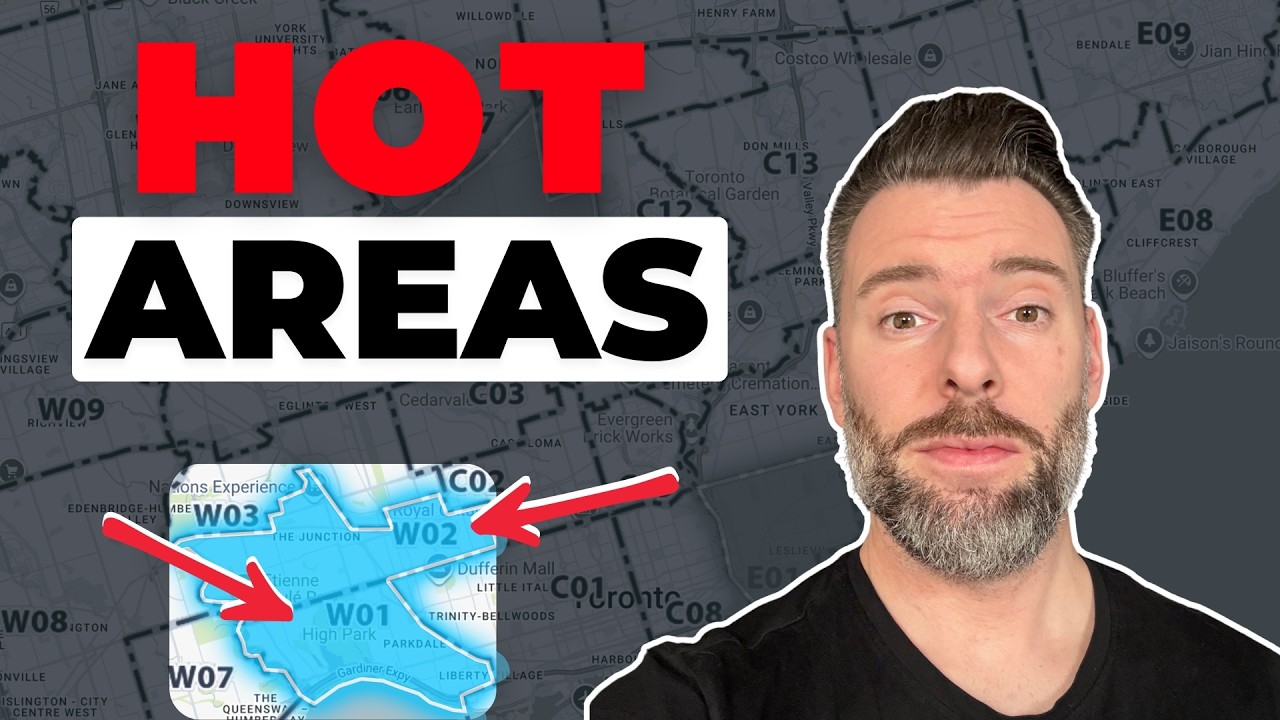
Toronto’s real estate market has been uneven in 2026. Some areas have slowed down, while others continue to attract strong buyer demand. One part of the city that has stood out is the West End.
Neighbourhoods such as Roncesvalles, High Park, Swansea, Bloor West Village, and parts of the Junction have continued to perform well, especially for detached and semi-detached homes. Even in a slower overall market, many West End properties are still selling quickly, often with strong competition. The reason comes down to a simple real estate principle: low supply and steady demand.
Toronto’s West End Remains Highly Desirable
The West End has long been one of Toronto’s most attractive areas for homebuyers, offering a strong mix of parks, restaurants, coffee shops, transit access, family-friendly streets, and established neighbourhood character. For many buyers, the appeal is not just the house itself, it is the lifestyle that comes with the area.
High Park is one of the city’s most valuable green spaces. Roncesvalles has a strong neighbourhood feel, with shops, restaurants, and walkable streets. Swansea and Bloor West Village offer larger homes, mature lots, and access to sought-after school districts. The Junction continues to attract buyers looking for character homes and a more urban feel. These features support demand even when the broader market is slower.
W1 and W2 Are Leading the West End Market
Two of the strongest West End areas in 2026 have been W1 and W2.
W1 includes areas west of Lansdowne and Dufferin, moving toward Roncesvalles, High Park, and Swansea. This part of the city includes many larger detached and semi-detached homes, often on good-sized lots and close to major amenities.
W2 includes areas north and west around High Park, Bloor West Village, the Junction, Wallace Emerson, and surrounding pockets. This area can vary significantly from one street to another, school districts, lot sizes, and housing styles change quickly.
Both areas have remained competitive, but not every pocket performs the same way. In the West End, crossing a major street can mean entering a different school zone or a different buyer profile, and that can have a real impact on pricing.
Detached Homes in W1 Are Still in Short Supply
From January to the end of May 2026, there were only 61 detached home sales in W1. That limited volume helps explain why the area has remained so competitive.
From January 1 to May 31, 2026, W1 detached homes sold at a median of $1,915,000 (61 sales, REALM sales); 56 of the 61 sold for $1.25 million or more, and 2 for under $1 million. Homes here are often larger than elsewhere in the city, frequently three or four bedrooms across two or three storeys. Pricing depends heavily on condition, location, parking, and renovation quality. By sale price:
- Under $1.25 million: 5 sales.
- $1.25 million to $2 million: 30 sales.
- $2 million to $3 million: 19 sales.
- $3 million and over: 7 sales.
Months of Inventory Explain the Competition
Months of inventory shows how long it would take to sell the current supply of homes if no new listings came to market. Lower inventory usually means more competition; higher inventory gives buyers more choice. A seller’s market is typically zero to two months of inventory.
W1 detached homes have been at or below that level for much of 2026. Supply has remained tight, and buyers have continued to compete for quality properties. When half the homes that come to market are selling, many within roughly two weeks, buyer interest is clearly still strong.
Semi-Detached Homes Are Even Hotter
Semi-detached homes have been one of the most competitive property types in Toronto, and the West End is no exception. The reason is straightforward: many semis fall in a more accessible price range than detached homes while still offering multiple bedrooms, outdoor space, and a residential setting.
In W1, 21 of the 28 semi-detached homes sold from January 1 to May 31, 2026 went for between $1 million and $2 million, at a median of $1,503,313 (REALM sales). Lower-priced semis often need significant work; those above $2 million are usually larger, updated, and sometimes three storeys. Turnkey semis have attracted multiple offers in many cases.
In May 2026, W1 semi-detached homes had around one month of inventory: 10 listings and 9 sales, with homes averaging about 11 days on market. That is a very strong result compared with slower areas of the city.
W2 Has Several Different Markets Within One Area
W2 is also performing well, but it is not one single market. Bloor West Village and High Park command higher prices, especially for renovated detached and semi-detached homes, thanks to neighbourhood feel, transit, parks, shops, and school districts. The Junction and Wallace Emerson offer relatively lower price points, but homes may be smaller, closer together, or in need of more work, not weakness, just different trade-offs. A home near Bloor West Village or High Park may perform very differently from a similar-looking home farther east or north.
Detached Homes in W2 Are Also Competitive
Detached homes in W2 are generally less expensive than in W1, but competition remains strong. From January 1 to May 31, 2026, W2 detached homes sold at a median of $1,675,000 (91 sales, REALM sales): 28 sold for $1 million to $1.5 million, 19 for $1.5 million to $1.75 million and 7 for $2.5 million or more, up to $3,700,000. The most a W2 detached home sold over its asking price was $552,000. W2 detached homes have also stayed around two months of inventory or less, keeping the market competitive and supporting pricing.
Semi-Detached Homes in W2 Are in High Demand
From January 1 to May 31, 2026, 56 of the 95 W2 semi-detached homes sold went for $1 million to $1.5 million, at a median of $1,280,000 (REALM sales); 20 sold for $1.5 million to $2 million and 2 for more than $2 million. The Junction offers some of the lower price points, especially for smaller homes or properties needing renovation, while Bloor West Village and High Park generally require a higher budget.
In May 2026, W2 had 28 semi-detached listings and 27 sales, roughly one month of inventory. That level of activity points to a strong seller’s market.
Benchmark Prices: W1 vs. W2
From January 1 to May 31, 2026, detached homes sold at a median of $1,915,000 in W1 (61 sales) and $1,675,000 in W2 (91 sales); semi-detached homes at a median of $1,503,313 in W1 (28 sales) and $1,280,000 in W2 (95 sales) (REALM sales). Medians are a general guide, condition, parking, lot size, street, school zone, renovations, and layout can all change the price significantly.
What This Means for Buyers
The West End remains a challenging market for buyers. Well-located detached and semi-detached homes are still moving quickly, so be prepared before a good listing comes up: understand the neighbourhood, know recent comparable sales, have financing ready, and be clear on acceptable trade-offs. A buyer looking for a turnkey home in Roncesvalles, High Park, Swansea, or Bloor West Village should expect competition. A buyer open to homes that need work, smaller layouts, or different pockets may find more options.
What This Means for Sellers
For sellers, the market remains favourable for the right property. Detached and semi-detached homes in strong locations are still in demand, and turnkey homes are especially attractive because many buyers want to avoid renovations and construction costs. Pricing still matters: even in a strong pocket, buyers are informed. A property priced too aggressively may sit, while a well-priced home creates more activity and stronger results. Presentation counts too, clean staging, strong photography, proper marketing, and a clear pricing strategy make a major difference.
The Bottom Line
Toronto’s West End continues to outperform much of the city in 2026, for uncomplicated reasons: these neighbourhoods offer the housing many buyers want, in locations that are hard to replace, while supply remains limited. Detached and semi-detached homes in W1 and W2 are still seeing low inventory, quick sales, and strong buyer interest. For buyers, preparation is essential. For sellers, the opportunity is there, especially when the property is positioned properly. The West End remains one of Toronto’s most resilient residential markets, and so far in 2026, that strength has continued.
Related reading
- Bloor West Village neighbourhood guide
- High Park neighbourhood guide
- All Toronto neighbourhood guides
- Toronto’s West End Is Outperforming the Market in 2026

Former pro hockey player and West Toronto's most data-driven agent. Michael publishes weekly market analysis on this blog and YouTube.