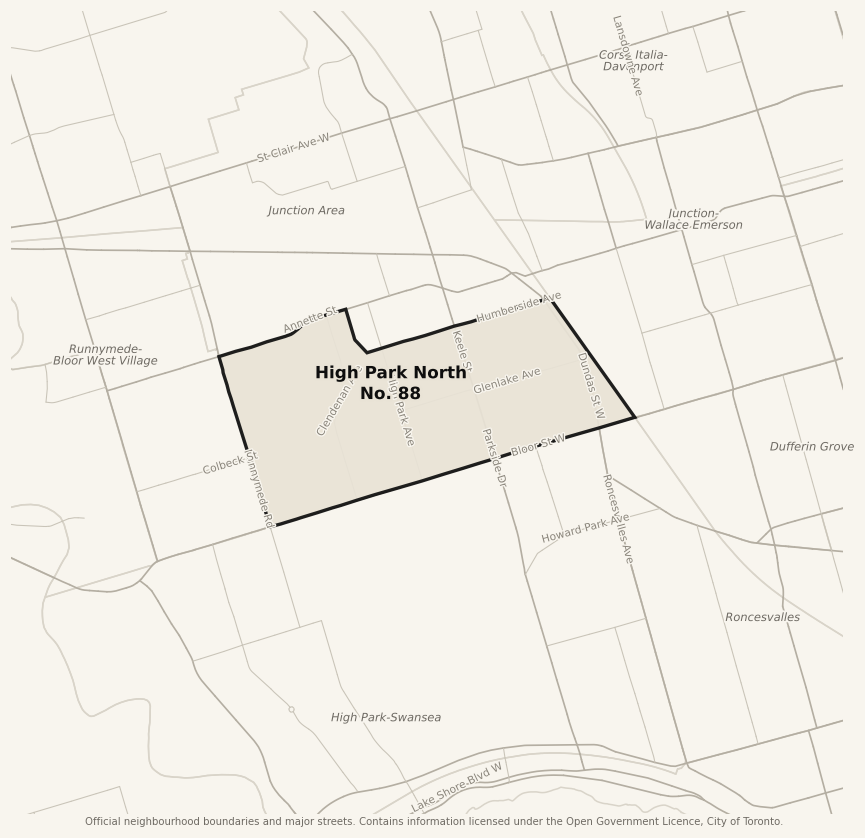
High Park North sits comfortably on Toronto’s west side as one of the city’s most desirable established neighbourhoods. This is where mature families, young professionals, and longtime residents converge in tree-lined streets that have felt stable and neighbourly for over a century. You’ll find Victorian and Edwardian charm, with homes that have character, walkability that actually works, and proximity to one of Toronto’s best parks. The TRREB community of High Park North, in District W02, bounded by Bloor to the south and stretching north to the Dundas corridor, between Keele and Runnymede avenues, has maintained a remarkable sense of community while evolving thoughtfully around it. This is not a trendy spot chasing Instagram credibility, it’s a genuinely livable neighbourhood where people stay for decades.
Official City of Toronto neighbourhood: High Park North (No. 88).
The History
High Park North emerged as a residential neighbourhood in the early 1900s, with the vast majority of housing stock built between 1910 and 1940. The neighbourhood developed as Toronto expanded westward along the streetcar lines, particularly after the opening of the Dundas and Bloor streetcars made commuting to downtown feasible. Many of the original homes were modest detached and semi-detached houses built for working and middle-class families, craftsmen, shopkeepers, and office workers who valued the area’s connection to both employment and green space. High Park itself, established in 1876 when John George Howard donated his estate to the city, became the heart of the community and shaped residential development around it.
The neighbourhood experienced steady growth through the mid-twentieth century as families chose it for its combination of affordability and livability. While other west-side areas like Parkdale declined in the 1970s and 1980s, High Park North maintained its residential integrity, partly because of the park’s enduring appeal and partly because property owners reinvested in their homes. Over the past twenty years, the neighbourhood has seen increasing interest from buyers priced out of Rosedale and Leslieville but seeking established character and walkability. This has driven careful renovations rather than wholesale redevelopment, a pattern that has largely enhanced rather than erased the neighbourhood’s historical character.
What You’ll Actually Find Here
Detached Victorian and Edwardian Homes: These are the neighbourhood’s backbone. Expect brick and stone exteriors, high ceilings, original hardwood floors (often in good condition), and period details like leaded windows, built-in cabinetry, and crown moulding. Many have been thoughtfully updated with modern kitchens and bathrooms while maintaining exterior integrity. Walk along Sorauren Avenue, Indian Road, or Dundas West above the park and you’ll see some of the best examples, substantial, elegant homes with mature trees and deep lots that provide genuine privacy.
Semi-Detached and Row Houses: These offer similar period charm at lower price points. Streets like Ossington north of Bloor, Constance, and Dovercourt contain lovely examples. Semi-detacheds give you character without the full maintenance burden of a detached home, and they’re increasingly popular with young families and first-time buyers upgrading from condos.
Converted Victorian Duplexes: Some original homes have been legally subdivided into two units, particularly on blocks closer to the Dundas corridor. This provides investors and owner-occupiers with rental income, though you need to understand the legal status carefully, conversion quality varies significantly.
Newer Low-Rise Residential: While the majority of the neighbourhood is pre-1945 housing, there are some 1950s-1980s apartment buildings, particularly north of Dundas and near Keele Station. These are generally less desirable than the Victorian stock but offer updated mechanical systems and lower maintenance for those wanting to avoid older home complications.
What Homes Cost in High Park North (W02)
From January 1 to November 2, 2026, here’s what homes sold for in the TRREB community of High Park North, in District W02:
Detached Homes: A median of $1,775,000 (40 sales), depending on size, condition, and exact proximity to High Park. Exceptional homes with large lots or premium locations sell at the top of the market; a solid 3-bedroom fixer-upper sells for less if you’re willing to manage renovation.
Semi-Detached Homes: A median of $1,601,000 (21 sales). These represent exceptional value compared to detacheds and have been gaining buyer interest accordingly: 76% sold over asking.
Row Houses and Converted Units: Freehold townhouses: a median of $1,163,500 (2 sales). Condo townhouses: a median of $1,220,000 (1 sale). Legal duplexes are not reported separately.
Condo Apartments: A median of $762,500 (46 sales).
In TRREB District W02, all home types averaged $1,198,431 over the 12 months to October 2026 (692 sales) and $1,266,814 in October 2026 alone (71 sales) (TRREB Market Watch).
Apartment Rentals: For those not buying, in TRREB District W02 condo apartments leased for an average of $1,748 a month for a bachelor (15 leases), $2,202 for one bedroom (241) and $2,942 for two bedrooms (130) in the second quarter of 2026 (TRREB quarterly rental report), with newer buildings commanding premiums. The neighbourhood has limited rental inventory and high retention rates, many renters stay for years.
What We Love About High Park North
Actual Walkability: This isn’t suburban walkability where you walk to a plaza. Dundas West, between Bloor and the Annex, has thriving independent retail, vintage shops, restaurants, cafes, used bookstores. You can walk to groceries, hardware, coffee, dinner, and browsing without a car on normal days. The neighbourhood feels like a village in the middle of the city.
High Park itself: Having a major 399-acre park as your neighbourhood anchor is genuinely transformative. Hiking trails, gardens, playgrounds, and genuine green space minutes from home. The park hosts art exhibits, outdoor cinema, and community events. In spring, the sakura (Japanese cherry) blossoms draw crowds, yes, it’s touristy, but the visual is stunning.
Keele Station Proximity: While not everyone wants to commute via streetcar or subway, having Keele Station four minutes north means real transit access without being directly above a subway (which means no construction noise or street vibration). The Dundas streetcar is walking distance and actually reliable.
Established Character Without Pretension: Unlike the Annex or Rosedale, this neighbourhood doesn’t feel precious or performative. Homeowners invest because they love their homes and neighbourhood, not because a real estate agent told them it’s aspirational. You’ll find professors, artists, families, young professionals, and long-term residents all getting along in a genuinely mixed community.
Renovation Potential with Permission: Unlike neighbourhoods with strict heritage designations, most of High Park North offers room for thoughtful renovation, adding a deck, finishing a basement, or extending a kitchen, without byzantine approval processes. You’re not frozen in 1920s condition, but you’re also not in a free-for-all development zone.
Schools: Multiple established public and Catholic elementary schools feed into solid high schools, and the neighbourhood is not defined by school selection anxiety. Many families stay long enough that their children actually walk to school on familiar streets.
The Honest Take
Aging Housing Stock Means Surprises: Homes built in the 1910s-1930s often have issues modern builders address as standard: old wiring that needs upgrading, settled foundations that crack plaster, outdated plumbing, and expensive-to-repair slate or clay tile roofs. Home inspections frequently uncover $20K to $50K in deferred maintenance. Budget conservatively and get a detailed inspection by someone who specializes in older homes, not a generalist.
Winters are Brutal in Older Homes: Most Victorian homes were built before meaningful insulation was standard. Attics have 2-3 inches of original mineral wool. Basements are often unfinished and damp. Ground floor rooms stay cold. Yes, modern heating and insulation help, but expect slightly higher utility bills than a new build of the same square footage, and expect cold spots in January.
Property Tax Creep: Assessments in this neighbourhood have risen significantly as prices have climbed. A property assessed at $1.4M five years ago might be assessed at $1.95M now. Your property taxes can increase 10-15% in a reassessment cycle. Plan accordingly if you’re buying at the top of your budget.
Streetcar Reliability: The Dundas streetcar, while convenient, can be unreliable in winter and subject to emergency service changes. If commuting is critical, the streetcar is a backup option, not a primary one. This is better than it was five years ago, but still not downtown-level reliability.
Noise from Dundas: Properties directly on Dundas West experience genuine traffic noise, particularly from large delivery vehicles and streetcars. One block back, it’s largely unnoticeable. But if your home is at street level on Dundas, factor in noise mitigation costs (upgraded windows, acoustic panels) or accept it as part of neighbourhood character.
Who Lives Here
High Park North attracts a genuinely mixed demographic by Toronto standards. Long-term residents (20+ year owners) live alongside younger families buying their first home. You’ll find academics from nearby universities, artists and musicians drawn to Dundas West cultural energy, professionals working downtown who value walkability, and retirees who’ve owned their homes for decades. Many residents have children at local schools. There’s a real sense of community, you see the same people at the park, the coffee shop, and the grocery store. The neighbourhood is approximately 45% families with children, 35% empty nesters and long-term residents, and 20% young professionals and small households. Income is solidly upper-middle-class but not uniformly wealthy, the diversity that comes from housing price points ranging over $1M creates a real economic mix.
What unites residents is a genuine appreciation for established character, walkability, and stable neighbourhoods. People choose High Park North intentionally, often after considering trendier areas. You won’t find many people here by accident or because real estate agents convinced them it was an investment. It’s a neighbourhood for people who actually want to live in the neighbourhood.
Schools
The neighbourhood is served by established public elementary schools including Jesse Ketchum (Dundas and Bathurst), Bloor Street Public (near Bloor and Ossington), and Gladstone (near Dundas and Ossington). Secondary students attend Parkdale Collegiate Institute or Victoria Park Secondary. Catholic school options include Holy Childhood and De La Salle. While these aren’t the most selective Toronto schools by standardized testing, they’re competent, stable institutions with strong community presence. Many families specifically choose the neighbourhood partly for the ability to send children to neighbourhood schools they can walk or bike to, rather than driving across the city.
The neighbourhood has good access to tutoring, extracurricular activity providers, and educational services concentrated on Dundas West and around Keele Station. It’s not a neighbourhood that centers school selection as a primary housing driver, most families are satisfied with their zoned public school options and appreciate the normalization that comes with that.
Getting Around
Without a car, you have solid options. The Dundas streetcar passes through the neighbourhood and connects downtown via King/Queen. The Bloor-Danforth subway is accessible via Keele Station. Combined, you can reach most of Toronto’s downtown and central neighbourhoods within 20-35 minutes. Many residents successfully use transit for commuting, particularly to King West or the Entertainment District. Cycling infrastructure is improving, Dundas has dedicated bike lanes, and the neighbourhood is generally flat and bikeable to downtown or the Annex.
With a car, you’re 8-12 minutes from the Gardiner Expressway (via Dufferin) and 15-20 minutes from the DVP. Parking on the street is available and free but competitive on some blocks, it’s not like suburban street parking where you always find a spot. Garages and driveways exist but aren’t universal in the housing stock. If you work in the inner city and drive occasionally, it’s manageable. If you drive daily, budget for garage rental or driveway access.
Things to Do
High Park itself anchors recreation, trails, sports facilities, community gardens, and programming run year-round. The Cherry Hill area (where the sakura are planted) is pedestrian-friendly for exploring. The neighbourhood boundaries include Dundas West between Bathurst and Keele, one of Toronto’s best independent commercial corridors. Vintage shops, galleries, independent bookstores (Rotate This records, The Ballad Tavern), and restaurants (Bar Hop, Parallel Brothers Pizzeria, Churrasqueira Bairrada) line the street. It’s a different vibe from the Instagram-driven Ossington or King West, less hype, more character, more likely to find something genuinely interesting.
The ROM, Art Gallery of Ontario, and Distillery District are accessible by transit for cultural activities.
Summer brings festivals and community events, the High Park Spring Festival, local street fairs on Dundas and Bathurst, and regular programming at the park. Winter is quieter residentially but the Dundas West arts scene maintains activity, smaller galleries, readings, and performances. This is a neighbourhood where you might actually know your neighbours and shop at places where owners recognize regular customers.
Buying in High Park North: What to Expect
Market Competition: This neighbourhood attracts serious buyers. Properties often have multiple offers within days of listing. You need to be prepared to make a strong offer with minimal conditions or face losing properties to competing buyers. The market is realistic but not a buyer’s market: in 2026, detached homes sold at an average of 103.6% of asking (55% over asking) and semi-detached homes at 115.7% (76% over asking).
Inspection Matters Enormously: Given the age of the housing stock, hire a detailed home inspector experienced with Victorian-era homes. Common issues include foundation settling, outdated knob-and-tube wiring, clay sewer lines that occasionally need replacing, and roofs that are near end of life. Build these costs into your offer calculation. A $1.8M home that needs $80K in urgent roof and wiring work is actually a $1.88M purchase at realistic pricing.
Contingency and Closing: Many serious buyers waive home inspection contingencies to stay competitive, which is risky. We recommend being prepared to close within 2-4 weeks, the faster you can close, the more competitive your offer. Financing must be solid and pre-approved. Subjects like inspection and appraisal slow the sale process and reduce offer attractiveness in this market.
Pricing Trajectory: Historically, High Park North has appreciated steadily, solid and consistent. It’s not a speculation play, it’s a neighbourhood where property value reflects genuine livability and established demand, not investor enthusiasm. Buy for the home and neighbourhood, expect reasonable appreciation.
Ready to Explore High Park North?
Buying in High Park North requires someone who understands the neighbourhood’s genuine character, knows how to navigate its older housing stock, and can work effectively in a competitive market of serious buyers. Michael Ouzas and his team know this neighbourhood intimately, we’ve helped dozens of families and young professionals find homes here, and we understand the specific issues that matter. Whether you’re a first-time buyer exploring your options or a family looking to upgrade into a character home, we’ll help you find the right fit. Contact us to start exploring what High Park North can offer.
Related Neighbourhood Guides
Interested in similar established neighbourhoods? Explore our guides to Trinity Bellwoods, Roncesvalles, Bloor West Village, and The Junction. Or if you’re drawn to the Dundas West arts and culture scene, check out our King West and Queen West guides for hipper, younger-focused neighbourhoods.
High Park North Sold Prices in 2026
Every MLS® sale from January 1 to November 4, 2026. Price per square foot uses above-grade size; the basement is not included.
| Type | Sales | Median price | Per sq ft | Sold over asking |
|---|---|---|---|---|
| Detached houses | 40 | $1,775,000 | $1,046 | 55% |
| Semi-detached houses | 21 | $1,601,000 | $1,011 | 76% |
| Condo apartments | 46 | $762,500 | $952 | 26% |
The same house sells for about 12% more here than across TRREB district W02 as a whole.
See the full pocket-by-pocket numbers on the High Park stats page.
Related reading
- High Park market stats: 2026 sold prices by pocket
- High Park North Schools: Rankings, Catchments, and What Families Need to Know
- Bloor West Village and High Park stats (TRREB W02)
- Toronto West market stats (W01 to W08), updated monthly
- High Park vs Roncesvalles
- High Park: nearby guide
- The Junction: nearby guide
- Baby Point: nearby guide