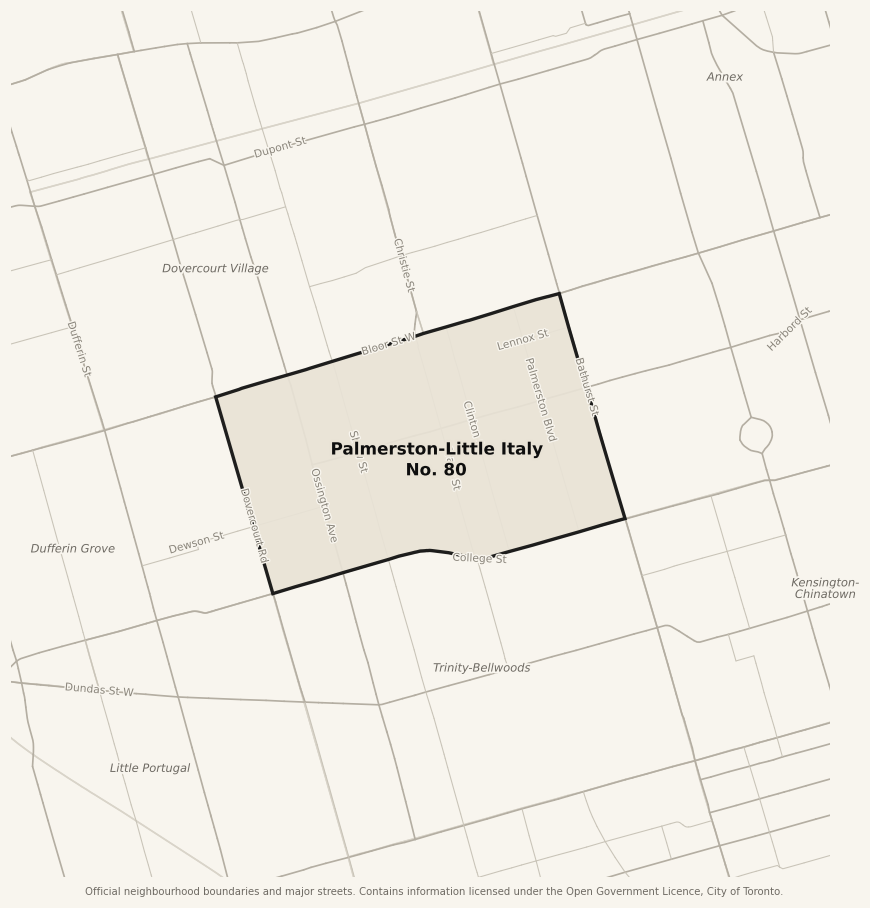
Palmerston-Little Italy is where old-world Toronto meets modern creative energy. Centred on College Street between Bathurst and Ossington, this neighbourhood layers Italian heritage with a contemporary mix of restaurants, bars, and indie shops. The residential streets, particularly along Palmerston Boulevard and Euclid Avenue, feature some of the city’s most striking Victorian homes, many with original details intact. It’s a neighbourhood that feels both established and evolving, with deep roots and a genuine sense of community that hasn’t been erased by gentrification.
Official City of Toronto neighbourhood: Palmerston-Little Italy (No. 80).
The History
Little Italy earned its name from the wave of Italian immigration that transformed College Street in the early 20th century. Italian families settled here in large numbers between the 1920s and 1960s, establishing the cafés, bakeries, and social clubs that defined the strip. College Street became Toronto’s Italian heart, the place where espresso culture existed decades before the rest of the city caught on.
The Palmerston neighbourhood to the north developed as a prestigious residential area in the late 1800s. Palmerston Boulevard was designed as a grand street with a central median, and the homes built here reflected upper-middle-class Victorian ambition. By the mid-20th century, these large homes were often subdivided into apartments, but the architectural bones remained.
Starting in the 1990s, gentrification brought renovation and restoration. Italian businesses gave way to a more diverse restaurant and bar scene, though key Italian institutions remain. Today’s neighbourhood blends Italian heritage with Portuguese, Latin American, and contemporary Canadian culture, a genuinely multicultural corridor with architectural distinction on the residential streets.
What You’ll Actually Find Here
Victorian Semi-Detached and Row Houses: The dominant housing form. Two- and three-storey Victorian semis line the residential streets, many with original gingerbread trim, bay windows, and front porches. Quality varies enormously, some have been meticulously restored, others need significant work. Expect 1,200-2,200 sq ft on lots that are typically 18-25 feet wide. These are the neighbourhood’s most desirable properties and drive most of the market activity.
Palmerston Boulevard Grand Homes: The boulevard itself features larger, more imposing Victorian and Edwardian homes, some approaching 3,000 sq ft. These are among the most architecturally significant residential properties in the west end. They command premium prices and rarely come to market. When they do, expect significant competition.
Low-Rise Apartments and Conversions: Many Victorian homes were converted to multi-unit rentals mid-century. Some remain as rental properties, while others have been reconverted to single-family homes. There are also purpose-built low-rise apartment buildings from the 1950s-1970s scattered throughout. These provide the neighbourhood’s more affordable housing options.
Newer Condos on College: Recent years have brought mid-rise condo developments along College Street, typically 6-10 storeys. These offer modern amenities but lack the character of the residential streets. They’re popular with younger buyers who want the neighbourhood’s walkability without Victorian home maintenance responsibilities.
What Homes Cost in Palmerston-Little Italy (C01)
Victorian Semis (Renovated): From January 8 to November 3, 2026, semi-detached homes in Little Italy (Bathurst Street to Ossington Avenue, from Dundas Street West up to Bloor Street West) sold at a median of $1,442,500 (58 sales), depending on size, renovation quality, and exact location. Well-restored Palmerston Boulevard properties sell at the top of the market. These prices reflect the neighbourhood’s central location and architectural appeal.
Victorian Semis (Original/Needs Work): Unrenovated homes sell for less, but factor in $150K-$400K for proper restoration. The all-in cost often approaches renovated prices, so the value proposition depends on your willingness to manage a renovation project.
Condos on College: Condo apartments in Little Italy sold at a median of $540,000 (15 sales) over the same months. Newer builds command higher prices.
Low-Rise Apartments: Rental-focused, but when condo conversions come to market, older units are the neighbourhood’s entry-level ownership options.
Over the same months, detached homes in Little Italy sold at a median of $1,567,500 (20 sales) and freehold townhouses at $1,457,000 (18 sales).
In TRREB District C01, all home types averaged $808,987 over the 12 months to October 2026 (3,022 sales) and $815,185 in October 2026 alone (272 sales) (TRREB Market Watch).
What We Love About Palmerston-Little Italy
Architectural Character: Palmerston Boulevard is one of Toronto’s most beautiful residential streets. The grand Victorian homes, mature tree canopy, and central boulevard create a streetscape that rivals anything in Rosedale or the Annex. Even on the smaller side streets, the Victorian housing stock has genuine character, this isn’t cookie-cutter suburban development dressed up as urban living.
College Street’s Food and Culture Scene: The restaurant density along College Street is remarkable. Italian trattorias sit alongside Vietnamese pho joints, Mexican taquerias, Ethiopian restaurants, and modern cocktail bars. Bar Raval, Café Diplomatico, and dozens of other establishments create a dining corridor that rewards regular exploration. This isn’t manufactured food-hall culture, it evolved organically over decades.
Walkability and Transit: Nearly everything you need is within walking distance. Groceries, restaurants, parks, schools, transit, all accessible on foot. The 506 College streetcar provides east-west transit, and Bathurst and Christie stations are both within walking distance for subway access. You can genuinely live car-free here.
Central Location Without Downtown Intensity: You’re minutes from the financial district and entertainment district but living on a tree-lined residential street that feels distinctly neighbourhood-scale. The transition from College Street energy to residential quiet happens within one block, a genuinely useful urban quality.
Community Stability: Long-term residents, established businesses, and active neighbourhood associations create genuine community fabric. This isn’t a transient neighbourhood, people buy here and stay. The Italian heritage community, while smaller than it once was, remains a visible and valued presence.
The Honest Take
Renovation Costs Are Real: Many of the Victorian homes that make this neighbourhood appealing also need significant work. Foundation issues, outdated electrical, old plumbing, and insufficient insulation are common in homes that haven’t been recently renovated. A $1.1M “fixer-upper” that needs $300K in work is really a $1.4M commitment. Be realistic about renovation budgets and timelines.
Parking Is Genuinely Difficult: Street parking is competitive and permit-only. Many Victorian homes lack garages or driveways. If you own a car, parking management becomes a daily consideration. This is a neighbourhood that genuinely works better without a car, which is fine if your lifestyle supports that, but challenging if it doesn’t.
College Street Noise: Properties directly on College Street experience significant bar and restaurant noise, especially on weekends. The streetcar adds additional sound. If you’re on a residential street, you’re largely insulated from this, but College-facing units in condos can be loud. Consider this carefully when evaluating specific properties.
Heritage Designation Complexity: Some properties carry heritage designation or are in heritage conservation districts. This protects character but limits renovation options, you may need additional approvals for exterior changes, which adds time and cost to renovation projects. Understand the heritage status of any property before purchasing.
Who Lives Here
Palmerston-Little Italy attracts a diverse demographic. Young professionals and creative workers drawn to the neighbourhood’s walkability and restaurant scene. Established families who bought in the area before prices escalated and have deep community ties. Italian-Canadian families maintaining generational connections to the neighbourhood. Academic professionals connected to the University of Toronto, which is walking distance east.
The neighbourhood has become increasingly popular with dual-income professional couples in their 30s and 40s, people who want urban living with architectural character and don’t need a backyard. There’s also a significant rental population in the apartment buildings and converted homes, which adds demographic diversity.
Schools
Palmerston Public School serves the immediate neighbourhood and is well-regarded within the TDSB system. It’s a genuine community school where families know each other and parent involvement is high. Central Commerce Collegiate Institute provides secondary education nearby. For French immersion, Clinton Street Junior Public School is a popular option in the adjacent neighbourhood.
Private school access is excellent given the central location, Upper Canada College, Bishop Strachan School, and various downtown independent schools are all accessible by transit. The University of Toronto’s St. George campus is within walking distance, which creates an education-oriented atmosphere in the broader area.
Getting Around
This is one of Toronto’s most transit-connected neighbourhoods. The 506 College streetcar runs east-west through the heart of the neighbourhood. Bathurst Station (Bloor-Danforth line) is a 10-minute walk north, and Christie Station is similarly close. The 511 Bathurst streetcar provides north-south connections. Cycling infrastructure is improving, with Harbord Street and Shaw Street providing dedicated bike lanes.
Walking is the primary mode of transportation for most residents. College Street provides nearly everything, groceries, restaurants, cafés, pharmacies, banks, within a few blocks. Bloor Street is a 10-minute walk north with additional retail and the subway line. The Gardiner Expressway is accessible via Bathurst Street for the occasions when driving is necessary.
Things to Do
College Street is the neighbourhood’s main attraction, a continuous strip of restaurants, cafés, bars, and shops that provides daily entertainment and social life. The stretch between Bathurst and Ossington is particularly dense with options. Café Diplomatico remains the iconic patio for people-watching. Bar Raval is nationally recognized for cocktails and architecture. Dozens of smaller restaurants offer everything from traditional Italian to contemporary fusion.
Trinity Bellwoods Park is the neighbourhood’s green anchor, a large urban park with sports facilities, off-leash dog areas, and the city’s most famous social gathering space in summer. Bickford Park provides additional green space to the north. The neighbourhood is also walking distance to Kensington Market and Chinatown, adding more cultural and shopping diversity.
Cultural institutions include the Royal Cinema on College (a beautifully restored art deco theatre), the Italian Cultural Institute, and various galleries along Dundas West. The neighbourhood hosts the annual Taste of Little Italy festival, one of Toronto’s largest street festivals, drawing hundreds of thousands of visitors each June.
Buying in Palmerston-Little Italy: What to Expect
Know What You’re Getting Into With Victorian Homes: The charm is real, but so are the maintenance demands. Before making an offer on any Victorian property, get a thorough inspection by someone experienced with heritage homes. Budget for ongoing maintenance costs that are higher than modern construction. Understand the difference between cosmetic renovation (new kitchen, updated bathrooms) and structural renovation (foundation, electrical, plumbing), the latter is where costs escalate dramatically.
Location Within the Neighbourhood Matters: Properties on Palmerston Boulevard command 15-20% premiums over comparable homes on adjacent streets. Properties closer to College Street are noisier but more walkable to amenities. Properties north of College toward Harbord are quieter and closer to the university area. Each block has a different character, spend time walking the streets before committing to a specific location.
Competition Is Consistent But Not Frenzied: Unlike some Toronto neighbourhoods, Palmerston-Little Italy doesn’t see the same level of bidding war intensity. Properties sell at or slightly above asking price in normal markets. This gives you time to make thoughtful decisions rather than panic-bidding. However, well-renovated properties on premium streets still attract multiple offers.
Consider the Long-Term Neighbourhood Trajectory: Palmerston-Little Italy is mature in its gentrification, this isn’t an emerging neighbourhood where you’re betting on future change. Values are established and appreciation is steady (3-5% annually) rather than explosive. You’re buying for quality of life and architectural character, not speculative upside. That’s actually a strength, mature neighbourhoods tend to hold value well in downturns.
Ready to Explore Palmerston-Little Italy?
Buying in Palmerston-Little Italy means navigating Victorian home complexities, heritage considerations, and a market where local knowledge genuinely matters. Michael Ouzas and his team understand this neighbourhood’s architectural character, heritage requirements, and street-by-street value differences. Whether you’re looking for a grand Palmerston Boulevard home, a renovated Victorian semi, or a modern condo on College Street, we’ll help you find the right property and avoid costly surprises. Contact us to explore Palmerston-Little Italy.
Related Neighbourhood Guides
Exploring similar neighbourhoods with architectural character and walkable streets? Check out our guides to Trinity Bellwoods (adjacent neighbourhood with similar Victorian character), Queen West (arts-oriented, similar housing stock), King West (more modern, similar walkability), Roncesvalles (family-friendly with village character), and Parkdale (emerging with great value). For established midtown alternatives, explore The Annex or Bloor West Village.
Palmerston-Little Italy Sold Prices in 2026
Every MLS® sale from January 8 to November 3, 2026. Palmerston-Little Italy here means Bathurst Street to Ossington Avenue, from Dundas Street West up to Bloor Street West. Price per square foot uses above-grade size; the basement is not included.
| Type | Sales | Median price | Per sq ft | Sold over asking |
|---|---|---|---|---|
| Detached houses | 20 | $1,567,500 | $826 | 20% |
| Semi-detached houses | 58 | $1,442,500 | $882 | 45% |
| Townhouses | 18 | $1,457,000 | $904 | 33% |
| Condo apartments | 15 | $540,000 | $774 | 33% |
| Condo townhouses | 2 | $1,587,500 | $1,106 | 0% |
The same house sells for about 13% more east of Montrose than west of Montrose.
See the full pocket-by-pocket numbers on the Little Italy stats page.