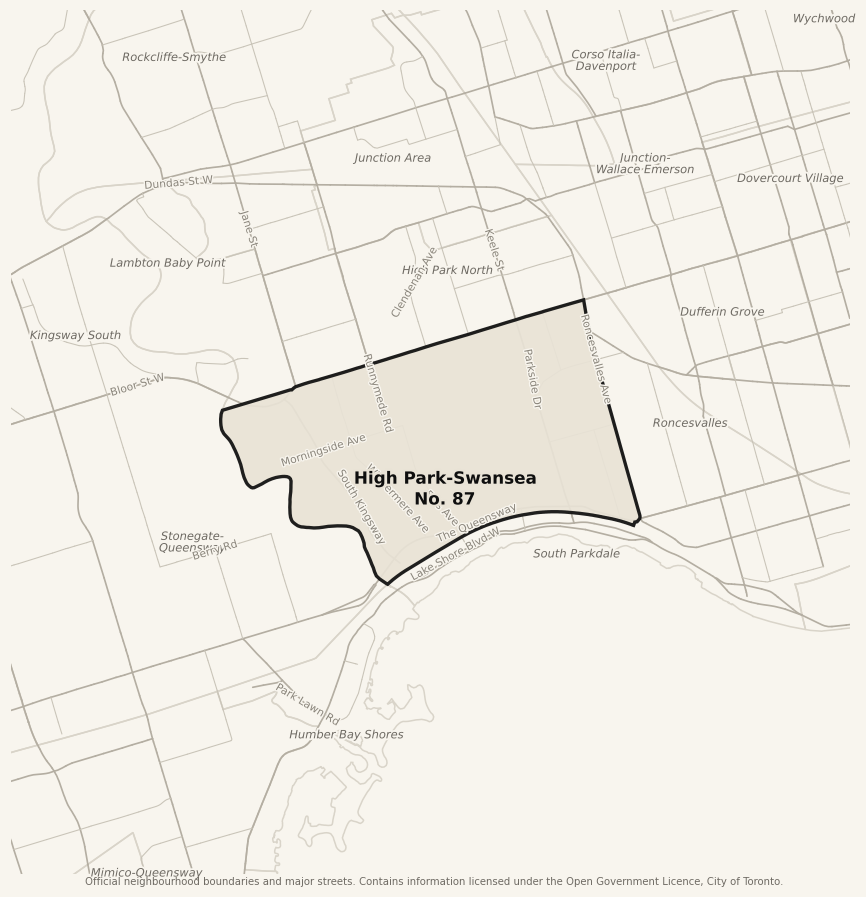
High Park-Swansea is the broader community encompassing two of Toronto’s most beloved west-end neighbourhoods, High Park and Swansea, plus the parkland that connects them. Bounded by Bloor Street to the north, the Humber River to the west, Lake Ontario to the south, and Roncesvalles Avenue to the east, this is a community defined by green space, family-oriented living, and access to nature that’s rare for an urban area. If you want to live near Toronto’s best park while still being minutes from downtown, High Park-Swansea is where you look.
Official City of Toronto neighbourhood: High Park-Swansea (No. 87).
The History
The area’s history is inseparable from High Park itself. John George Howard donated his 165-acre estate to the City of Toronto in 1876, creating one of North America’s largest urban parks. The surrounding residential areas developed in the late 1800s and early 1900s, attracting families who wanted proximity to the park’s recreational opportunities and the lakefront.
Swansea was actually an independent village until 1967, when it was amalgamated into the City of Toronto, the last municipality absorbed before the mega-city merger of 1998. This independent history gives Swansea a distinct village identity that persists today, with its own community centre, town hall (now the Swansea Town Hall community space), and strong neighbourhood association.
The area has remained predominantly residential throughout its history, evolving from a mix of working-class and middle-class families to the affluent, family-oriented demographic that characterizes it today. Unlike many Toronto neighbourhoods, High Park-Swansea’s transformation has been gradual rather than sudden, there’s been no dramatic gentrification event, just steady appreciation driven by the park, the lake, and consistently high livability.
What You’ll Actually Find Here
Edwardian and Victorian Detached Homes: The neighbourhood’s signature housing, particularly on streets like Indian Road, Wendigo Way, and the streets immediately surrounding High Park. These are substantial homes, 2,000-3,500 sq ft on generous lots by Toronto standards (25-50 feet wide). Many feature original architectural details, mature gardens, and front porches with park views. These represent the premium tier of the market.
Tudor and Arts & Crafts Homes: Swansea in particular features distinctive Tudor-revival and Arts & Crafts-style homes from the 1920s-1940s. These are architecturally distinctive, half-timbering, steep gables, stone accents, and varied rooflines create streetscapes with genuine character. Sizes range from 1,500-2,800 sq ft. These homes attract buyers specifically looking for architectural distinction.
Bungalows and Smaller Homes: Scattered throughout, particularly in the southern portions of Swansea. These are the area’s more affordable freehold options, 1,000-1,500 sq ft on smaller lots. Many have renovation potential, though lot coverage restrictions limit expansion options. These attract young families entering the neighbourhood.
Condos and Apartments: Several mid-rise and high-rise developments along Bloor Street West and near the lakefront. The Humber Bay Shores area to the west has seen significant condo development. These range from studio units to three-bedroom family-sized condos and provide the area’s most affordable ownership entry points.
What Homes Cost in High Park-Swansea (W01)
From January 2 to October 30, 2026, here’s what homes sold for in the TRREB community of High Park-Swansea, in District W01:
Detached Homes: A median of $1,920,000 (83 sales). Larger homes on desirable streets near the park, with direct park views or on Indian Road, sell at the top of the market. These prices reflect the combination of park proximity, lot size, architectural quality, and neighbourhood prestige.
Semi-Detached and Townhomes: Semi-detached homes sold at a median of $1,245,000 (11 sales) and condo townhouses at $782,500 (14 sales); 2 freehold townhouses also sold. Prices depend on size, condition, and proximity to the park and transit. These are competitive options for families who want the neighbourhood’s amenities without the premium detached home price.
Condos: Condo apartments sold at a median of $620,000 (90 sales). Newer developments near the lake command higher prices. Maintenance fees vary significantly between older buildings and newer developments with extensive amenities; the median fee on the condo apartments that sold was $944 a month.
In TRREB District W01, all home types averaged $1,207,607 over the 12 months to October 2026 (457 sales) and $1,269,569 in October 2026 alone (51 sales) (TRREB Market Watch).
What We Love About High Park-Swansea
High Park Itself: This is Toronto’s best park, 399 acres of trails, gardens, sports facilities, a zoo, playgrounds, swimming pool, and genuine wilderness areas. Living next to High Park means daily access to nature that most urban residents only experience on weekend trips. The cherry blossoms in spring, swimming at the outdoor pool in summer, the fall colours, cross-country skiing in winter, the park provides year-round quality of life enhancement that’s genuinely irreplaceable.
Lakefront Access: The southern portions of the community provide direct access to the waterfront trail and Lake Ontario. Sunnyside Pavilion, the Sunnyside Bathing Pool, and the western beaches offer recreational options that complement the park. The combination of lake and park access in one community is unique in Toronto.
Family Infrastructure: This is one of Toronto’s best neighbourhoods for families. Excellent public schools, safe streets, abundant parks and playgrounds, community centres with children’s programming, and a demographic that’s predominantly families with children. The community is genuinely designed around family life in a way that many urban neighbourhoods aren’t.
Village Character with Urban Access: Despite being part of Toronto, High Park-Swansea maintains a village feel. Local shops along Bloor Street West, the Swansea community centre, neighbourhood events and festivals, these create community cohesion. Yet you’re 20 minutes from downtown by subway, making this a neighbourhood where you can have both suburban quality of life and urban career access.
The Honest Take
Premium Pricing for Park Proximity: You pay significantly more to live near High Park than in comparable neighbourhoods without a major park. The question is whether daily park access justifies the premium, for many families, it absolutely does, but be honest about whether you’ll actually use the park enough to justify the cost difference.
Transit Limitations South of Bloor: While the Bloor-Danforth subway provides excellent east-west transit, the southern portions of Swansea are less well-served. Getting to the subway from south Swansea requires a bus ride or a 15-20 minute walk. If transit dependence is important, focus your search on properties closer to Bloor Street.
Older Housing Stock Maintenance: Many homes in the area are 80-100+ years old. Beautiful architecture comes with ongoing maintenance demands, aging systems, foundation issues, outdated insulation, heritage preservation requirements. Budget for higher maintenance costs than newer construction and get thorough inspections before purchasing.
Limited Nightlife and Dining: This is a family neighbourhood, and the amenities reflect that. If you want vibrant restaurant and bar scenes, you’ll need to head to Roncesvalles, the Junction, or downtown. Bloor Street West has some dining options, but this isn’t a foodie destination. The trade-off for quiet family living is that evening entertainment options are limited.
Who Lives Here
High Park-Swansea is dominated by established families. Professional couples with children who prioritize park access, school quality, and safe streets. Many residents are in their 30s-50s with school-age children. There’s also a significant population of retirees who bought decades ago and have deep community roots. The area attracts nature-oriented people, dog walkers, runners, cyclists, gardeners, who want daily access to green space as part of their lifestyle.
The neighbourhood is less diverse than many Toronto areas, both economically and demographically. Housing prices have created a fairly affluent, professional demographic. This is changing somewhat with condo development bringing younger buyers and more varied income levels, but the freehold housing stock remains firmly upper-middle-class territory.
Schools
School quality is a major draw for families. Swansea Junior and Senior Public School, High Park Alternative Junior School, and Humberside Collegiate Institute all have strong reputations within the TDSB system. The neighbourhood also has access to French immersion programs and specialized arts programs. The concentration of families means schools are well-funded through parent council activities and have active community engagement.
Private school access is reasonable, Royal St. George’s College, Bishop Strachan School, and various independent schools are accessible by transit from the Bloor-Danforth line. The neighbourhood’s family focus means education resources and support networks are readily available.
Getting Around
The Bloor-Danforth subway line runs along the northern boundary, with High Park, Keele, and Dundas West stations providing excellent rapid transit access. The 501 Queen streetcar serves the southern portions of the community. Multiple bus routes connect the residential streets to the subway. Cycling is excellent, the park provides car-free cycling routes, and the waterfront trail connects to the broader cycling network.
Driving access is good, the Gardiner Expressway is accessible via Lakeshore Boulevard, and the neighbourhood’s western location means relatively quick highway access for suburban commutes. Parking is generally easier than in denser downtown neighbourhoods, with most homes having driveways or garages.
Things to Do
High Park dominates the recreational landscape, hiking trails, the Jamie Bell Adventure Playground, Colborne Lodge (a historic house museum), the free zoo, sports fields, tennis courts, and the Grenadier Pond for fishing and skating. The High Park Amphitheatre hosts Canadian Stage’s Dream in High Park summer theatre productions. The outdoor pool is a summer institution.
Beyond the park, Bloor Street West offers neighbourhood shopping and dining. The Roncesvalles strip is walking distance east with its restaurants, cafés, and independent shops. The Junction is accessible to the north. Sunnyside Pavilion on the waterfront hosts events and provides a gathering space. The Budapest Park community area offers additional recreation options.
For families, the community centres offer extensive programming, swimming lessons, sports leagues, arts classes, and seasonal events. The neighbourhood’s family focus means children’s activities and family-friendly events are well-organized and well-attended throughout the year.
Buying in High Park-Swansea: What to Expect
Park Proximity Commands Clear Premiums: Properties with park views or within a 5-minute walk of High Park sell for more than comparable homes further away. If park access is your primary motivation, pay the premium for genuine proximity rather than settling for a home that requires a 15-minute walk to reach the park entrance.
Assess the Home’s Relationship to the Park: Not all “High Park area” homes have equal park access. Some streets connect directly to park entrances, while others require walking through residential areas to reach the park. Visit properties on foot and walk to the park to understand the actual experience of living there.
School Catchment Matters: Many families buy in High Park-Swansea specifically for school access. Verify current school catchment boundaries before purchasing, they can change, and a home one block outside a desirable school’s catchment loses a significant part of its appeal for family buyers.
Understand Swansea vs. High Park Differences: The two sub-neighbourhoods have different characters. High Park (north of the park, near Bloor) is more urban, with better transit and closer to commercial amenities. Swansea (south, near the lake) is quieter and more village-like, with better lake access but weaker transit. Choose based on your lifestyle priorities, the price difference between them is less important than the lifestyle fit.
Ready to Explore High Park-Swansea?
Buying in High Park-Swansea means understanding the relationship between park proximity, housing age, and long-term value. Michael Ouzas and his team are deeply familiar with this community, we know which streets offer best park access, which homes have been properly maintained versus cosmetically updated, and how to position you strategically in this competitive family market. Whether you’re looking for a character home near the park, a Swansea village cottage, or a modern condo with lake views, we’ll help you find the right property in one of Toronto’s most livable communities. Contact us to explore High Park-Swansea.
Related Neighbourhood Guides
Exploring similar park-adjacent, family-oriented neighbourhoods? Check out our guides to High Park (the neighbourhood immediately surrounding the park), Swansea (the village community south of the park), Roncesvalles (adjacent family-friendly neighbourhood with village character), Bloor West Village (similar family focus, excellent shopping strip), and The Junction (more urban character, growing food scene). For quieter suburban alternatives, explore Baby Point, Sunnylea, or Lambton.
High Park-Swansea Sold Prices in 2026
Every MLS® sale from January 2 to October 30, 2026. Price per square foot uses above-grade size; the basement is not included.
| Type | Sales | Median price | Per sq ft | Sold over asking |
|---|---|---|---|---|
| Detached houses | 84 | $1,922,500 | $1,089 | 50% |
| Semi-detached houses | 11 | $1,245,000 | $864 | 45% |
| Condo apartments | 92 | $620,000 | $727 | 8% |
See the full pocket-by-pocket numbers on the High Park stats page.
Related reading
- Swansea market stats: 2026 sold prices street by street
- High Park market stats: 2026 sold prices by pocket
- High Park-Swansea Schools: Rankings, Catchments, and What Families Need to Know
- Toronto West market stats (W01 to W08), updated monthly
- High Park vs Roncesvalles
- Roncesvalles: nearby guide
- Swansea: nearby guide
- Parkdale: nearby guide