SUNNYLEA is one of Toronto’s most underrated family neighbourhoods. Located in south Etobicoke and bounded roughly by Bloor Street to the north, The Kingsway to the west, Mimico Creek to the east, and the Queensway to the south, this pocket offers something increasingly rare in Greater Toronto: genuine suburban peace combined with real city access. The neighbourhood’s post-war character, tree-lined streets, and strong schools have made it a perennial favourite among families seeking space and stability without sacrificing transit connectivity. If you’re looking for a place where you can actually have a yard, know your neighbours, and be downtown in 25 minutes, Sunnylea deserves serious consideration.
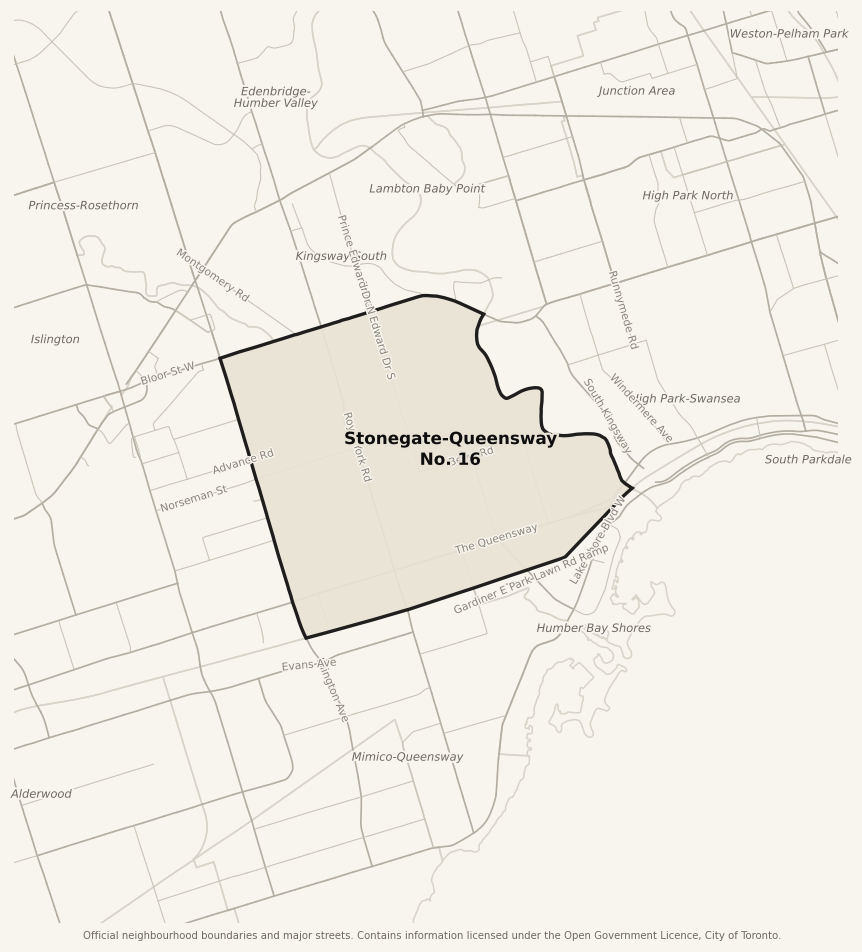
Official City of Toronto neighbourhood: Stonegate-Queensway (No. 16).
The History
SUNNYLEA’s origins are thoroughly post-war. Developed primarily between the 1940s and 1960s, the neighbourhood emerged as part of the suburban boom that followed World War II, when returning servicemen and growing families sought affordable housing beyond Toronto’s urban core. The neighbourhood’s name reflects its character, the sunny, open disposition that defined early suburban planning, with generous lot sizes and wide streets designed for a slower pace of life. What started as modest, practical housing stock became something of a blueprint for Canadian suburban family life.
The initial wave of development favoured simple, efficient designs: bungalows and split-level homes that maximized livability on modest budgets. Land was plentiful, labour was cheaper, and the philosophy was straightforward: build solid homes on generous lots for young families. By the 1970s and 1980s, Sunnylea had solidified its identity as a stable, established community. The arrival of the Bloor-Danforth subway line (Line 2) in 1966, with the Royal York Station serving the neighbourhood, further anchored Sunnylea as a transit-accessible destination rather than a car-dependent suburb.
More recently, Sunnylea has experienced gradual but significant evolution. Starting in the 1990s and accelerating through the 2010s, tear-downs and substantial renovations have become increasingly common. Developers and individual builders recognize the value of the land and lot sizes, leading to the construction of larger, more contemporary homes that command premium prices. This has created an interesting architectural heterogeneity, meticulously maintained vintage post-war homes sit alongside newly built 3,000+ square-foot custom residences, often across the same street.
What You’ll Actually Find Here
Post-War Bungalows and Split-Levels: These remain the backbone of Sunnylea’s housing stock. Charming, solidly built homes from the 1940s-1960s, typically featuring 2-4 bedrooms, character details like hardwood floors and brick exteriors, and modest square footage (1,000-1,600 square feet) compensated by exceptional lot sizes, often 35-40 feet wide by 100+ feet deep. Many have been thoughtfully updated with new kitchens, bathrooms, and mechanical systems. These homes appeal to buyers seeking authenticity, value, and space, though they require diligent inspection for age-related issues like foundation settling, knob-and-tube wiring, or asbestos.
Tear-Down Replacements and New Custom Builds: Over the past two decades, perhaps 15-20% of the original housing stock has been demolished and replaced with new construction. These are substantial homes, often 3,000-4,500 square feet of finished space, taking full advantage of generous Sunnylea lots. They typically feature open-concept main floors, large master suites, and finished basements with potential for rental or multi-generational living. Pricing reflects this. The aesthetic is contemporary, but many builders respect the neighbourhood’s character by keeping setbacks and proportions consistent with existing homes.
Semi-Detached and Townhouses: Less common than detached homes, but present along certain streets, particularly closer to Bloor. These properties offer moderate pricing advantages and are attractive to downsizers or first-time buyers seeking Sunnylea location with lower maintenance burden. Quality varies; some are original 1950s constructions, others are newer infill projects.
The Market Reality: From January 11 to October 30, 2026, 24 detached homes sold in Sunnylea (between Royal York Road and Prince Edward Drive, from Berry Road up to Bloor Street West), at a median of $2,153,600. Sunnylea has two distinct submarkets: vintage post-war homes, and tear-down sites and new custom builds. There’s also a small rental market (mostly second units and basement apartments in existing homes), though owner-occupation dominates.
What Homes Cost in Sunnylea (W07)
Post-War Vintage Homes in Good Condition: These are the workhorse homes of Sunnylea, 2-4 bedroom bungalows and split-levels with character, original or updated mechanical systems, and solid bones. These homes offer the best value proposition in the neighbourhood.
Recently Renovated or Substantially Updated Homes: Add a modern kitchen, new bathrooms, finished basement, and perhaps an addition or deck upgrade, and prices climb significantly. Buyers are paying for contemporary comfort without losing the neighbourhood’s character or lot size advantage.
Tear-Down Sites and New Custom Builds: A 35 x 120-foot lot in Sunnylea commands premium pricing because builders and high-net-worth buyers recognize the development potential. A few premium addresses near Sunnylea Park or with exceptional lot dimensions sell at the top of the market.
Semi-Detached and Townhouses: No semi-detached sales were recorded in Sunnylea from January 11 to October 30, 2026.
In TRREB District W07, all home types averaged $1,403,960 over the 12 months to October 2026 (222 sales) and $1,183,000 in October 2026 alone (25 sales) (TRREB Market Watch).
Market Dynamics: Sunnylea has proven resilient through multiple market cycles. The neighbourhood’s combination of schools, transit, lot sizes, and proximity to The Kingsway shopping and Bloor West Village creates steady demand. In 2026, 42% of its detached homes sold over asking. Seller’s markets favour vendors here.
What We Love About Sunnylea
Genuinely Spacious Lots: In an era when suburban lots shrink and urban intensification accelerates, Sunnylea offers rare space. Most homes sit on 35-40-foot-wide lots with depths of 100-120 feet, enough for mature trees, proper backyards, potential for pools or gardens, and genuine privacy. For families with children, dogs, or outdoor hobbies, this is transformative compared to downtown condo living or cramped suburban developments.
Excellent Schools: Sunnylea Junior School is one of Etobicoke’s most respected public elementary schools, consistently ranking among Toronto’s top performers. The school’s principal and teaching staff maintain high standards, the building is well-maintained, and there’s a genuine sense of community engagement. Secondary students feed to Etobicoke Collegiate Institute, a strong public high school. For families prioritizing education, these institutions justify neighbourhood choice.
Real Subway Access with Suburban Peace: Royal York Station sits just blocks away (Royal York Road and Bloor), providing reliable Line 2 access directly to downtown. You can be at St. George Station in 25 minutes, making Sunnylea genuinely accessible for commuters without sacrificing the quiet, car-oriented suburban feel most residents value. This combination, true transit access combined with suburban character, is increasingly rare in Toronto.
Walkable to Bloor West Village: Sunnylea’s northern boundary hugs Bloor Street, where the Bloor West Village commercial strip offers excellent dining, shopping, and services. The Kingsway to the west provides additional shopping (Loblaws, pharmacies, banks). You’re never in a situation where you must drive for groceries or everyday needs, yet you’re nowhere near the density or congestion of prime urban neighbourhoods.
Family-Friendly Amenities: Sunnylea Park (immediately east of Royal York Road) features playgrounds, sports fields, and trails along Mimico Creek. The creek itself is a natural asset, with trails connecting south toward the waterfront and north toward High Park. For families with young children or anyone seeking nature access, these green spaces are invaluable. The park hosts community events, and there’s a genuine sense of shared neighbourhood space.
Stable, Established Community: Sunnylea doesn’t flip, people move here and stay. This creates a real sense of community, active local associations, and genuinely maintained properties. You’re unlikely to encounter problematic landlords, short-term rentals creating chaos, or the transience that characterizes more speculative neighbourhoods. This stability appeals deeply to families seeking roots.
The Honest Take
Limited Commercial Vibrancy: While proximity to Bloor West Village and The Kingsway is genuine, Sunnylea itself has minimal commercial character. There’s no main street, no distinctive local restaurant scene, no gathering places beyond the park. For people who value walkable neighbourhood restaurants and shops, you’re relying on adjacent areas rather than neighbourhood-specific destinations. On Friday and Saturday nights, Sunnylea feels quiet, which some love and others find limiting.
Aging Housing Stock Requires Due Diligence: Most original homes are 60-75 years old. While many have been mechanically updated, issues like foundation settling, roof condition, plumbing upgrades, and hidden asbestos are common. Inspection costs ($600-$1,000) often uncover needed repairs ($10,000-$50,000+). Unlike newer subdivisions with warranties, vintage homes require experienced inspection and realistic expectations about ongoing maintenance. Budget accordingly.
Car Dependency Remains Real Despite Transit: Royal York Station is convenient, but many Sunnylea residents don’t commute daily or work downtown. For local errands, shopping, schools, parks, most families rely on cars. Public transit within Etobicoke is less convenient than within the City of Toronto proper, and bus service on Royal York Road and Dundas (the main north-south routes) is adequate but not frequent. If you don’t own a car, Sunnylea is less convenient than central urban neighbourhoods.
Weather and Flooding Considerations: Mimico Creek, while a natural asset and recreational opportunity, poses flooding risk during heavy rainfall. Several homes in Sunnylea sit in or near flood-prone areas. Basements can be vulnerable; basement flooding insurance is common. Before purchasing, particularly for homes near creek, investigate flood history, insurance costs, and whether home has undergone flood mitigation (weeping tiles, sump pumps, backflow preventers). This is genuinely important due diligence, not paranoia.
Limited Neighbourhood Evolution Means Limited Character: Sunnylea is deliberately static, that’s part of its appeal. But this also means minimal neighbourhood-level evolution, new development, trendy openings, or cultural dynamism. You’re choosing suburban stability and family focus over urban vitality. If you crave walkable neighbourhoods with active nightlife, independent restaurants, galleries, and cultural institutions, Sunnylea is likely too quiet.
Who Lives Here
Sunnylea skews heavily toward established families. Primary demographics are middle-to-upper-middle-class households with school-aged children, often with dual professional incomes. Many residents have lived in Sunnylea for 10+ years and show no inclination to move. There’s a meaningful cohort of empty nesters who’ve chosen to age in place rather than downsize, appreciating the space, community stability, and independence from condo living. Increasingly, younger professional couples and young families are discovering Sunnylea as an alternative to either cramped downtown condos or sprawling far suburbs, they’re attracted by schools, value, and authentic subway access.
The neighbourhood is diverse by Toronto standards, with significant Italian, Portuguese, Polish, and South Asian communities. This manifests subtly, restaurants, groceries, and community institutions reflect these populations, though Sunnylea isn’t known for ethnically concentrated commercial strips the way some neighbourhoods are. Residents are predominantly homeowners (70%+), creating investment in neighbourhood maintenance and stability. Rental population is smaller (mostly basement apartments and secondary suites) and typically consists of young professionals or recent immigrants seeking affordable housing near transit.
Sunnylea residents tend to be unpretentious and pragmatic. You’ll encounter many families who chose Sunnylea specifically because it offers excellent schools and space at reasonable prices compared to downtown or prestige suburbs like Rosedale or Forest Hill. There’s relatively little “scene” or social hierarchy; people are focused on family, work, and practical neighbourhood maintenance rather than competitive consumption or status signalling.
Schools
Education is Sunnylea’s primary institutional strength. Sunnylea Junior School (grades JK-6) sits immediately south of Bloor on Royal York Road and has built a reputation as one of Etobicoke’s flagship elementary schools. The principal maintains high academic standards, staff engagement is visible, and student outcomes consistently rank in Toronto’s top quartile. The school has active parent involvement, community events throughout the year, and a cohesive culture around excellence and respect. For families with young children, Sunnylea Junior School is a primary draw to the neighbourhood; waiting lists for school catchment aren’t uncommon. The building itself is well-maintained and offers strong facilities.
Secondary students feed to Etobicoke Collegiate Institute (Dundas Street West and Royal York Road, just south of the neighbourhood), a solid public high school with a range of academic and enrichment programs. ECI offers advanced placement courses, arts programming, and strong sports teams. Like most Toronto public high schools, it faces typical challenges (aging facilities, large class sizes), but maintains academic credibility and appropriate discipline standards. Many Sunnylea families remain satisfied with the public system through secondary education; private school exodus is less common than in some Toronto neighbourhoods.
The combination of an excellent elementary school directly in the neighbourhood and a credible secondary institution nearby makes Sunnylea genuinely attractive to education-focused families. Early childhood centres and licensed daycares are available, though quality varies; given Ontario’s ongoing childcare accessibility challenges, this isn’t necessarily a Sunnylea-specific advantage.
Getting Around
Royal York Station (Bloor and Royal York Road) provides Line 2 Bloor-Danforth access, making downtown commutes viable and predictable. Most working Sunnylea residents report 25-35 minute commutes to downtown during off-peak hours; rush hour adds 10-15 minutes. The station is straightforward, no frills, but reliable. Bike lanes exist on Royal York Road heading north toward Bloor, and some cycle commuting occurs, though winter conditions and traffic volume limit this to committed cyclists.
Bus service is adequate. Routes 110 (Dundas), 105 (Dundas), and several local feeders serve the neighbourhood, but frequency is moderate (10-15 minute intervals at peak, 15-20 minutes off-peak) compared to inner-city routes. Within Etobicoke, bus travel is functional but slower than within Toronto proper. Most residents own cars and rely on them for local trips, shopping, and school runs despite transit availability. Parking is not a constraint, most homes have driveways and detached garages, or street parking is readily available.
The Gardiner Expressway is 10-15 minutes south (via Dundas or Park Lawn), and the Queensway provides east-west access. For residents commuting to other employment centres (York University, Mississauga, Airport), driving is typically more practical than transit. Traffic patterns are reasonable outside rush hours; commuting west toward Mississauga or north toward downtown follows predictable patterns. Active transportation infrastructure is improving (bike lanes on major streets) but isn’t a primary feature compared to downtown neighbourhoods.
Things to Do
Within Sunnylea proper, recreational activities centre on Sunnylea Park and Mimico Creek trails. The park includes playgrounds for multiple age groups, sports fields (soccer, baseball), and open green space ideal for informal recreation. The creek itself offers naturalized trails running north-south, connecting to larger trail systems and providing walking/running routes without road crossing. In winter, sledding on park hills is a neighbourhood institution; in summer, the park hosts community events, picnics, and informal social gatherings. This is legitimate neighbourhood character, not polished programming.
Bloor West Village (immediately north) offers substantially more commercial recreation: independent restaurants (diverse cuisines), cafes, shopping, and galleries concentrated along Bloor from Royal York Road west toward High Park. Bloor West has genuine character and walkability; many Sunnylea residents cross into Bloor West for dining, weekend activities, and shopping despite its marginal geographic location. The Kingsway (west of Royal York) provides shopping and services more functional than appealing, big-box retailers, grocery stores, banks, pharmacies.
High Park (1 km north of Bloor) is substantially larger and more developed, with extensive trail systems, sports facilities, and cultural programming. For families seeking parks beyond Sunnylea-specific amenities, High Park is a 10-minute drive and frequently accessed. The Toronto waterfront (Mimico Waterfront Park, Queensway area) is 10-15 minutes south, providing beach access and larger recreation options. Sunnylea itself doesn’t generate entertainment or culture independently; appeal is the base location from which residents access broader Toronto and Etobicoke amenities.
Buying in Sunnylea: What to Expect
Establish Your Priorities Early: Decide whether you’re seeking a vintage home (character, space, value) or newer construction (modern finishes, reduced maintenance risk). This shapes your search and price expectations fundamentally. Vintage homes require inspection expertise and realistic renovation budgets; newer builds cost more but eliminate surprise structural issues.
Inspect Thoroughly: Given housing stock age, hire a detailed, experienced home inspector familiar with 1950s-era construction. Specifically ask about foundation integrity, roof condition and age, plumbing materials (knob-and-tube still exists), electrical panel adequacy, asbestos presence, and basement water history. Flood history is critical, ask neighbours and review city records. Don’t skip this; Sunnylea homes frequently reveal $15,000-$40,000 in needed work upon detailed inspection.
Budget for Updates: Even well-maintained vintage homes typically need kitchen and bathroom updates within 5-10 years post-purchase. If cosmetic updates have been deferred, factor $30,000-$60,000 for kitchen alone, $15,000-$25,000 per bathroom. Plan conservatively; recent renovations often hide underlying age-related issues that emerge later.
Understand Lot Value: Much of Sunnylea’s price reflects lot size and development potential. If you’re buying vintage, don’t overpay based on theoretical tear-down value, that’s a speculative bet. If you’re actually planning to tear down and rebuild, hire a contractor to validate construction costs; many buyers underestimate build expenses and end up with marginal returns on the overall project.
Consider Schools and Proximity: If children are in your future, proximity to Sunnylea Junior School adds measurable value. Homes within the school’s designated catchment area command modest premiums. Similarly, proximity to Royal York Station (within 10-minute walk) is valuable for commuters. Factor these into your valuation.
Assess Timing and Market Position: Sunnylea typically shows strength in spring/early summer and relative quiet in winter. If you’re selling, spring is optimal. The neighbourhood has shown appreciation (5-7% annually over the past decade in normal conditions), but it’s not speculative, it’s steady, which is both advantage and limitation depending on investment perspective.
Discover Sunnylea with MORE Realty
If you’re serious about exploring Sunnylea, whether you’re seeking a family home with schools and space, a real estate investment opportunity, or simply understanding what’s available in this underrated pocket, the MORE Realty team knows Sunnylea intimately. We’ve represented dozens of buyers and sellers here, understand the neighbourhood’s nuances, school catchments, transit accessibility, flood risks, and the genuine value proposition versus overpriced adjacent areas. We can guide you toward homes with authentic potential and away from traps. Message us to discuss Sunnylea specifics, book a private showing, or understand current market conditions in W02.
Related Neighbourhood Guides: Bloor West Village | The Kingsway | Mimico | Long Branch | New Toronto
Sunnylea Sold Prices in 2026
Every MLS® sale from January 11 to November 3, 2026. Price per square foot uses above-grade size; the basement is not included.
| Type | Sales | Median price | Per sq ft | Sold over asking |
|---|---|---|---|---|
| Detached houses | 24 | $2,153,600 | $1,201 | 42% |
| Condo apartments | 1 | $450,000 | $614 | 0% |
In the Sunnylea pocket (between Royal York Road and Prince Edward Drive, from Berry Road up to Bloor Street West), the same house sells for about 27% more than in the rest of W07.
See the full pocket-by-pocket numbers on the Stonegate-Queensway stats page.