New Toronto is the historically working-class lakefront neighbourhood between Mimico and Long Branch: post-war housing, lake access, and a Lakeshore commercial corridor. From January 1 to November 2, 2026, detached homes in the TRREB community of New Toronto sold at a median of $1,144,500 (48 sales).
Official City of Toronto neighbourhood: New Toronto (No. 18).
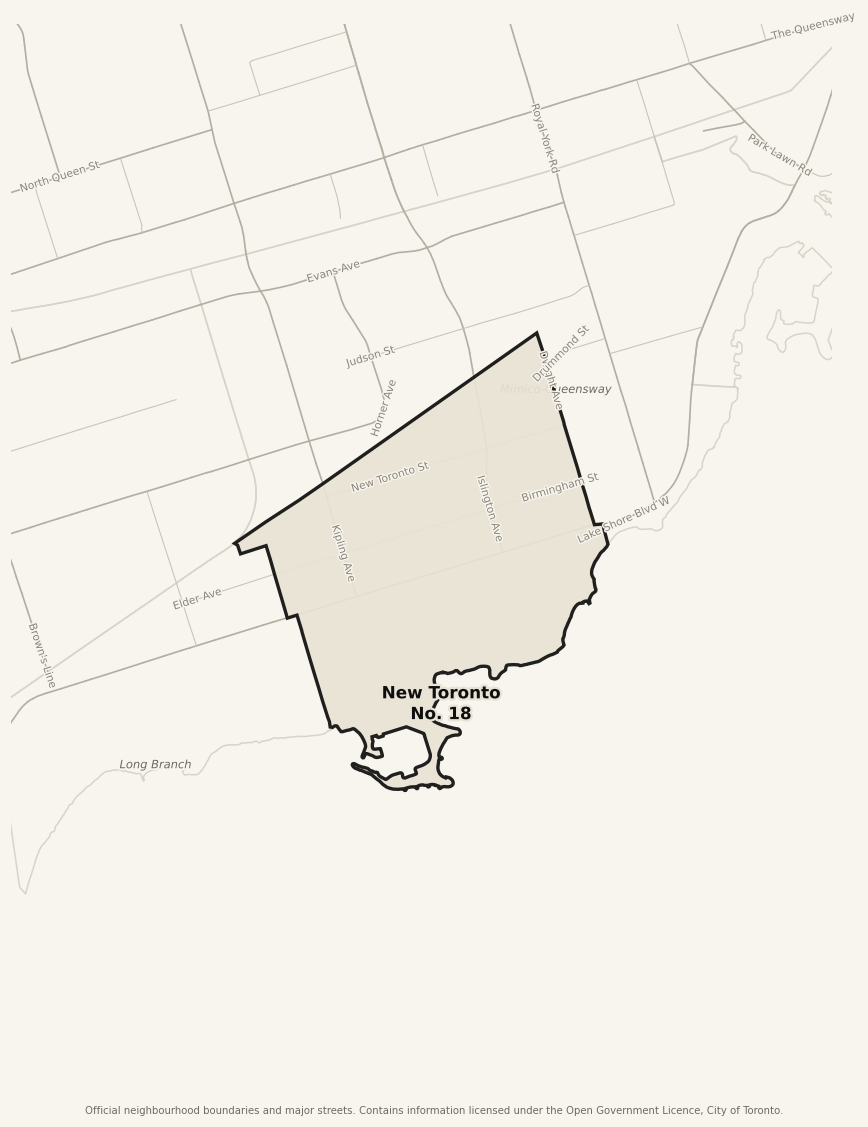
New Toronto runs along Lake Shore Boulevard West between Mimico and Long Branch, from the rail line down to the lake, with Kipling Avenue and Islington Avenue through the middle. It is a grid of numbered streets, small lots and modest houses, built for the families who worked in the factories that once lined the rail corridor.
The factories are mostly gone, and the neighbourhood that is left is mostly houses, with a main street on Lake Shore, a college campus by the water and one of the best lakefront parks in the west end. It is a freehold neighbourhood first: in 2026 there were 48 detached sales and only 4 condo apartment sales.
The History
New Toronto was planned as an industrial town. In 1890 a group of industrialists filed a subdivision plan and laid out the first streets, naming them in order: First Street, Second Street and onward to the west. Kipling Avenue was known as Eighteenth Street for most of the 20th century, and the numbering carries on into Long Branch.
The town grew around its employers. Goodyear opened a tire plant here in 1916 and 1917 and became the largest employer, followed by Anaconda American Brass in 1922, Campbell Soup in 1930, the Gilbey distillery in 1933 and Continental Can in 1936. New Toronto was incorporated as a village in 1913 and became a town in 1920. In 1916 residents voted down a proposal to join Mimico. The town joined Metropolitan Toronto in 1953, became part of the Borough of Etobicoke in 1967 and part of the City of Toronto in 1998.
Goodyear closed its New Toronto plant in 1987, and the site is now co-op housing, townhouses, condos and a park. By the lake, the Mimico Asylum opened in 1888 on what had been farmland at the foot of Kipling Avenue. It later became the Lakeshore Psychiatric Hospital, and after it closed its grounds and historic buildings became Humber’s Lakeshore Campus.
What You’ll Actually Find Here
Most of the housing is detached and semi-detached, much of it from the first half of the 20th century and the post-war years: storey-and-a-half houses, bungalows and simple two-storey homes on narrow lots along the numbered streets. A good share have been renovated, and new infill houses are scattered through the grid, sometimes two homes replacing one on a severed lot.
There are condo townhouses (11 sales in 2026), a few low-rise apartment buildings and some newer developments on former industrial land, including the old Goodyear site, but the high-rise condo market that defines Humber Bay Shores is not part of New Toronto.
Which side of Lake Shore you are on matters. In 2026 sales, the same house sold for about 21% more south of Lake Shore than north of it, with size and type held equal. South of Lake Shore puts you closer to the water, Colonel Samuel Smith Park and the campus.
What Homes Cost in New Toronto (W06)
From January 1 to November 2, 2026, in New Toronto, the TRREB community that matches the neighbourhood:
- Detached homes: a median of $1,144,500 (48 sales).
- Semi-detached homes: a median of $1,155,000 (6 sales).
- Freehold townhouses: a median of $715,000 (1 sale).
- Condo apartments: a median of $312,500 (4 sales).
- Condo townhouses: a median of $750,000 (11 sales).
In TRREB District W06, all home types averaged $885,964 over the 12 months to October 2026 (930 sales) and $909,737 in October 2026 alone (79 sales) (TRREB Market Watch).
Detached houses in New Toronto sold at a median of $918 per square foot of above-grade space in 2026, and semis at $942. 19% of detached houses sold over asking. With only a handful of semi, freehold townhouse and condo apartment sales, the medians for those types can move a lot from one year to the next.
What We Love About New Toronto
Colonel Samuel Smith Park. It sits at the foot of Kipling Avenue on land built out into the lake, with trails around the shoreline, a marina, wetlands that draw birdwatchers through the spring and fall migrations, and a skating trail in winter. For a neighbourhood with house prices like these, having a park like that at the end of the street is unusual.
Lake Shore Boulevard West is a real main street. Bakeries, cafes, restaurants, small grocers and services line the strip through the neighbourhood, and it is the kind of street where people walk to run errands.
The Lakeshore Grounds. The restored hospital buildings, the Humber campus and the Assembly Hall community and arts centre give the waterfront end of New Toronto a sense of history that most of the lakeshore lacks.
And the schools are close. New Toronto has public and Catholic elementary and secondary schools inside the neighbourhood, so most children can walk to school (see Schools).
The Honest Take
It is a long way from downtown. There is no GO station inside New Toronto itself; most commuters use Mimico or Long Branch GO, or the streetcar, which is slow over that distance. If your work is downtown or in midtown, test the commute before you buy.
The houses are older and often small. Many need updating, and a fully renovated house is the exception rather than the rule. Most buyers either pay for someone else’s renovation or plan their own, and the price difference between the two can be large.
The north side is more industrial. The blocks closer to the rail corridor still have warehouses, workshops and commercial buildings alongside the houses, and the trains are audible near the tracks. The 21% difference between houses south and north of Lake Shore reflects that.
Secondary school results are mixed. Lakeshore Collegiate, the local TDSB high school, ranks in the bottom quarter of Ontario secondary schools, while Father John Redmond, the Catholic secondary school in the neighbourhood, ranks in the top 6% (see Schools).
Who Lives Here
A mix of long-time owners, many of whom have been on the same street for decades, and younger families and couples buying their first house in a price range that is hard to find closer to downtown. The neighbourhood has deep working-class roots and long-established immigrant communities, visible in its churches, delis and bakeries.
Humber’s Lakeshore Campus brings students and staff, and some of the housing near Lake Shore is rented to them. People who like the water tend to stay: the paddling, sailing, cycling and running communities around Colonel Samuel Smith Park are a big part of local life.
Schools
New Toronto has more schools than most neighbourhoods its size. Rankings below are from the Fraser Institute’s 2025 report cards (2023/24 results).
- Second Street Junior Middle School (JK-8), TDSB, the main public elementary school. Ranked 2,337th of 3,047 Ontario elementary schools, with a rating of 4.7 out of 10.
- Seventh Street Junior School and Twentieth Street Junior School, two smaller TDSB junior schools. Neither is ranked by Fraser.
- The Holy Trinity Catholic School, TCDSB, in a newer building. Ranked 260th of 3,047, rating 8.3 out of 10 (top 9%).
- St. Josaphat Catholic School, TCDSB. Ranked 1,640th of 3,047, rating 5.9 out of 10.
- Lakeshore Collegiate Institute (Grades 9-12), 350 Kipling Avenue, the TDSB secondary school for the Lakeshore neighbourhoods. Ranked 559th of 742 Ontario secondary schools, rating 4.9 out of 10.
- Father John Redmond Catholic Secondary School (Grades 9-12), TCDSB, on Colonel Samuel Smith Park Drive, which also runs a regional arts program. Ranked 39th of 742, rating 8.6 out of 10 (top 6%).
- Humber’s Lakeshore Campus, for college programs, at the foot of Kipling Avenue.
With several elementary schools inside one small neighbourhood, the lines between them run block by block. Check the exact address with the TDSB and TCDSB school locators before you buy.
Getting Around
Mimico GO and Long Branch GO, both on the Lakeshore West line, sit just beyond either end of the neighbourhood. Which one is closer depends on the street, and most people get to the station by bike, bus or car.
Streetcars run along Lake Shore Boulevard West. The 507 Long Branch route connects with the 501 Queen at Humber Loop for the ride into the city. TTC buses on Kipling Avenue and Islington Avenue run north to Line 2. Route patterns on Lake Shore change from time to time, so check the TTC before you rely on a specific trip.
By car, the Gardiner Expressway is reached from Kipling Avenue or Islington Avenue, Highway 427 is a short drive west, and the Waterfront Trail runs right through the neighbourhood for cyclists heading east or west.
Things to Do
Colonel Samuel Smith Park is the first stop: the shoreline loop, the marina, the birding along the wetlands, and the skating trail in winter. The Waterfront Trail continues east toward Mimico and Humber Bay and west toward Long Branch and Marie Curtis Park.
The Assembly Hall, in a restored building on the Lakeshore Grounds, is a City community and cultural centre with concerts, theatre, classes and events. The Lakeshore Grounds themselves are worth a walk for the old hospital buildings and gardens.
Lake Shore Boulevard West has the neighbourhood’s cafes, restaurants and bakeries, and community events along the strip in the warmer months. The Lakeshore Lions Arena, on the former Gilbey distillery site, has rinks for hockey and skating.
Buying in New Toronto: What to Expect
Most of what comes up is detached houses and semis, and condition varies widely. In 2026, 19% of detached houses sold over asking, so most sold at or below their asking price.
Look at the block, not just the house. South or north of Lake Shore, distance to the tracks and nearby industrial buildings, and the street’s mix of original and rebuilt houses all affect value.
Get a thorough inspection. Older houses on the numbered streets often have original wiring, plumbing and foundations, and basements in older homes deserve a close look for moisture. If you plan to add a basement apartment or rebuild, check zoning and permits before you firm up.
Michael Ouzas and the Michael Ouzas Real Estate Team work New Toronto and the neighbourhoods around it, and price from the actual sales on and around the street.
New Toronto Sold Prices in 2026
Every MLS® sale from January 1 to November 4, 2026. Price per square foot uses above-grade size; the basement is not included.
| Type | Sales | Median price | Per sq ft | Sold over asking |
|---|---|---|---|---|
| Detached houses | 48 | $1,144,500 | $918 | 19% |
| Semi-detached houses | 6 | $1,155,000 | $942 | 17% |
| Condo apartments | 4 | $312,500 | $603 | 0% |
In New Toronto, the same house sells for about 21% more south of Lake Shore than north of Lake Shore.
See the full pocket-by-pocket numbers on the Toronto W06 stats page.