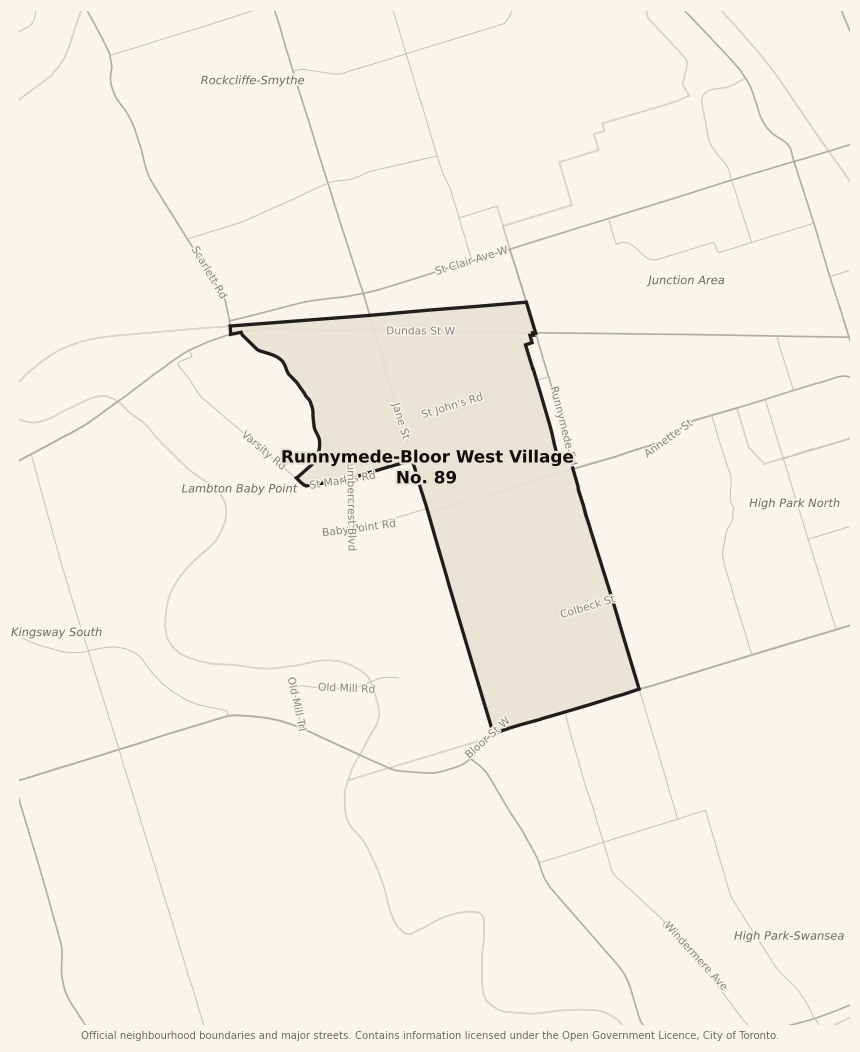
Runnymede is one of west Toronto’s most underrated neighbourhoods, a place where genuine community roots run deep, housing remains more affordable than nearby Bloor West Village or High Park, and the streetscape tells the story of working-class Toronto from the 1920s. Bounded by Runnymede Road to the east, Jane Street to the west, St. Clair Avenue to the north, and Annette Street to the south, this neighbourhood punches well above its weight in terms of character, walkability, and family appeal. It’s the kind of place where longtime residents and young families coexist, where you’ll recognize shopkeepers on the main streets, and where the bones of classic Toronto housing stock are still intact. If you’re looking for an authentic piece of west Toronto without the premium price tag of some neighbouring areas, Runnymede deserves serious consideration.
Official City of Toronto neighbourhood: Runnymede-Bloor West Village (No. 89).
The History
Runnymede takes its name from the historic Runnymede estate, which once occupied a significant portion of land in the area. The neighbourhood’s modern development exploded after streetcar service extended westward along St. Clair Avenue in the early 1910s, opening up the area for suburban residential development. What followed was a building boom that transformed farmland and estates into a neighbourhood of solid, unpretentious homes, the kind of modest middle-class housing that Toronto built by the tens of thousands during the interwar period.
The 1910s through 1930s saw the neighbourhood fill in almost completely with single-family homes, semi-detached houses, and the occasional small apartment building. Runnymede was built for working-class and lower-middle-class Torontonians: tradespeople, labourers, office workers, and small business owners who wanted a piece of property with a yard and a commute they could manage by streetcar. The neighbourhood developed a distinct character around Runnymede Road and St. Clair West, with local shops, services, and community institutions clustering along these main arteries. This DNA, accessible housing, community focus, local commerce, remains central to Runnymede’s identity today.
Like much of Toronto west of Bathurst, Runnymede has experienced waves of immigration and demographic change. The area has been home to Italian, Portuguese, Chinese, and South Asian families, each group contributing to the neighbourhood’s cultural fabric and local institutions. This layered history is visible in the street-level retail mix, in religious institutions of various traditions, and in the multigenerational family roots that many households maintain in the area.
What You’ll Actually Find Here
Victorian and Edwardian Semi-Detached Homes (1910s-1930s): The backbone of Runnymede’s housing stock consists of modest red-brick semis built in the 1910s through early 1930s. These are typically two-storey homes with narrow lots, front porches, sloped roofs, and the kind of solid construction that was standard for the era. Many feature simple decorative brickwork, arched windows on the first floor, and practical back porches. They’re not architectural showpieces, but they’re honest, well-proportioned houses that have aged gracefully. Most have been renovated to varying degrees, some sympathetically, others less so. Original footprints are usually around 1,000-1,200 square feet, though finished basements have expanded usable square footage in many cases. These homes typically sit on 20-25 foot wide lots with small backyards that are perfect for families but not palatial.
Detached Homes: Scattered throughout the neighbourhood, particularly on the quieter tree-lined streets north of St. Clair and west of Runnymede Road, are detached homes, mostly early 20th-century cottages and modest Victorian-era houses. These tend to command premium prices precisely because detached properties are less common here. Many sit on deeper lots than the semis and offer more privacy and flexibility for renovations. The quality and scale vary widely, but they’re consistently sought after by families and renovators willing to pay for separation from neighbours.
Small Apartment Buildings and Multiplexes: Interspersed throughout Runnymede are older walk-up apartments, duplexes, and converted single-family homes with multiple units. These date from the 1920s-1970s and represent opportunities for investors and multi-generational families. Many are older conversions rather than purpose-built apartments, meaning unit sizes can be generous by apartment standards, but finishes and mechanical systems often need attention.
The Reno Reality: Don’t come to Runnymede expecting move-in-ready homes. The area’s strength, affordable housing from the 1920s, comes with the reno expectation. Almost every home on the market will need basement work (older homes frequently have clay pipe and poor drainage), kitchen and bathroom updates, updated electrical or plumbing, and often roof replacement. The bones are good, but the skins need attention. This is actually why prices remain more accessible than in neighbourhoods where gentrification happened earlier, you’re buying potential and character, not finished product.
What Homes Cost in Runnymede (W02)
Semi-Detached Homes: From January 1 to November 2, 2026, semi-detached homes in the TRREB community of Runnymede-Bloor West Village sold at a median of $1,240,000 (31 sales). Prices are driven by condition, specific location within the neighbourhood, lot size, and proximity to St. Clair West’s retail and Runnymede Station.
Detached Homes: Over the same months, detached homes there sold at a median of $1,601,000 (57 sales).
Freehold Townhouses: a median of $1,210,000 (5 sales) over the same months.
Apartments and Multiplexes: No condo sales were recorded in Runnymede-Bloor West Village from January 1 to November 2, 2026. Multiplexes are not reported separately.
In TRREB District W02, all home types averaged $1,198,431 over the 12 months to October 2026 (692 sales) and $1,266,814 in October 2026 alone (71 sales) (TRREB Market Watch).
Runnymede and Bloor West Village: they are one TRREB community, Runnymede-Bloor West Village, so these are the same figures as the Bloor West Village guide.
What We Love About Runnymede
Authentic Community Feel: Runnymede feels like a real neighbourhood in a way that feels increasingly rare in Toronto. Shopkeepers on St. Clair West and Runnymede Road know their customers. Parents run into each other at Runnymede Library. There are actual neighbours who look out for each other. This isn’t manufactured or nostalgic, it’s the living residue of how this neighbourhood was built and has evolved. Compared to many Toronto neighbourhoods that feel more like bedroom communities, Runnymede has genuine civic roots.
Walkability and Local Retail: St. Clair West is a genuinely walkable main street with a mix of longtime institutions and newer independent shops. You’ll find casual restaurants, coffee shops, butchers, bakeries, vintage stores, and service businesses scattered along both St. Clair and Runnymede Road. This is how many Toronto neighbourhoods used to work before cars dominated, you can handle much of daily life on foot or by transit.
Transit Access: Runnymede Station sits on the Bloor-Danforth Line 2, giving you direct subway access to downtown, the Danforth, and the Eastside. Streetcars and buses cover St. Clair West and connect to neighbouring areas. If you work downtown or use transit regularly, the commute is reasonable and reliable. The station area itself is also becoming a focal point for some quiet intensification.
Character Housing and Renovation Upside: If you enjoy the process of renovation and have taste and budget to back it up, Runnymede’s housing stock is a genuine playground. You’re working with solid 1920s construction, good proportions, and enough examples of thoughtfully renovated homes to understand the potential. The payoff, a beautiful, substantial home in an established neighbourhood, is real.
Family-Friendly Infrastructure: Good schools, proximity to parks (including access to Humber River trails), and a neighbourhood culture oriented around families means this is a genuine place to raise kids. It’s not precious or self-conscious about family life the way some hipper Toronto neighbourhoods are, it’s just built into the neighbourhood’s DNA.
The Honest Take
Reno Work is Non-Negotiable: Very few homes here are truly move-in ready without significant investment. If you’re not prepared to spend $75,000 to $200,000+ on mechanical updates, plumbing, electrical, basement work, and kitchen/bathroom updates, you need to be very selective. This isn’t a neighbourhood where you can casually buy something and do it over time, most homes need work to be livable to modern standards. Budget accordingly and don’t be surprised by hidden costs.
Gentrification Pressure and Changing Demographics: Runnymede’s affordability is attracting younger buyers and professionals, gradually changing the neighbourhood’s character. This isn’t necessarily negative, the neighbourhood is becoming less economically isolated, and property maintenance is improving. But longtime residents are being priced out, and the local mom-and-pop retail is slowly being replaced by newer independent businesses and chains catering to younger demographics. If you’re moving here partly for the “authentic working-class community” vibe, understand that you’re also participating in the process that changes that. The neighbourhood is in transition, and that transition is visible and ongoing.
St. Clair West Can Feel Worn: While St. Clair West has genuine charm and walkability, it’s also showing its age. Some stretches feel tired, with vacant storefronts and dated storefronts that haven’t been renovated. The street is used by trucks and heavy traffic, it’s not a quiet retail district. On rainy days or winter evenings, some blocks can feel a bit grim. This is improving, but it’s the current reality. If you’re imagining a polished, carefully curated main street, you’ll be disappointed.
Traffic and Noise on Main Streets: St. Clair West and Runnymede Road carry significant vehicle traffic. If your home is close to these streets, expect traffic noise, especially during rush hours and weekends. Truck traffic is regular. This is fine if you’re accustomed to urban living, but it’s worth acknowledging if you’re coming from quieter neighbourhoods.
Schools Are Adequate, Not Exceptional: Schools serving the area are decent but not top-tier by Toronto standards. Runnymede Collegiate Institute is a solid neighbourhood high school, and elementary schools like Lord Lansdowne and Beaconsfield Public are reliable, but you won’t find the reputation or resources of schools in areas like Forest Hill or the Annex. If school choice is a primary driver, this matters.
Who Lives Here
Runnymede is increasingly a neighbourhood of young professional couples, young families, and some longtime residents who’ve owned homes here for decades. The neighbourhood is economically diverse, you’ll find established working-class families whose parents bought here in the 1970s, newer arrivals in professional fields (finance, tech, education, design), artists and creatives attracted by affordability and space, and multi-generational immigrant families. The ethnic makeup has shifted repeatedly over the neighbourhood’s history; currently you’ll find significant Portuguese, Italian, Chinese, South Asian, and Latin American communities, though the neighbourhood is becoming demographically more mixed and younger.
Families are a substantial presence, the neighbourhood has a genuine kid-oriented culture. You’ll see young families renovating homes, using the parks, walking kids to schools. At the same time, younger professionals without children are increasingly visible, attracted by the price point and proximity to work downtown or in other employment centres. Empty-nesters who want to stay in the neighbourhood they’ve long inhabited form another cohort.
What ties these groups together is a certain tolerance for urban density, comfort with walking and transit, and willingness to buy into a neighbourhood that requires work rather than one that’s already finished. Runnymede attracts people who see housing as a project and community as something worth investing in, not just a location to sleep.
Schools
The neighbourhood is served by several public elementary schools: Lord Lansdowne Public School, Beaconsfield Public School, and Howard Park Avenue Public School are the main options depending on exact address. These are solid neighbourhood schools with reasonable reputations and community involvement. They’re not selective or academically elite, but they’re not problematic either, they reflect the neighbourhood’s composition and serve families well. Class sizes and resources are typical for TDSB schools in this area. Many families send kids to these schools and are satisfied; some choose private or alternative schools.
For secondary school, Runnymede Collegiate Institute is the neighbourhood high school. It’s a traditional TDSB secondary school with a full range of programs. It has a decent reputation in the neighbourhood and serves a broad student body. It’s not a specialized school or top-tier academic institution, but it’s functional and produces graduates successfully. Some parents choose to send kids elsewhere for secondary school, but Runnymede Collegiate is a legitimate local option.
Both elementary and secondary schools in the area have diverse student populations and reflect the neighbourhood’s demographics. If specialized or alternative education is important to you, you’ll likely be looking beyond Runnymede’s immediate neighbourhood options, but for conventional public education, the schools are adequate and embedded in the community.
Getting Around
Runnymede Station sits directly on the Bloor-Danforth Line (Line 2), providing direct subway access to downtown Toronto, Kipling Station and points west, and the Danforth and Danforth corridor eastward. The station is the neighbourhood’s main transit anchor. A short walk from the station puts you in central Runnymede, making transit-oriented living genuinely accessible. Commutes downtown are typically 15-25 minutes depending on your destination. The streetcar loop is reliable and less crowded than some inner-city transit.
Beyond the subway, the neighbourhood is served by several TTC streetcar and bus routes. 506 Streetcar runs along Carlton and Queen in routes nearby. 505 Dundas Streetcar reaches areas south. Various bus routes cover St. Clair Avenue and Runnymede Road, connecting to neighbouring areas and secondary commercial streets. For most daily trips within the neighbourhood or to nearby areas, transit is convenient and sufficient.
Cycling is feasible, the neighbourhood is relatively flat and has access to some cycling routes, though infrastructure isn’t comprehensive. The Humber River trail system, accessible from the southern edge of the neighbourhood, offers recreational cycling and walking. For car owners, street parking is typically available but can tighten on residential streets. Traffic on main streets is regular and noticeable. A car is optional but not essential if you work downtown or use transit regularly, which is true for many residents.
Things to Do
St. Clair West is the neighbourhood’s recreational and commercial hub. You’ll find a mix of restaurants ranging from casual Portuguese and Italian spots to newer independent cafes, vintage and antique shops, second-hand bookstores, yoga studios, and specialty food shops. It’s not exhaustingly trendy, which is actually refreshing, the retail mix serves residents rather than trying to become a destination. Runnymede Road has additional shops and services, including grocery stores, hardware stores, and smaller independent businesses.
Runnymede Library, a beautiful Carnegie library building, is a genuine neighbourhood focal point with programming, community meeting space, and the kind of library culture that still exists in established Toronto neighbourhoods. If you appreciate libraries, this one has character and community integration. The Runnymede Park nearby offers green space, playgrounds, and recreational facilities. Further south, you have direct access to the Humber River trail system, which connects to the broader Toronto ravine network, excellent for walking, cycling, and outdoor recreation.
Cultural and recreational institutions include Runnymede Collegiate Institute (which hosts some public events and performances), local community centres, and various community organizations rooted in the neighbourhood. For more varied dining, entertainment, and cultural options, St. Clair West extends both east and west, and neighbouring areas like Bloor West Village and The Junction are a short transit ride away. Close proximity to Lambton Golf Club (just south) is a draw for golfers.
The neighbourhood also benefits from proximity to some of Toronto’s best parks and natural areas. The Humber River valley is minutes away on foot or bike, providing trails, ravine walks, and access to the broader ravine network. High Park is a 10-15 minute trip east by transit or a longer walk. This combination of local walkability and proximity to larger parks makes Runnymede attractive for outdoor-oriented residents.
Buying in Runnymede: What to Expect
Understand Your Reno Budget: Before making an offer, budget properly for the work the home will need. Get a good home inspection and a plumbing/electrical assessment. Many homes have original basement brick that needs damp-proofing, old clay pipes that need replacement, and electrical systems that need updating. A conservative budget might be $100,000 to $200,000 for a home that looks decent but needs modern systems. This is the real cost of entry in Runnymede. If you’re unprepared for this, the neighbourhood’s affordability becomes a trap rather than a feature.
Location Within the Neighbourhood Matters: Homes directly on St. Clair West or Runnymede Road will be noisier but more walkable and convenient. Quieter tree-lined streets offer more peace but less immediate walkability to retail and transit. North of St. Clair, the neighbourhood becomes quieter and more residential; south of St. Clair toward Annette, you transition toward different neighbourhood character. Drive around at different times of day and spend time on the specific streets you’re considering. Noise tolerance and walkability preferences should inform your choice of where in Runnymede to buy.
Plan for the Market to Continue Improving: Runnymede is not fully gentrified, it’s in active process. This means prices have room to appreciate as the neighbourhood continues to stabilize, local retail improves, and the transition completes. If you’re buying here, you’re partly betting on neighbourhood upside. This isn’t certain, but the evidence from comparable Toronto neighbourhoods suggests it’s plausible. That said, don’t bank entirely on appreciation, buy because you want to live here and the home works for you now.
Expect Multiple Offers and Some Competition: Runnymede has become known enough in the Toronto market that decent homes in decent locations attract genuine buyer interest. You likely won’t have the same level of multiple-offer competition as in trendier areas, but you also shouldn’t expect to be the only buyer interested in a well-positioned property. Have your financing ready and your offer strategy clear before you bid.
Watch for Changing Buyer Demographics: The neighbourhood’s buyer profile is shifting. There are still longtime residents and established families, but increasingly you’ll see younger professional couples and families buying here as their first major purchase.
Are You Curious About Runnymede or Ready to Buy Here?
The team lives and works across west Toronto, including Runnymede. We know the neighbourhoods, the streets, the houses, and the people. We understand the reno requirements, the price dynamics, and the neighbourhood trajectories. If you’re considering Runnymede, whether you want a detailed neighbourhood consultation, help navigating the reno process, or support finding and purchasing the right home, we’re here. Reach out and let’s talk about what Runnymede could be for you.
Related Neighbourhood Guides: Bloor West Village | The Junction | Lambton | Baby Point | High Park North
Weighing your options? Read our comparison: Bloor West Village vs The Junction: an honest comparison
Runnymede Sold Prices in 2026
Every MLS® sale from January 1 to November 4, 2026. TRREB counts Runnymede inside its Bloor West Village neighbourhood, so these are the numbers for Bloor West Village. Price per square foot uses above-grade size; the basement is not included.
| Type | Sales | Median price | Per sq ft | Sold over asking |
|---|---|---|---|---|
| Detached houses | 57 | $1,601,000 | $1,065 | 65% |
| Semi-detached houses | 31 | $1,240,000 | $1,046 | 65% |
Between Jane Street and Runnymede Road, the same house sells for about 21% less north of Annette Street than south of it. Median house price: $1,691,000 south of Annette (40 sales), $1,207,500 north of Annette (24 sales). Median detached: $1,764,500 south (30 sales), $1,285,000 north (10 sales). Median semi-detached: $1,491,500 south (10 sales), $1,202,500 north (11 sales).
See the full pocket-by-pocket numbers on the Bloor West Village stats page.