Islington is a quiet, established Etobicoke neighbourhood of mature post-war detached homes on generous lots. Islington is part of the TRREB community of Islington-City Centre West, in District W08, where detached homes sold at a median of $1,293,000 (104 sales) from January 4 to November 3, 2026.
Official City of Toronto neighbourhood: Islington (No. 158).
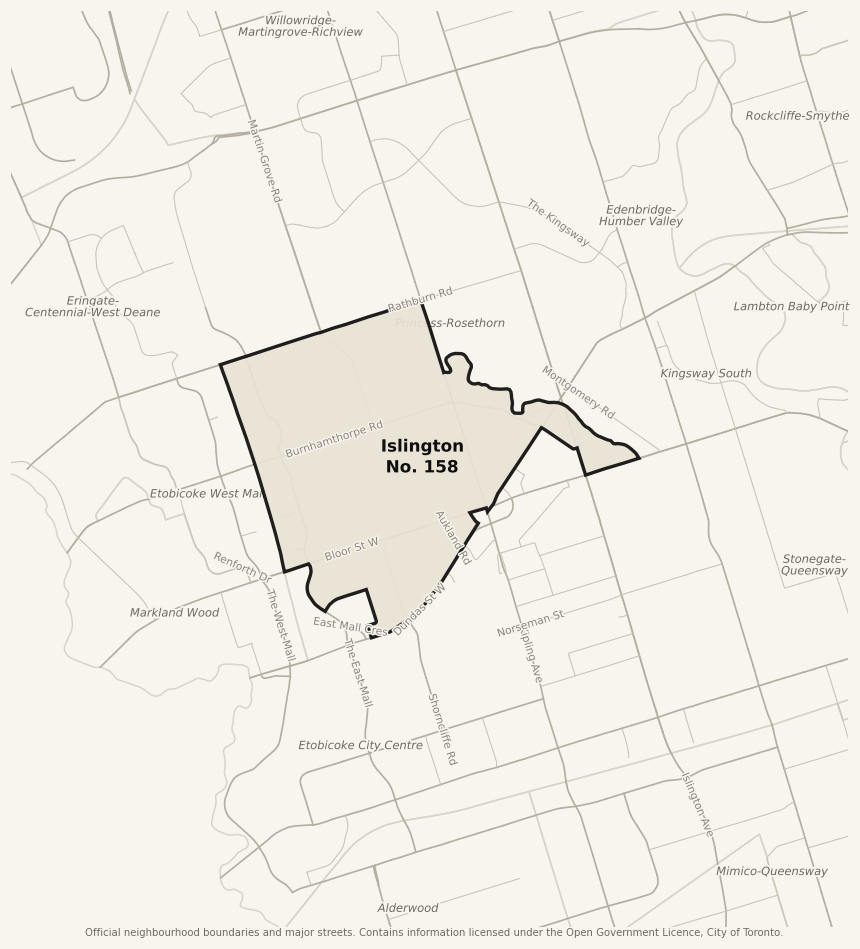
Islington, as the City draws it, is a large residential area of central Etobicoke that runs north from Bloor and Dundas toward Rathburn Road, with Burnhamthorpe Road crossing the middle. Islington Village, the old main street on Dundas, sits at its south-east corner, and Kipling and Islington subway stations are just off its southern edge.
Most of Islington is quiet streets of post-war houses with driveways and yards. Around the subway stations it changes character completely, with condo towers and busier roads. Where you buy inside Islington shapes the price, the commute and the feel of daily life, so it helps to think of it as several pockets rather than one place.
The History
For most of its history this was farmland in the Township of Etobicoke, with the small settlement of Islington on Dundas Street as its local centre. The settlement took the Islington name around 1860, when it got its own post office, and Montgomery’s Inn, built in the early 1830s at Dundas and Islington, still stands as a reminder of that era.
The fields north of Dundas filled in after the Second World War, when Etobicoke grew quickly as a suburb. Etobicoke joined Metropolitan Toronto in 1954, and the bungalows, storey-and-a-half houses and split-levels that make up most of Islington today went up on the curving streets laid out in those years.
The subway changed the southern edge. Line 2 was extended to Islington station in 1968 and to Kipling station in 1980, and apartment and condo towers followed around both stations. Etobicoke became a borough in 1967 and a city in 1984, and was amalgamated into the City of Toronto in 1998. More recently, the old Six Points interchange where Bloor, Dundas and Kipling meet was replaced with ordinary street intersections, opening up land next to Kipling station for new development.
What You’ll Actually Find Here
Most of Islington is detached houses from the post-war decades: brick bungalows, storey-and-a-half homes, side-splits and back-splits, and two-storey houses, usually with a private drive and a garage. Lots are generous by Toronto standards and the trees have had decades to grow. On many streets you will see original houses next to large new custom builds where an older home has been replaced.
There is very little semi-detached housing: the TRREB community recorded 4 semi-detached sales in 2026, against 104 detached sales. Freehold and condo townhouse complexes fill some pockets, with 19 freehold townhouse and 29 condo townhouse sales this year.
Condo apartments are the largest part of the market by number of sales, with 334 sales in 2026. Most of these are in the towers around Islington and Kipling stations and in the Etobicoke City Centre area to the west, which TRREB includes in the same community. Keep that in mind when reading the numbers: the condo figures say more about the towers near the subway than about Islington’s residential streets.
What Homes Cost in Islington (W08)
From January 4 to November 3, 2026, in Islington-City Centre West, the TRREB community that includes Islington:
- Detached homes: a median of $1,293,000 (104 sales).
- Semi-detached homes: a median of $1,010,000 (4 sales).
- Freehold townhouses: a median of $1,140,000 (19 sales).
- Condo apartments: a median of $513,750 (334 sales).
- Condo townhouses: a median of $790,000 (29 sales).
In TRREB District W08, all home types averaged $1,153,826 over the 12 months to October 2026 (1,225 sales) and $1,053,537 in October 2026 alone (115 sales) (TRREB Market Watch).
Detached houses sold at a median of $880 per square foot of above-grade space, semi-detached houses at $897 and condo apartments at $700. In 2026, 29% of detached homes and 10% of condo apartments sold over asking. The same condo sold for about 10% more south of Dundas than north of it, although building age and finish were not held equal.
What We Love About Islington
A detached house with a driveway and a yard, on a quiet street, within reach of the subway. That combination is hard to find in Toronto, and it is the main reason people buy here. From the streets closest to Bloor and Dundas you can walk to Islington or Kipling station; from the rest, it is a short bus ride or drive.
The streets themselves. Islington’s residential blocks are calm, with little through traffic on the inner streets, mature trees and houses set back from the road.
Islington Village on Dundas gives the area a real main street, with independent restaurants and shops, the murals, and Montgomery’s Inn with its weekly farmers’ market. Mimico Creek and Tom Riley Park run through the south-east corner, and the Humber River trails are a short drive east.
Choice. Within one neighbourhood you can find a first condo near the subway, a townhouse, an original bungalow to renovate or a new custom house. Few parts of the city offer that range so close together.
The Honest Take
Islington is large and uneven. The quiet streets north of Dundas and the condo blocks around the stations are very different places to live, and prices vary with them. Two houses with the same address range can be a world apart depending on how close they are to the subway, a busy road or the creek.
Most of the housing is post-war suburban, not heritage. If you want the stone, slate and Tudor detail of the Kingsway, this is not it. The appeal here is the lot, the street and the location, and many houses need updating.
The northern streets are car-oriented. Toward Burnhamthorpe and Rathburn, the subway is a bus ride away, and most households drive for groceries and errands. Bloor, Dundas, Kipling and Islington are all busy roads at rush hour.
Expect construction near the stations. The land around Kipling station and the former Six Points interchange is being redeveloped, and new condo buildings continue to go up along the subway corridor. That brings new shops and services over time, and years of construction in the meantime.
Who Lives Here
Families make up much of the detached-house market: some who grew up in Etobicoke and came back, and others who bought here for a house with parking and a yard close to the subway. Long-time owners are common too, and some households are multi-generational, with parents and grown children under one roof.
The condos near the stations add first-time buyers, young professionals who commute downtown on Line 2, renters, and downsizers from larger Etobicoke houses who want to stay in the area without the upkeep.
Schools
Islington is a large area, and several elementary schools serve different parts of it. Rankings below are from the Fraser Institute’s 2025 report cards (2023/24 results).
- Islington Junior Middle School (JK-8), TDSB, on Cordova Avenue near Islington station. Founded in 1832, it is one of the oldest schools in the city. Ranked 1,964th of 3,047 Ontario elementary schools, with a rating of 5.4 out of 10 (top 65%).
- Etobicoke Collegiate Institute (Grades 9-12), TDSB, on Montgomery Road near Dundas and Islington. Ranked 79th of 742 Ontario secondary schools, with a rating of 8.1 out of 10 (top 11%).
- Michael Power/St. Joseph High School (Grades 9-12), TCDSB, formed in 1982 when Michael Power and St. Joseph’s Islington merged. Ranked 201st of 742, with a rating of 7.1 out of 10 (top 28%).
- Bishop Allen Academy (Grades 9-12), TCDSB. Ranked 33rd of 742, with a rating of 8.7 out of 10 (top 5%).
- Etobicoke School of the Arts (Grades 9-12), a TDSB specialized arts school that admits by audition. Ranked 65th of 742, with a rating of 8.2 out of 10 (top 9%).
Other TDSB junior schools serve the streets further north and west, and the Catholic elementary school depends on the address. Catchment lines do not follow the neighbourhood’s edges. Check the exact address with the TDSB and TCDSB school locators before you buy.
Getting Around
Line 2 Bloor-Danforth runs along the southern edge, with Islington and Kipling stations both close by. Kipling is the western end of the line and also has a GO station on the Milton line and a bus terminal for MiWay routes into Mississauga. Bus routes run north from both stations along Islington Avenue and Kipling Avenue and across on Burnhamthorpe and Rathburn.
By car, Highway 427 is just to the west and connects to the Gardiner Expressway, the QEW and Highway 401, so Pearson Airport and Mississauga are easy to reach. Downtown by car depends heavily on the Gardiner at rush hour.
Further north, the western extension of Line 5 Eglinton is under construction along Eglinton Avenue, with stations planned at Islington Avenue and Kipling Avenue. When it opens, it will give the northern part of Etobicoke a second rapid transit line.
Things to Do
Spend a morning in Islington Village: walk the murals along Dundas, visit Montgomery’s Inn and its farmers’ market, and stop at one of the family-run cafes or restaurants on the strip.
Tom Riley Park follows Mimico Creek between Dundas and Bloor, with sports fields, tennis courts, a playground and a community garden. Centennial Park, one of Etobicoke’s largest parks, with its conservatory, ski hill and sports facilities, is a short drive west.
For more green space, the Humber River trails, James Gardens and Lambton Woods are a short drive east. The Bloor strip in the Kingsway, with the Kingsway Theatre, and Sherway Gardens to the south-west cover most shopping and dining beyond the neighbourhood.
Buying in Islington: What to Expect
Decide which Islington you want before you start. A condo near the station, a townhouse and a detached house on a quiet inner street are different searches with different numbers. For detached houses, location relative to the subway, busy roads and the creek moves price more than the neighbourhood name does.
Detached houses move at a steady pace. In 2026, 29% of detached homes in Islington-City Centre West sold over asking, so the well-presented ones go quickly and others take longer. Have your financing confirmed before you start.
For condos, compare buildings, not just units. With 334 condo apartment sales in the community this year, there is a lot to choose from, and age, finish, fees and the side of Dundas all show up in price.
Get a thorough inspection on any post-war house. Original wiring, plumbing, windows and roofs, and older basements, all deserve a close look. Michael Ouzas and the Michael Ouzas Real Estate Team work Islington and the neighbourhoods around it, and price from the actual sales on and around the street.
Islington Sold Prices in 2026
Every MLS® sale from January 4 to November 3, 2026. TRREB counts Islington inside its Islington-City Centre West community, so these are the numbers for Islington-City Centre West. Price per square foot uses above-grade size; the basement is not included.
| Type | Sales | Median price | Per sq ft | Sold over asking |
|---|---|---|---|---|
| Detached houses | 104 | $1,293,000 | $880 | 29% |
| Semi-detached houses | 4 | $1,010,000 | $897 | 25% |
| Condo apartments | 334 | $513,750 | $700 | 10% |
In Islington-City Centre West, the same condo sells for about 10% more south of Dundas than north of Dundas. The age and finish of the building are not held equal.
See the full pocket-by-pocket numbers on the Toronto W08 stats page.
Related reading
- Toronto West market stats (W01 to W08), updated monthly
- The Kingsway: nearby guide
- Islington Village: nearby guide
- Princess Rosethorn: nearby guide