Bedford Park is one of Toronto’s most coveted midtown neighbourhoods, where tree-lined streets and solid family homes meet unmatched proximity to Yonge Street shopping and the Lawrence subway station. Located in TRREB District C04, this established community has quietly become one of the city’s most competitive real estate markets, attracting established families, young professionals, and downsizers willing to pay a premium for the combination of convenience, heritage character, and strong schools. The neighbourhood’s appeal lies in its balance, close enough to downtown and the Yonge corridor to feel connected, yet residential enough to offer genuine community feel and mature greenery that makes you forget you’re in the middle of the city.
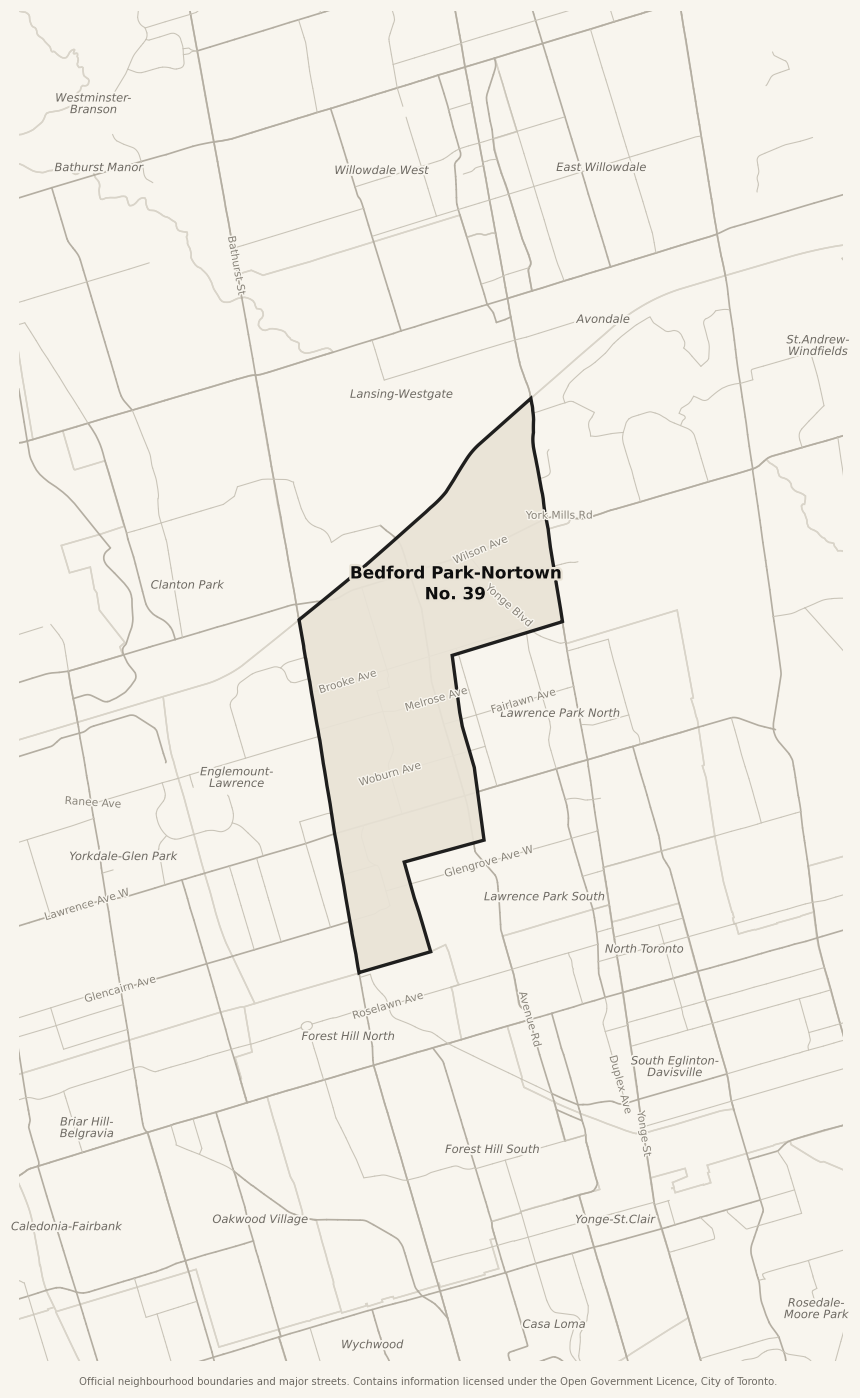
Official City of Toronto neighbourhood: Bedford Park-Nortown (No. 39).
The History
Bedford Park wasn’t always the leafy, affluent enclave it is today. The neighbourhood emerged in the early 1900s as Toronto expanded northward, gradually transforming from farmland and ravine property into a planned residential community. The area’s name derives from the original large estate that once occupied much of the land, and that sense of space and generous lot sizes, a legacy of the area’s rural past, remains one of the neighbourhood’s defining characteristics even today. The early development prioritized tree-planting initiatives and reserved park space, design choices that fundamentally shaped the neighbourhood’s character and have made it increasingly valuable as urban green space becomes scarcer.
The golden age of Bedford Park development occurred between the 1920s and 1960s, when most of the current housing stock was constructed. This period produced the classic Toronto streetscapes residents love today: gracious detached homes on substantial lots, elegant semi-detached houses with period details, and compact bungalows that appeal to renovators and families. The neighbourhood’s physical form was solidified during these decades, wide streets, setbacks that create visual breathing room, and the tree canopy that defines the area’s character were all products of early 20th-century planning decisions that subsequent decades have only reinforced.
Official annexation to Toronto occurred in 1912, though the neighbourhood’s real integration into the city’s fabric accelerated with the opening of the Lawrence subway station in 1927 as part of the TTC’s expansion. This transit connection fundamentally altered Bedford Park’s trajectory, making it accessible to downtown workers and transforming it from a remote suburb into a genuinely desirable address. The station remains the neighbourhood’s anchor and a key factor in its enduring appeal, it’s proximity that many newer Toronto neighbourhoods simply cannot offer.
What You’ll Actually Find Here
Classic Detached Homes: The backbone of Bedford Park’s housing stock is the substantial detached home, typically built between 1920-1960. These properties sit on lots ranging from 4,000 to 8,000+ square feet, offering the kind of genuine space that’s increasingly rare in central Toronto. Architectural styles span the period: Tudor Revival homes with decorative half-timbering and leaded windows, brick Georgian colonials with shutters and centre-hall plans, Arts and Crafts influenced homes with deep eaves and stone detailing, and clean-lined 1950s and early 60s houses that represent the tail end of the neighbourhood’s development. Many feature original hardwood floors, plaster walls, and built-in shelving that speak to quality construction from an era when homes were designed to last. Condition varies significantly, some are showpieces maintained by owners committed to heritage preservation, while others are lived-in homes awaiting renovation or cosmetic refresh. Lot depth is substantial on many properties, creating secluded backyard spaces with mature trees that create a private oasis feeling.
Semi-Detached Properties: Semi-detached homes are well-represented throughout Bedford Park, particularly on the neighbourhood’s west and southern edges. These typically date from the 1920s-1950s and often feature the same period charm and solidity as their detached counterparts, brick construction, generous floor plates, and lots that, while smaller than detached homes, still offer meaningful outdoor space. Semis appeal to buyers who want the character and space of a house but with slightly lower entry costs and reduced maintenance responsibilities. The best examples maintain original windows, doors, and architectural details, while others have been updated with modern kitchens and bathrooms while retaining their essential character.
Bungalows and Compact Homes: Scattered throughout the neighbourhood are charming bungalows, primarily from the 1920s-1940s, that represent excellent renovation opportunities for the right buyer. These modest-footprint homes sit on decent-sized lots and offer what many see as prime tear-down candidates or, for buyers with vision and budget, perfect platforms for sympathetic renovation. The compact floor plans typical of these homes, small footprints with contained heating costs, are increasingly attractive to downsizers and young professionals willing to invest sweat equity for authenticity.
Contemporary Infill and Rebuilds: In recent years, Bedford Park has seen selective new construction and major renovations that bring modern amenities while respecting the neighbourhood’s character. Some lots have been carefully subdivided to allow new construction of appropriately-scaled homes. These newer properties command a premium, reflecting buyers’ willingness to pay for move-in condition, modern systems, and open-concept living within the neighbourhood’s desirable boundaries. The best examples are contextual, respecting lot coverage limits and setbacks that maintain the neighbourhood’s spacious feel.
What Homes Cost in Bedford Park (C04)
Detached Homes: From January 1 to November 3, 2026, detached homes in the TRREB community of Bedford Park-Nortown sold at a median of $2,600,000 (123 sales). Properties requiring renovation or on smaller or narrower lots sell for less, and pristine examples on premium streets within walking distance of Yonge and Lawrence sell for more. Properties facing onto Avenue Road or extremely high-traffic streets command discounts; conversely, homes tucked away on quieter streets command premiums. Lot size and configuration significantly impact pricing, larger lots and those with better depth and less exposure to noise realize better value.
Semi-Detached Homes: No semi-detached sales were recorded in Bedford Park-Nortown from January 1 to November 3, 2026.
Bungalows and Compact Homes: Detached bungalows sold at a median of $1,348,000 (14 sales) over the same months. These properties attract both downsizers and young families looking to enter the neighbourhood, and buyers evaluating tear-down potential where lot value exceeds structure value.
Condominiums: While not abundant, condo opportunities exist on the neighbourhood’s periphery, particularly around Yonge and Lawrence. Condo apartments sold at a median of $918,700 (38 sales) and condo townhouses at $1,532,500 (4 sales) over the same months. These provide the lowest entry point to the neighbourhood for buyers seeking the area’s convenience without house ownership demands.
In TRREB District C04, all home types averaged $2,060,899 over the 12 months to October 2026 (660 sales) and $2,202,807 in October 2026 alone (62 sales) (TRREB Market Watch).
Bedford Park consistently trades at a premium relative to outer midtown neighbourhoods, both north and south of the 401, due to its established character, proximity to transit, and school quality. Buyers should expect to pay a 10-15% premium relative to equivalent properties in neighbourhoods like Mount Pleasant or Avondale, a differential that reflects the neighbourhood’s desirability and finite supply of available properties.
What We Love About Bedford Park
The Yonge and Lawrence Hub: Few Toronto neighbourhoods offer this caliber of convenience so seamlessly integrated into residential streets. From Bedford Park, you’re steps to the Lawrence subway station and directly atop one of the city’s most vibrant shopping and dining strips. Walk east and west along Lawrence Avenue and you encounter every conceivable amenity, grocery stores (Metro, Loblaws), pharmacies, excellent restaurants spanning cuisines and price points, cafes, hardware stores, clothing boutiques, and banks. This isn’t gentrified convenience that arrived last year, it’s been here for decades, tested, proven, and woven into the neighbourhood’s fabric. You can genuinely run most daily errands on foot, which matters whether you’re in your 30s juggling work schedules or in your 70s less inclined to drive.
The Tree Canopy and Green Space: Bedford Park’s most distinctive visual feature is its mature tree canopy. Walking the neighbourhood in summer, you’re enveloped in green, streets feel shaded and cool, properties gain privacy from street-level views, and the psychological effect of abundant vegetation is genuinely restorative. This didn’t happen by accident; early planning prioritized tree-planting, and subsequent decades of careful stewardship have created what is objectively one of Toronto’s most verdant stable neighbourhoods. Combined with proximity to Sherwood Park and ravine trails, the neighbourhood offers genuine nature access without leaving the city. For families and anyone who values greenery, this matters profoundly.
School Quality and Catchment Value: Bedford Park encompasses catchment areas for some of Toronto’s best-performing public schools, Bedford Park Public School and Lawrence Park Collegiate Institute are anchors that attract family buyers and support property values. Beyond test scores, these schools benefit from stable, affluent catchment areas with high parental engagement and community participation. Families often prioritize these school catchments, and proximity to top-ranked Catholic schools adds another layer of educational optionality. School catchment value is real and tangible in Bedford Park real estate.
Established Community and Neighbourhood Character: Bedford Park feels like an actual neighbourhood, not a collection of properties. Residents tend to stay for decades, creating genuine community continuity. Neighbourhood associations maintain standards, community events happen annually, and there’s a shared sense that the neighbourhood is worth maintaining and investing in. This doesn’t mean residents are nostalgic about resisting change, but there’s a general commitment to preserving what makes the area special. New residents typically find genuine community presence and social opportunities, a contrast to many newer Toronto subdivisions that function more as collections of individual households.
The TTC Connection without Transit Intensity: Lawrence station puts most of downtown Toronto 20-30 minutes away by transit. The reliability and frequency of the Bloor-Danforth line means actual workability for families and professionals with downtown commutes. Yet unlike neighbourhoods immediately adjacent to Dundas, Wellesley, or King stations, Bedford Park remains relatively quiet, you’re not constantly hearing the ambient roar of heavy transit use. You get legitimate transit convenience with genuinely residential quiet. This combination is increasingly rare in central Toronto.
Walkable Streets and Cycling Infrastructure: Bedford Park’s grid of streets works genuinely well for walking and cycling. Avenue Road provides north-south cycling infrastructure, while the neighbourhood’s street pattern encourages local connectivity. You can walk or cycle to the subway, shopping, parks, and schools without navigating highways or major arterials. The streets feel appropriately scaled, neither too narrow and claustrophobic nor too wide and car-dominated. It’s walkable in the pre-automobile Toronto sense, which is increasingly valued.
The Honest Take
Aging Housing Stock Requires Realistic Assessment: Most Bedford Park homes are 60-100+ years old, and that age comes with genuine implications. Original plumbing may need replacement, original wiring may be inadequate for modern electrical demands, roofs require regular attention, and foundations, while often solid, may have cracks or settling issues. Buyers enamored with character and charm need to budget realistically for system replacements: new windows typically run $40,000-$70,000 for a mid-size home, kitchen renovations easily exceed $100,000, basement underpinning can cost $50,000+, and asbestos remediation adds thousands to renovation projects. That beautiful 1920s home might require $200,000-$400,000 in system updates over a decade. This isn’t a reason to avoid the neighbourhood, but it’s essential context for financial planning.
Lot Sizes Sound Generous Until You Measure Them: While Bedford Park lots are larger than inner-city neighbourhoods, they’re often narrower than they appear. Many properties feature 30-35 foot frontages, adequate for the period but narrow for contemporary standards. This limits development potential (tough to subdivide), constrains yard layouts, and creates privacy challenges on smaller lots. Properties on wider lots or corner lots command premiums for good reason. Similarly, lot depth varies considerably, some properties have surprising depth while others tail off quickly. Lot configuration matters enormously for eventual renovation or development potential.
Traffic on Avenue Road and Surrounding Arterials: Avenue Road functions as a major north-south arterial with consistent traffic volume and speed concerns. Properties directly on Avenue Road experience traffic noise and exhaust exposure that significantly diminishes appeal and justifies pricing discounts. Lawrence Avenue similarly handles substantial traffic, and while the strip’s commercial character somewhat normalizes this, it’s not a quiet street. Bayview Avenue on the neighbourhood’s east edge is another high-volume corridor. Properties several streets removed from these arterials benefit substantially from reduced traffic exposure, a key consideration when evaluating specific listings.
Premium Pricing: Detached homes in Bedford Park-Nortown sold at a median of $2,600,000 from January 1 to November 3, 2026, which can create buyer’s remorse for price-sensitive purchasers. Whether that price justifies itself depends on how much you value the specific conveniences and established character that come with this neighbourhood.
Limited Nightlife and Restaurant Evolution: While Lawrence and Yonge offers excellent daytime shopping and casual dining, the neighbourhood is fundamentally residential and oriented toward families. You won’t find the concentration of late-night bars, clubs, live music venues, or cutting-edge restaurants that characterize Ossington, King West, or the Entertainment District. The restaurant scene skews toward reliable chains and established independents, not destination dining. For young professionals seeking vibrant nightlife, Bedford Park represents a trade-off, residential quiet and family-friendly amenities in exchange for less buzz and fewer late-night options.
Who Lives Here
Bedford Park’s population reflects its role as an established family neighbourhood with increasingly diverse household types. The core cohort remains multi-generational families, parents in their 40s-60s who’ve owned homes for 20+ years and raised children in the neighbourhood. These residents have tremendous community attachment and typically maintain their properties to high standards, contributing substantially to the neighbourhood’s overall quality. A growing cohort of younger families (30s-40s) are buying in, willing to pay the premium to secure what they view as a destination neighbourhood with superior schools and established character. These buyers often undertake major renovations, bringing contemporary aesthetics and open-plan layouts while maintaining period exteriors and character elements.
Young professionals and couples without children occupy units and smaller properties, attracted by the transit connection to downtown employment and the neighbourhood’s general sophistication. A growing contingent of downsizers, couples and individuals in their 60s-70s, are increasingly attracted to bungalows and small semis in Bedford Park, preferring the established neighbourhood character and proximity to shopping to newer retirement communities. This demographic diversity is healthy, preventing the neighbourhood from calcifying around a single income or life-stage group. However, it’s worth noting that entry prices effectively limit Bedford Park to above-average income households, creating economic homogeneity that contrasts with more economically diverse Toronto neighbourhoods.
Schools
Public education in Bedford Park is anchored by Bedford Park Public School and Lawrence Park Collegiate Institute, both highly regarded TDSB institutions. Bedford Park Public School has built a strong reputation for academic performance, well-maintained facilities, and active parent involvement. The school’s catchment encompasses much of the neighbourhood and consistently ranks among Toronto’s higher-performing elementary schools. Lawrence Park Collegiate, serving as the secondary institution for the area, similarly maintains strong academic credentials and offers diverse programming including French immersion, specialized arts programs, and extensive extracurricular activities. These schools are genuine assets that families cite repeatedly as reasons for choosing the neighbourhood, and school catchment value is tangibly reflected in property values.
For Catholic education, St. Augustine of Hippo Catholic School (elementary) and St. Pius X Catholic Secondary School serve the catchment area. Both schools maintain strong community reputations and offer the religious education component sought by Catholic families. French immersion options are available through TDSB programming at select schools, providing linguistic opportunities for families prioritizing bilingual education. The neighbourhood also falls near several private school options, Upper Canada College, Crescent School, and others, though these represent different educational philosophies and significant cost differentials compared to public and Catholic options.
School accessibility is typically walkable or a short transit ride for most properties in the neighbourhood. Parents consistently note that the school quality and established educational reputation are primary reasons for choosing Bedford Park despite premium pricing. The schools and their catchments function as genuine community anchors, with school events, parent associations, and recreational programming serving as social connectors.
Getting Around
The Lawrence subway station is the neighbourhood’s transit lifeline, providing direct access to the Bloor-Danforth line and connections to the entire TTC network. From Lawrence, downtown is 20-30 minutes to stations like Dundas, King, or Queen depending on your destination. The station sits at the neighbourhood’s centre-south boundary, making it walkable (or bikeable) from most residential areas. Service is frequent and reliable, making it genuinely viable for daily commuting. For longer trips, the station provides connections to GO Transit and reasonable walking access to the Gardiner Expressway if you’re driving to the airport or beyond.
Yonge Street itself functions as a secondary transit corridor with frequent streetcar service and numerous bus routes providing access to Dundas Station to the south and Bloor-Yonge to the north. Avenue Road offers cycling infrastructure and bus service providing north-south connectivity. Overall, Bedford Park offers legitimate car-optional living for individuals with downtown commutes or access to amenities on the Yonge corridor, though many residents maintain vehicles for weekend trips and suburban travel. Parking is typically provided by newer properties and accessible though sometimes tight on older residential streets. During peak hours, Avenue Road and Lawrence Avenue experience notable congestion, but neighbourhood streets themselves remain relatively quiet.
Things to Do
The Yonge and Lawrence commercial intersection is the neighbourhood’s primary activity hub. East of Yonge, Lawrence Avenue hosts diverse restaurants, from casual sushi and Thai to Italian, Indian, and contemporary casual dining. The strip includes excellent coffee shops, bakeries, and independent bookstores alongside national chains. West of Yonge, the character is slightly different with more retail, banks, and services, but dining continues with additional options. Friday and Saturday nights, the intersection feels genuinely lively with foot traffic, adding to the neighbourhood’s walkable urban feel. This isn’t Downtown Toronto density, but it’s substantial enough to feel like a genuine commercial district rather than a sleepy suburban strip.
Sherwood Park is Bedford Park’s primary recreational anchor, a substantial city park offering green space, formal gardens, tennis courts, and playground facilities. The park remains popular with families and serves as the neighbourhood’s visual centrepiece. Ravine trails accessible from multiple points provide walking and cycling opportunities, connecting to broader city trail systems. For fitness-oriented residents, the nearby Lawrence Park Recreational Centre offers aquatic facilities, gymnasium space, and community programming.
Cultural and entertainment venues cluster along Yonge Street and in nearby neighbourhoods. The Royal Ontario Museum (ROM) is a 10-minute drive south; the Art Gallery of Ontario (AGO) and live theatre district are 15-20 minutes. This isn’t a neighbourhood where you stumble upon theatre or galleries, but they’re accessible and reasonably convenient. Shopping along Yonge between Bloor and Dundas offers chain retailers alongside independent boutiques. For more specialized shopping, Yorkville and the downtown core are adjacent neighbourhoods requiring minimal travel time.
Buying in Bedford Park: What to Expect
Multiple Offers and Competitive Market Dynamics: Well-listed, well-maintained homes in Bedford Park typically attract multiple offers. The neighbourhood’s combination of limited supply, strong buyer demand, and desirable location characteristics means that good properties rarely sit long. Expect competition and be prepared to move quickly if you find something suitable. Conversely, properties with significant deficiencies, awkward lot configurations, or unusual features may languish, suggesting that specificity of location and property condition dramatically impacts market reception.
Professional Inspection and Detailed Assessment Are Non-Optional: Given the age of most housing stock, professional home inspection is essential. Inspectors familiar with heritage and older homes can assess the severity of aging systems, identify items requiring imminent attention versus those with longer timelines, and provide repair cost estimates. Foundation inspections, separate from general home inspection, are often warranted given the era of construction. This isn’t paranoia, it’s protection against purchasing properties with hidden six-figure repair requirements. Some buyers engage specialists for asbestos, lead paint, and environmental assessment depending on property specifics.
Renovation Potential and Pricing: Properties in original or dated condition but with solid bones often offer renovation potential at attractive entry prices relative to fully renovated comparables. However, renovation budgets consistently exceed initial estimates. A $250,000 renovation budget becomes $350,000 as unexpected structural issues surface, materials cost more than anticipated, and scope creep occurs. Conversely, cosmetic updates in dated homes, fresh paint, kitchen cabinet refinishing, minor bathroom upgrades, can yield quick appeal improvements without major expense. Understanding the difference between cosmetic updating and necessary system replacement is essential for realistic financial planning.
School Catchment Value Is Real and Tangible: Properties within Bedford Park Public School and Lawrence Park Collegiate catchments command premium pricing. This isn’t subtle, families demonstrably prioritize school catchments, and agents explicitly note catchment boundaries. If schools are priorities, secure properties within preferred catchments; if schools are not relevant to your household, off-catchment properties may offer better value. Similarly, proximity to the Lawrence subway station commands meaningful premiums relative to more distant properties within the neighbourhood.
Lot Configuration and Street Orientation Matter Enormously: Two nominally similar homes can differ dramatically in appeal and value based on lot frontage, depth, configuration, and street character. A home on quiet, tree-lined Avenue Road (proper name, not the traffic corridor) with good depth commands premiums; a home on Avenue Road (the traffic corridor) with minimal depth offers less appeal despite potentially identical floor plates. Corner lots and those with greater width offer more flexibility and privacy. Narrow, shallow lots are harder to sell and typically attract lower valuations. Understanding these subtleties helps identify properties with better long-term appreciation potential.
Ready to Explore Bedford Park?
Buying in Bedford Park means understanding the balance between location convenience, housing condition, and long-term value. Michael Ouzas and his team know which streets offer the best value, which homes have been properly maintained versus cosmetically updated, and how to position you strategically in this competitive family market. We understand which properties sit on premium locations and which offer hidden value for buyers willing to undertake renovation. We know the school catchment specifics, the transit accessibility nuances, and the emerging buyer preferences reshaping this 100-year-old neighbourhood. Whether you’re a young family seeking established community feel, an empty-nester seeking accessible walkability, or an investor evaluating long-term appreciation potential, Bedford Park offers genuine opportunity for the right buyer at the right property. Contact us to explore what’s available, understand true condition and value, and position yourself strategically in one of Toronto’s most desirable established neighbourhoods.
Related Neighbourhood Guides
Exploring similar midtown neighbourhoods? Check out our guides to Lawrence Park North, Lawrence Park South, Forest Hill, Yorkville, and Rosedale.
Bedford Park Sold Prices in 2026
Every MLS® sale from January 1 to November 3, 2026. TRREB counts Bedford Park inside its Bedford Park-Nortown community, so these are the numbers for Bedford Park-Nortown. Price per square foot uses above-grade size; the basement is not included.
| Type | Sales | Median price | Per sq ft | Sold over asking |
|---|---|---|---|---|
| Detached houses | 123 | $2,600,000 | $1,045 | 12% |
| Condo apartments | 38 | $918,700 | $722 | 3% |
In Bedford Park-Nortown, the same house sells for about 11% more east of Avenue Road than west of Avenue Road.
See the full pocket-by-pocket numbers on the Toronto C04 stats page.