Yorkville stands as Toronto’s most glamorous neighbourhood, a place where ultra-luxury retail, world-class galleries, and architectural sophistication converge on tree-lined streets. Once a bohemian village filled with folk singers and counterculture energy, Yorkville has transformed into an ultra-luxury enclave that attracts billionaires, international investors, and those seeking Toronto’s most prestigious address. The neighbourhood’s metamorphosis from 1960s coffee houses to designer boutiques and five-star amenities represents one of the city’s most dramatic transformations, yet it somehow manages to preserve a sense of cultured elegance that sets it apart from other wealthy Toronto districts.
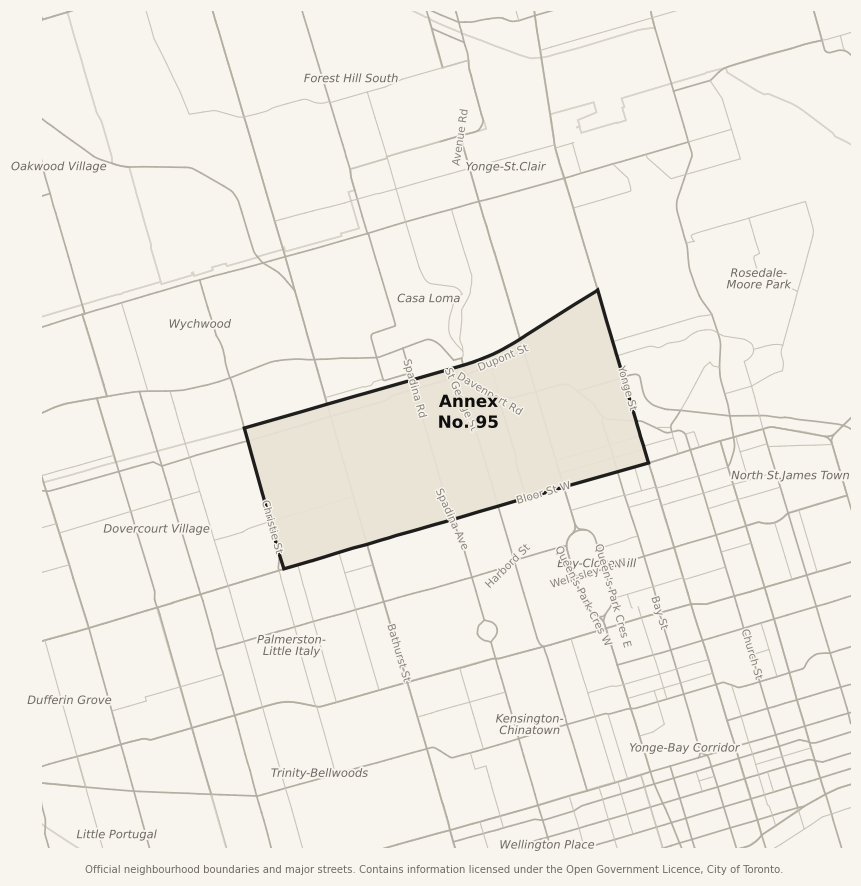
Official City of Toronto neighbourhood: Annex (No. 95).
The History
Yorkville’s story begins in the 1830s as a quiet village north of Toronto’s urban core, established by the Bloor family and named after York (Toronto’s former name). For over a century, it remained a quaint residential community, gradually absorbing residents fleeing the downtown congestion. The neighbourhood’s character shifted dramatically in the 1960s when young artists, musicians, and bohemians discovered its affordable rent and intimate coffee houses. This era, the golden age of Canadian folk music, saw future legends like Joni Mitchell, Neil Young, Gordon Lightfoot, and Leonard Cohen perform in clubs along Yorkville Avenue and Cumberland Street. The Yorkville Park Coffee House, the Half Pint, and other venues became pilgrimage sites for folk music devotees, establishing Toronto as a cultural centre rivalling even larger American cities.
The 1970s brought gradual gentrification, and by the 1980s and 1990s, Yorkville began its transformation into a luxury retail and residential destination. The opening of high-end boutiques, art galleries, and upscale restaurants signalled a fundamental shift in the neighbourhood’s identity. Wealthy Torontonians started investing in Victorian properties and new condo developments. The establishment of the Bloor-Yorkville Business Improvement Area formalized the neighbourhood’s role as a premium shopping and cultural district, attracting flagship stores from international designers and establishing strict standards for streetscape and business quality. This transformation accelerated dramatically in the 2000s and 2010s with the arrival of luxury supertall condominiums and the gentrification of every remaining corner.
Today, Yorkville represents the pinnacle of Toronto’s luxury real estate market. The Bloor-Yorkville BIA maintains strict architectural and commercial standards, ensuring the neighbourhood maintains its position as Canada’s most exclusive shopping destination and a global centre for ultra-high-net-worth real estate. Every block tells the story of this evolution, from heritage buildings housing contemporary art galleries to gleaming residential towers housing some of Canada’s wealthiest residents. The neighbourhood’s cultural institutions, including the Royal Ontario Museum and Art Gallery of Ontario nearby, cement its position as a centre of sophistication and taste.
What You’ll Actually Find Here
Ultra-Luxury Condominiums: Yorkville’s residential market is dominated by high-rise and mid-rise condominiums that cater to luxury buyers. The Four Seasons Private Residences (which occupy the upper floors of the iconic Four Seasons Hotel), One Bloor East (a architectural statement piece designed by Herzog & de Meuron), and The Yorkville (a collection of ultra-luxury suites) represent the pinnacle of residential condo development. These buildings offer concierge services, spa facilities, fine dining access, and residences with finishing quality that rivals five-star hotels. Units typically feature floor-to-ceiling windows, smart home technology, marble bathrooms, and access to premium amenities.
Victorian and Heritage Conversions: Scattered throughout Yorkville are converted Victorian mansions and row houses, though these are increasingly rare and typically occupied by single-family owners or subdivided into high-value rental units. These heritage properties, many dating to the late 1800s, offer substantial square footage and architectural character but command premium prices. Finding these for sale is exceptional, most owners hold them as legacy properties or generational assets.
Mid-Range Condo Market: Beyond the supertall flagships, Yorkville contains numerous mid-rise and older residential condos that offer more “affordable” entry points to the neighbourhood, though prices remain stratospheric by Toronto standards. Buildings constructed in the 1980s and 1990s offer smaller units (700-1,200 square feet) at lower price points than contemporary supertalls, though they typically lack the amenities and finishes of newer developments.
Freehold Properties: True freehold properties in Yorkville are vanishingly rare and typically substantial Victorian estates or heritage buildings worth multi-millions. The land itself commands extraordinary value, making new single-family construction virtually non-existent. Any detached house in Yorkville represents either a heritage preservation or a teardown opportunity valued primarily for its land position.
What Homes Cost in Yorkville (C02)
Luxury Condominiums: Yorkville is part of the TRREB community of Annex, in District C02. From January 1 to November 3, 2026, condo apartments in the Annex sold at a median of $835,000 (218 sales), a median of $1,012 per above-grade square foot. Penthouses and premium corner suites in premier buildings sell at the top of the market.
Mid-Range Condominiums: Smaller units in older buildings or less prominent newer developments sell for less. These represent better value but still reflect Yorkville’s premium positioning.
Freehold Properties: Over the same months, detached homes in the Annex sold at a median of $2,019,600 (21 sales), semi-detached homes at $1,725,000 (54 sales) and freehold townhouses at $1,736,000 (19 sales). These properties are valued almost entirely for their land, as buyers pay substantial premiums for the freehold structure itself.
In TRREB District C02, all home types averaged $1,712,023 over the 12 months to October 2026 (711 sales) and $1,599,139 in October 2026 alone (70 sales) (TRREB Market Watch).
Rental Market: In TRREB District C02, condo apartments leased for an average of $2,623 a month for one bedroom (280 leases) and $5,181 for two bedrooms (170) in the second quarter of 2026 (TRREB quarterly rental report). Rental demand supports condo investment fundamentals, particularly for units in trophy buildings.
What We Love About Yorkville
Walkability and Density: Yorkville offers exceptional walkability with virtually everything you need within a five to ten-minute walk. The neighbourhood’s concentration of shops, galleries, restaurants, and services means residents rarely need to venture elsewhere for daily necessities, despite being in the heart of the city. The tree-lined streets maintain a neighbourhood feel despite the urban density.
World-Class Retail and Dining: Nowhere else in Canada offers shopping and dining comparable to Yorkville’s concentration of flagship boutiques and Michelin-calibre restaurants. From the designer galleries of Hazelton Lanes and Cumberland Street to the fine dining establishments of Yorkville Avenue, the neighbourhood delivers unmatched luxury retail and culinary experiences. Restaurants like Alo, Edulis, and Bacchanal have achieved international acclaim.
Cultural and Institutional Anchors: The Royal Ontario Museum (ROM) and Art Gallery of Ontario (AGO) sit just south of the neighbourhood, while the Gardiner Museum of ceramic art, the Textile Museum of Canada, and countless private galleries throughout Yorkville create an extraordinary cultural ecosystem. TIFF (Toronto International Film Festival) operates facilities on and around Bloor Street, making film and culture central to the neighbourhood’s identity.
Architectural Heritage and Sophistication: The neighbourhood’s architectural vocabulary ranges from Victorian heritage buildings through contemporary glass towers, creating a sophisticated visual environment that avoids the homogeneity of some newer developments. The strict design standards of the Bloor-Yorkville BIA ensure that even new developments respect the neighbourhood’s aesthetic character.
Exceptional Transit Access: The Bloor-Yonge subway station provides direct access to both the TTC’s Line 1 (Yonge-University) and Line 2 (Bloor-Danforth), offering comprehensive connections across Toronto. The Bay station on the south side provides additional transit options. This transit infrastructure makes Yorkville accessible while its walkability reduces dependence on transit entirely.
Prestige and Status: Let’s be honest, Yorkville commands status precisely because it’s expensive and exclusive. A Yorkville address carries weight in Toronto’s social and business circles, something that matters to many residents. The neighbourhood’s reputation for elegance, culture, and wealth is cemented in the city’s collective consciousness.
The Honest Take
Extreme Pricing with Questionable Value: Yorkville’s premium pricing reflects scarcity, location, and brand appeal more than substantive advantages over neighbouring Rosedale or Forest Hill. You’re paying a significant premium for the Yorkville name and the luxury retail/cultural ecosystem, but comparable properties in adjacent neighbourhoods offer better value. Some condo buildings command prices that vastly exceed their actual quality and amenities.
Tourist Congestion: Yorkville attracts massive tourist crowds, particularly along Bloor Street and around Hazelton Lanes. Weekend pedestrian traffic can be overwhelming, and the neighbourhood lacks any real “locals only” feel. Residents frequently contend with crowds shopping, dining, and exploring cultural attractions.
Limited Green Space: Unlike wealthy neighbourhoods like Rosedale or Forest Hill, Yorkville offers minimal green space. While Yorkville Park provides a small oasis, the neighbourhood is predominantly urban with limited options for quiet nature immersion. Families seeking parks and playgrounds will be frustrated.
Not Family-Oriented: Yorkville is decidedly not a family neighbourhood. Schools are limited, parks are scarce, and the dense urban environment with heavy traffic and tourist congestion makes it challenging for families with children. Most young families find more suitable options in Rosedale, Lawrence Park, or the Annex.
Noise and Urban Intensity: Bloor Street maintains constant traffic noise, and the vibrant nightlife throughout the neighbourhood means ambient sound levels never drop to what many find comfortable for residential living. The urban intensity that some celebrate, others find exhausting.
Who Lives Here
Yorkville attracts a very specific demographic: ultra-wealthy individuals, many of whom are international buyers or pied-à-terre owners. You’ll find business executives, successful entrepreneurs, established professionals, and retirees who’ve downsized from larger family homes. The neighbourhood increasingly appeals to wealthy empty nesters and childless couples who value urban sophistication and proximity to culture and dining over space and schools.
A significant portion of Yorkville’s residential base comprises international luxury buyers, successful businesspeople from Asia, the Middle East, Europe, and Latin America seeking Toronto real estate as a hedge against currency fluctuation or as an investment. Many maintain primary residences elsewhere and use Yorkville properties as pied-à-terre for their Toronto visits. This international character has become increasingly pronounced in recent years.
Younger professionals and entrepreneurs, typically aged 28 to 40, form another significant demographic, drawn to the neighbourhood’s urban amenities and proximity to downtown offices and financial districts. These residents typically occupy smaller one and two-bedroom units rather than the multi-bedroom penthouses preferred by older, wealthier buyers.
Schools
Yorkville is poorly positioned for families with school-aged children. The primary public school serving the area is Jesse Ketchum Public School, a well-regarded institution serving the broader neighbourhood, but elementary school capacity is limited. Secondary students are served by Jarvis Collegiate Institute, a solid school but lacking the reputation and resources of schools in wealthier neighbourhoods further north.
Most Yorkville families opt for private education, with options including Upper Canada College (boys), Havergal College (girls), and various other independent schools in neighbouring areas. The neighbourhood’s unsuitability for public school families, combined with the cost of private alternatives, reinforces Yorkville’s positioning as a neighbourhood for childless households and empty nesters rather than growing families.
Families seeking quality schools are better served by neighbourhoods like Rosedale, Forest Hill, Lawrence Park, and the Annex, where family-oriented communities have developed around excellent public school options. Yorkville’s educational infrastructure reflects the neighbourhood’s adult-focused character.
Getting Around
Yorkville benefits from exceptional transit infrastructure. The Bloor-Yonge subway station, located at the neighbourhood’s southern edge, provides access to two major TTC lines: the Yonge-University Line and the Bloor-Danforth Line. This dual-line access offers unmatched connectivity across Toronto, with direct connections to downtown, the PATH system, and cross-town destinations. The nearby Bay station provides additional alternatives on Line 1.
Walking is the primary transportation method for Yorkville residents and visitors. The neighbourhood’s high walkability score reflects its density, mixed-use character, and the proximity of amenities. Most residents rarely require personal vehicles for daily activities, though parking is available in underground lots beneath residential buildings and commercial properties throughout the neighbourhood.
Yorkville’s street culture emphasizes walking and transit, with personal vehicle ownership less essential than in suburban or car-oriented neighbourhoods. Taxi and rideshare services are readily available on Bloor Street and other major avenues. Bike infrastructure has improved in recent years, though Yorkville’s steep hills and heavy pedestrian traffic make cycling less practical than in flatter, less congested neighbourhoods.
Things to Do
The neighbourhood itself functions as a primary attraction. Yorkville Village, the open-air shopping complex anchored by Whole Foods and featuring high-end retailers, serves as a focal point for retail and leisure. Hazelton Lanes, an enclosed shopping arcade featuring flagship boutiques and restaurants, attracts shoppers seeking premium fashion and accessories. Cumberland Street has emerged as the neighbourhood’s gallery district, with numerous contemporary art galleries showcasing established and emerging Canadian artists.
Bloor Street itself functions as a shopping destination, with flagship stores from Louis Vuitton, Hermès, Gucci, Chanel, and numerous other luxury brands creating one of North America’s premier shopping streets. The street’s retail density is unmatched in Canada. Beyond shopping, Bloor Street restaurants and cafes offer everything from casual dining to Michelin-calibre experiences.
Cultural institutions anchor the neighbourhood’s appeal. The Royal Ontario Museum sits immediately south, offering world-class exhibitions on natural history, world cultures, and art. The Art Gallery of Ontario, slightly further south, presents Canadian and international art in an architecturally stunning setting. The Gardiner Museum specializes in ceramic art, while the Textile Museum of Canada showcases textile design and history. TIFF operates multiple facilities on and near Bloor Street, hosting the prestigious Toronto International Film Festival each September and presenting year-round film programming.
The restaurant scene matches the retail sophistication. Fine dining establishments like Alo (Michelin-starred), Edulis, Bacchanal, and Scaramouche represent the pinnacle of Toronto’s culinary scene. More casual options abound, from sushi and contemporary Asian cuisine to Italian trattorias and French bistros. The concentration of high-quality restaurants per capita likely exceeds any other Toronto neighbourhood. Yorkville Avenue in particular has developed as a dining destination, with restaurants occupying Victorian heritage buildings and contemporary spaces.
Buying in Yorkville: What to Expect
Extensive Condo Due Diligence Required: Yorkville’s condo market demands more rigorous due diligence than other neighbourhoods due to the complexity of trophy buildings and the significant investment required. Buyers must examine status certificates carefully, understand reserve fund requirements, and assess the competence of condo boards overseeing these complex properties. Older buildings (1980s-1990s) may face substantial capital expenditure requirements.
Amenity Fees and Hidden Costs: Luxury condominiums in Yorkville carry high maintenance fees, particularly in trophy buildings; the median fee on the Annex condo apartments that sold in 2026 was $957 a month. These fees cover concierge, building maintenance, gym facilities, spa amenities, and common area upkeep. When purchasing, factor these substantial monthly costs alongside mortgage and property tax obligations. Some buyers underestimate the true cost of ownership when amenity fees are high.
Investment vs. Lifestyle Purchase Distinction: Yorkville buyers must honestly assess whether they’re making a lifestyle purchase (planning to occupy the property and enjoy the neighbourhood’s amenities) or an investment purchase (seeking capital appreciation and rental income). Properties purchased purely for investment with no intention of occupancy should be evaluated against alternative investment vehicles and real estate markets offering stronger fundamentals.
Building Selection and Reputation: Not all Yorkville buildings command equal prestige or appreciation potential. The Four Seasons Private Residences and One Bloor represent trophy properties with strong long-term outlooks, while other buildings offer less certain prospects. Proximity to Bloor Street and specific building management quality significantly impact resale value and appreciation potential. The team’s experience in Yorkville luxury real estate is essential in identifying buildings with solid fundamentals versus those trading primarily on neighbourhood prestige.
Resale Considerations: Ultra-luxury properties in Yorkville have limited buyer pools. While demand remains strong, the highest-end penthouses and rare freehold properties may require extended marketing periods. Liquidity decreases as price increases, particularly for distinctive or unusual properties. This limited buyer pool argues for conservative positioning and quality location selection.
Ready to Explore Yorkville?
Buying in Yorkville means navigating Toronto’s most exclusive condo market. Michael Ouzas and his team understand the nuances, from which buildings offer genuine value to which carry premium price tags without premium quality. Whether you’re seeking a pied-à-terre for your Toronto business visits, a luxury downsizing option from a larger family home, or an investment property in Toronto’s most prestigious address, we’ll help you find the right fit. The team’s deep experience in Yorkville real estate, combined with our understanding of the neighbourhood’s cultural and retail ecosystem, ensures you make an informed decision aligned with your lifestyle and investment objectives. Contact us to explore Yorkville and discover how a residence in Canada’s most glamorous neighbourhood can enhance your Toronto experience.
Related Neighbourhood Guides
Exploring other prestigious Toronto neighbourhoods? Check out our guides to Rosedale, Forest Hill, Lawrence Park South, King West, and Liberty Village.