Lawrence Park South is Toronto’s most exclusive and expensive residential enclave, a neighbourhood where heritage estates and modern mansions sit on sprawling ravine-backed lots along tree-lined streets. Located in TRREB District C04, this is where Toronto’s top earners, C-suite executives, established entrepreneurs, and old-money families, have chosen to build their legacy homes for over a century. Walking through Lawrence Park South feels like stepping into a private world of architectural grandeur, mature landscaping, and the kind of quiet elegance that comes with serious generational wealth. This is not a neighbourhood for everyone, and that’s entirely the point.
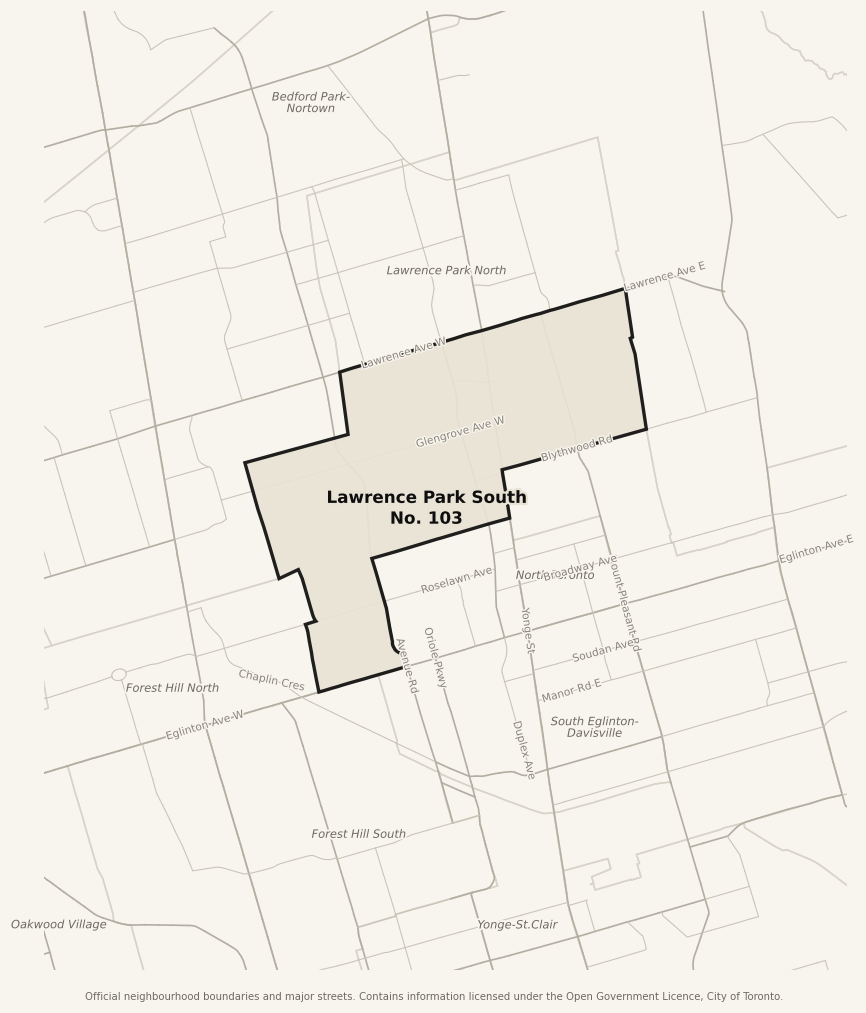
Official City of Toronto neighbourhood: Lawrence Park South (No. 103).
The History
Lawrence Park South has deeper historical roots than its northern counterpart, dating back to the early 1900s when the broader Lawrence Park estate was developed by real estate entrepreneur Frank O’Meara. The neighbourhood emerged from what was originally part of the Mount Pleasant area, with development beginning around 1910. The southern section was more slowly built out than the North, with many early homes dating from the 1920s through 1940s, a period when Toronto’s professional class and wealthy merchants were seeking refuge from downtown density in substantial estate properties.
The neighbourhood’s connection to Mount Pleasant cemetery to the west has always been part of its character, it created a natural boundary and ensured that undeveloped parkland would protect the enclave from commercial creep. Early residents were prominent Toronto figures: industrialists, bankers, judges, and physicians who built or commissioned homes that reflected their status. Unlike some Toronto neighbourhoods that underwent significant transitions over the decades, Lawrence Park South has remained remarkably consistent in its raison d’être: a sanctuary for Toronto’s highest-income households and their substantial residential properties.
The post-war period saw selective modernization and renovation rather than wholesale redevelopment. It wasn’t until the 1990s and especially the 2000s that significant teardown activity began, as property values skyrocketed and the economics of replacing older homes with new custom builds became compelling. Today, you’ll find a fascinating mix of carefully preserved historic homes and contemporary luxury construction, a tension that defines the neighbourhood’s current character.
What You’ll Actually Find Here
Original Character Homes (1920s-1940s): These are the homes architecture buyers come for. You’ll find substantial brick and stone detached homes with slate roofs, leaded glass windows, and craftsmanship details that would be enormously expensive to replicate today. Many feature grand entry halls, high ceilings, crown moulding, and wood-panelled libraries. Properties like those on Ardmore Street, The Crescent, and parts of Bayview Avenue showcase this heritage authenticity. Some have been meticulously maintained by families who’ve owned them for generations; others have been selectively updated while preserving their character bones.
Significant Renovations & Restored Properties: A substantial portion of the neighbourhood consists of original homes that have undergone comprehensive updates, knocking through walls for modern open-plan living, adding primary suites with spa-like ensuite bathrooms, updating kitchens with professional-grade appliances, and creating home offices and wine cellars. These homes retain the generous lot sizes and established landscaping of the originals while offering contemporary interiors. They typically represent the best value proposition in the neighbourhood.
Teardowns and New Builds: Over the past 15-20 years, the teardown phenomenon has accelerated dramatically in Lawrence Park South. Older homes on prime lots, particularly those with significant ravine views or exceptional proportions, are increasingly demolished to make way for new construction. These new builds typically range from 6,000-12,000+ square feet, featuring multiple storeys, smart home technology, geothermal systems, wine cellars, gyms, home theatres, and guest houses. They’re designed for a lifestyle of entertaining and privacy, with meticulous attention to materials and finishes. Properties like those being developed on Summit Avenue and parts of Bayview represent this new wave of wealth expression in the neighbourhood.
Heritage-Protected Properties: Several homes in Lawrence Park South carry heritage designations that restrict demolition and require sympathetic restoration. These include some exceptional examples on The Crescent and Ardmore Street. While this protection preserves architectural history, it can complicate ownership and renovation for some buyers, though it also protects the neighbourhood’s character and justifies premium pricing for buyers seeking authentic period properties.
What Homes Cost in Lawrence Park South (C04)
Detached Houses: From January 1 to November 3, 2026, detached homes in the TRREB community of Lawrence Park South sold at a median of $2,750,000 (93 sales). Smaller, older homes requiring substantial renovation sell for less; exceptional properties with significant heritage status, prime ravine lots, or new custom builds with 8,000+ square feet sell at the top of the market.
Over the same months, semi-detached homes sold at a median of $1,400,000 (5 sales), condo apartments at $950,000 (25 sales), and 2 freehold townhouses and 2 condo townhouses also sold.
In TRREB District C04, all home types averaged $2,060,899 over the 12 months to October 2026 (660 sales) and $2,202,807 in October 2026 alone (62 sales) (TRREB Market Watch).
Cost Per Square Foot: Detached homes in Lawrence Park South sold at a median of $1,149 per above-grade square foot over the same months; new construction and extensively renovated homes sell for more per square foot, and older properties being renovated for less. These metrics, however, tell only part of the story, what truly drives pricing is land value. A one-acre property in Lawrence Park South commands a premium measured in millions simply for the land beneath it, before any structure is considered.
Lawrence Park South consistently ranks as one of Toronto’s, and Canada’s, most expensive residential neighbourhoods, comparable to Forest Hill, Rosedale, and Yorkville in price trajectory, though with notably larger average lot sizes that actually offer more square footage value than the downtown core’s priciest areas.
What We Love About Lawrence Park South
Architectural Grandeur: Where else in Toronto can you find such a concentration of exceptional homes representing a century of design and craftsmanship? From Edwardian and Victorian mansions to mid-century moderns to contemporary estates, Lawrence Park South is an architectural archive. The neighbourhood rewards those who appreciate fine building, original details, and the kind of domestic design that reflects serious investment in materials and aesthetics.
Mature Ravine Lots with Serious Privacy: The neighbourhood’s ravine geography creates a remarkable feature: homes are often set back substantially from the street, surrounded by mature landscaping and natural topography that makes properties feel genuinely secluded despite being in the heart of Toronto. You can have a conversation outside without worrying about being overheard from the street. Many properties feature ravine views to the south and west. In a city increasingly defined by proximity and density, this degree of privacy feels genuinely luxurious.
Prestige Address with Substance: Unlike many “prestige” neighbourhoods, Lawrence Park South has earned its reputation. The families here have been building wealth and community for generations. There’s no marketing required, everyone in Toronto knows what Lawrence Park South means. It’s a neighbourhood where address actually conveys something meaningful about achievement and resources.
Excellent Schools: Blythwood Public School is consistently ranked among Toronto’s top elementary schools, with involved parents and strong academics. High school students typically attend Bloor Collegiate Institute or University of Toronto Schools (private). The neighbourhood’s demographics ensure that schools have engaged families with resources to support education, creating positive peer environments.
Quiet, Tree-Lined Streets with Minimal Through Traffic: Because Lawrence Park South’s streets don’t connect directly to major thoroughfares and are somewhat labyrinthine in their layout, the neighbourhood has virtually no through traffic. You’ll encounter other residents walking, cycling, or getting in and out of their own properties, not streams of commuters. The mature trees lining every street create a canopy that feels almost rural, which is remarkable for a neighbourhood so central to the city.
Walk to Yonge & Lawrence: While the neighbourhood itself is car-dependent (as we’ll discuss in the honest take), you’re walking distance to the very vibrant Yonge & Lawrence commercial corridor, which has excellent restaurants, shops, and services. It’s a sweet spot: you live in profound quiet and seclusion but can walk to good restaurants and cafes in about 10 minutes.
The Honest Take
The Extreme Price Barrier: Let’s be direct: if you’re looking at Lawrence Park South, you need north of $3 million in liquid capital available for a down payment, and you need legitimate six-plus-figure household income to carry a mortgage and property taxes that could exceed $40,000-$60,000 annually on a $5 million property. This isn’t a neighbourhood where you’re priced out of the market by a few hundred thousand dollars, you’re either in the game at this price point or you’re not. For most Toronto buyers, this is academic. That’s fine. It keeps the neighbourhood precisely as it is.
Constant Construction from Teardowns: Lawrence Park South is in the middle of an active rebuilding phase. On any given drive through the neighbourhood, you’ll encounter multiple demolition and construction projects. Some are quick (12-18 months); others go on for years. This creates noise, dust, traffic disruption, and visual chaos for adjacent properties. If you’re looking for perfect quiet and tranquility, you may find yourself unlucky enough to have a construction site two properties over. The good news is that individual projects are finite. The challenging part is that the phenomenon is neighbourhood-wide and ongoing.
Limited Walkability Outside the Immediate Yonge Corridor: While Yonge & Lawrence is accessible, the neighbourhood itself is car-dependent. You won’t be popping out to grab a coffee without driving (or expecting to be back in 5 minutes on foot). Restaurants, grocery stores, and services are concentrated along Yonge, with sparse commercial activity elsewhere. If you’re a person who loves neighbourhood walkability, spontaneously stopping at independent shops, bumping into friends at local cafes, Lawrence Park South may feel isolating. This is absolutely intentional neighbourhood design, but it’s worth acknowledging.
A Car-Required Lifestyle: Toronto’s public transit system doesn’t penetrate Lawrence Park South meaningfully. The closest subway access is Bloor-Yonge or Lawrence stations, both requiring a drive or substantial walk. If you rely on transit, this neighbourhood is impractical. Most residents drive, to work, to shops, to social obligations. If you’re someone committed to a car-free or car-light lifestyle, Lawrence Park South isn’t for you, full stop.
Serious Property Maintenance Costs and Responsibilities: The homes here are large, the lots are expansive, and the properties require significant investment to maintain. Estate homes from the 1920s-40s have charm but also have older mechanical systems, potential foundation concerns, roof complexity, and historic preservation responsibilities. New builds cost $8,000-$15,000+ annually just in property maintenance. Property taxes alone on a $5 million home run $30,000-$40,000+ per year. Heat, hydro, insurance on a 10,000-square-foot home will run substantial. You’re not just buying a home; you’re buying a significant annual operating commitment. Owners who treat this as a simple real estate transaction rather than a lifestyle choice often become frustrated.
Who Lives Here
Lawrence Park South residents are Toronto’s economic elite. You’ll find CEOs and C-suite executives from major Canadian corporations, successful entrepreneurs and business owners, established professionals (prominent lawyers, surgeons, dentists), and families with multi-generational wealth. Many are second-generation or third-generation Toronto money, families who’ve been prominent in the city for decades. There’s also a segment of newer wealth, successful tech entrepreneurs, private equity executives, and international business leaders who’ve relocated to Toronto.
What unites residents is not necessarily their origin story but their commitment to privacy, quality, and the aesthetic and social values that come with living in a neighbourhood that demands serious financial commitment. The community is relatively insular, not unfriendly, but definitely inward-focused. People here tend to socialize with other residents and their broader professional networks rather than viewing the neighbourhood as a place to “meet people.” Many residents have lived here for 20+ years and know their neighbours well. Younger families moving in are often the exception and may find the demographic skews older and more established.
The neighbourhood has minimal transience. People buy these homes intending to stay for decades, raise children here, and eventually pass them down or sell to similarly-situated buyers. The turnover is relatively low compared to most Toronto neighbourhoods, which contributes to the established, exclusive feel.
Schools
Blythwood Public School serves the neighbourhood and is consistently ranked among Toronto’s top elementary schools. Average family income is very high, parent involvement is substantial, and test scores reflect this. The school has strong arts programming, dedicated teachers, and the kind of cohesive community that comes when all families have significant resources. Students typically transition to high schools across Toronto’s elite academic programs: University of Toronto Schools, Upper Canada College, St. Andrew’s College, or TDSB’s top academic programs (like Bloor CI).
For high school, most Lawrence Park South students attend either UTS (private, highly selective, excellent academics) or Bloor Collegiate Institute (public TDSB school with strong academics and engaged student body). Some families opt for private school environments like Upper Canada College or St. Andrew’s College, which draw from similar neighbourhoods and serve a similar demographic. The secondary schools themselves are not in the neighbourhood but are easily accessible via car or transit from Lawrence Park South.
The neighbourhood’s demographics, high family income, educated parents, strong expectation for educational achievement, mean that school culture is academically oriented. This appeals to some families and may feel pressurized to others. There’s no question that Blythwood parents are actively involved in school governance, fundraising, and programming, which benefits the school but also creates significant social expectation around involvement and participation.
Getting Around
Lawrence Park South is definitively car-dependent. There’s no meaningful transit penetration within the neighbourhood. While Yonge Street itself has multiple transit options (streetcar, bus, and subway stations), getting from your home on Ardmore or The Crescent to Yonge Street requires either a 10+ minute walk downhill or driving. For daily commuting, shopping, social obligations, and entertainment, car ownership is essentially mandatory.
That said, Lawrence Park South’s location relative to major routes is excellent. You’re minutes from the Bloor viaduct (northbound access to DVP), Yonge Street (straight shot downtown), and the Avenue Road corridor heading north. Getting downtown takes 15-20 minutes in off-peak traffic. Getting to Pearson Airport is straightforward via either the gardiner or northern routes. Getting to the 401 is quick. For a neighbourhood with such a car-centric orientation, the access to major routes is genuinely efficient.
Cycling is possible on Yonge Street but limited within the neighbourhood itself, which has hills and limited infrastructure. Walking is pleasant for recreation (street walks, ravine walks) but impractical for shopping or services unless you’re focused on the Yonge & Lawrence corridor. The physical geography, ravines, hills, tree canopy, makes the neighbourhood feel disconnected from broader Toronto, which is part of its appeal but also reinforces the car-dependent reality.
Things to Do
Yonge & Lawrence Commercial Corridor: The intersection of Yonge and Lawrence has evolved into one of Toronto’s more vibrant mid-range commercial areas. You’ll find excellent restaurants including staples like Terroni (casual wood-fired pizza), Pai (Thai cuisine), and Kaba Espresso Bar for coffee culture. There’s a strong retail component: independent shops, services, and a feel that’s distinct from big-box commercial. The streetcar line on Yonge creates a pedestrian-oriented environment that contrasts nicely with the quiet residential streets just a block away. This is walkable from the neighbourhood for those willing to do the 10-minute downhill walk, though most residents drive.
Sherwood Park: Located at the west end of the neighbourhood near Mount Pleasant, Sherwood Park is a small but well-maintained park with playground equipment, open green space, and recreational facilities. It’s not a major destination but serves the neighbourhood’s day-to-day recreation needs. The park connects to ravine trails that wind through the neighbourhood’s natural topography.
Ravine System and Natural Trails: Lawrence Park South’s defining geographic feature is its ravine system, which creates stunning natural landscapes and offers walking, jogging, and cycling opportunities. The ravines connecting south toward the Rosedale Valley offer miles of trails through mature forest. For residents, this is a major recreational asset, you can literally step out of your property and be in nature. The ravines are particularly stunning in spring and fall when the tree canopy is most dramatic.
Mount Pleasant Cemetery: Just west of the neighbourhood, Mount Pleasant Cemetery is actually a remarkably beautiful landscape with mature trees, walking paths, and cultural significance. While visiting a cemetery isn’t everyone’s idea of recreation, the physical space offers peaceful walking opportunities and serves as a natural boundary protecting the neighbourhood from commercial encroachment from the west.
Mount Pleasant Area Dining and Culture: Just south, the Mount Pleasant area (around Bloor East) has a growing selection of restaurants, coffee shops, and retail. It’s close enough for residents willing to drive 5-10 minutes, creating easy access to casual dining, independent shops, and cultural activities without being in the heart of the commercial city.
Buying in Lawrence Park South: What to Expect
Prepare for Lengthy Due Diligence: These homes are complex assets. New builds require detailed review of construction schedules, completion timelines, and custom specifications. Heritage homes or extensively renovated properties need serious inspection for foundation stability, roof condition, mechanical systems, and hidden defects that could cost substantial capital to address. Budget for thorough professional inspections, don’t skip this. The purchase price is so significant that spending $10,000-$20,000 on comprehensive professional due diligence is trivial relative to the total investment.
Understand Your True Annual Carrying Costs: Property taxes, insurance, utilities, and routine maintenance on a $5 million home aren’t academic. Do the math: $5 million home at 0.8% property tax rate = $40,000 annually in taxes alone. Insurance on a $10,000-square-foot home could run $4,000-$7,000 annually. Heat and electricity could reach $10,000+ annually in winter. Routine maintenance (lawn care, tree service, gutter cleaning, seasonal repairs) could easily run $15,000-$25,000 annually. On a new build, these numbers might be lower initially; on a heritage property, they could be higher. A $5 million home with $2 million mortgage at current rates carries roughly $80,000+ annually in property carrying costs. Make sure you understand what you’re actually committing to.
Expect Competition from International Buyers and Cash Buyers: Lawrence Park South attracts local, national, and international buyers with significant capital. You may find yourself competing against all-cash offers from out-of-province entrepreneurs or international money. In a neighbourhood at this price point, appraisals are rarely the limiting factor in offers, it’s simply what people are willing to pay. If someone else wants the property and has more capital available, you may find yourself unable to compete. That’s the reality at this tier.
Consider the Teardown Decision Carefully: If you’re buying a property that sits on a valuable lot but contains an older home, you’ll face the teardown vs. renovate decision. Tearing down and rebuilding might cost $2-4 million additional capital and take 18-36 months. Extensively renovating an existing home might cost $1-2 million and take 12-18 months but preserve character. There’s no universal right answer, but you need to think through the timeline, cost, and ultimate vision before committing to the property. Some buyers underestimate these costs; some find the construction timeline more disruptive than anticipated. Think it through carefully.
Work with Specialists Who Know This Neighbourhood: Not every real estate agent understands the nuances of Lawrence Park South. You need someone with direct experience in the neighbourhood, understanding of estate properties, contacts with architects and builders, and realistic perspective on the market. This neighbourhood rewards specialists. Similarly, your lawyer needs to understand heritage designations (if applicable), complex building contracts, and the kinds of title issues that can emerge with older properties.
Factor in Personalization and Customization Costs: Whether you’re buying a new build and customizing finishes or buying an existing home that needs updating, budget for the reality that professional customization at this price point costs significantly more than you might imagine. A kitchen renovation in a $5 million home easily runs $200,000-$400,000+. Bathrooms run $75,000-$150,000 each. Understand what you’re actually committing to if you plan to personalize the space.
Ready to Explore Lawrence Park South?
Buying in Lawrence Park South is a significant investment in one of Toronto’s most exclusive residential enclaves. Michael Ouzas and the Michael Ouzas Real Estate Team work Lawrence Park South and price from the actual sales on and around the street. We understand the complexity of heritage properties, the nuances of new custom builds, and the investment mentality that drives purchasing decisions at this level. If you’re seriously considering Lawrence Park South, we’d welcome the opportunity to share our perspective and help you find exactly what you’re looking for. Contact us to explore Lawrence Park South.
Related Neighbourhood Guides
Exploring similar prestigious neighbourhoods? Check out our guides to Lawrence Park North, Bedford Park, Forest Hill, Rosedale, and Yorkville.
Lawrence Park South Sold Prices in 2026
Every MLS® sale from January 1 to November 3, 2026. Price per square foot uses above-grade size; the basement is not included.
| Type | Sales | Median price | Per sq ft | Sold over asking |
|---|---|---|---|---|
| Detached houses | 93 | $2,750,000 | $1,149 | 24% |
| Semi-detached houses | 5 | $1,400,000 | $974 | 40% |
| Condo apartments | 25 | $950,000 | $876 | 8% |
The same house sells for about 7% more here than across TRREB district C04 as a whole. In Lawrence Park South, the same house sells for about 13% more east of Yonge than west of Yonge.
See the full pocket-by-pocket numbers on the Toronto C04 stats page.