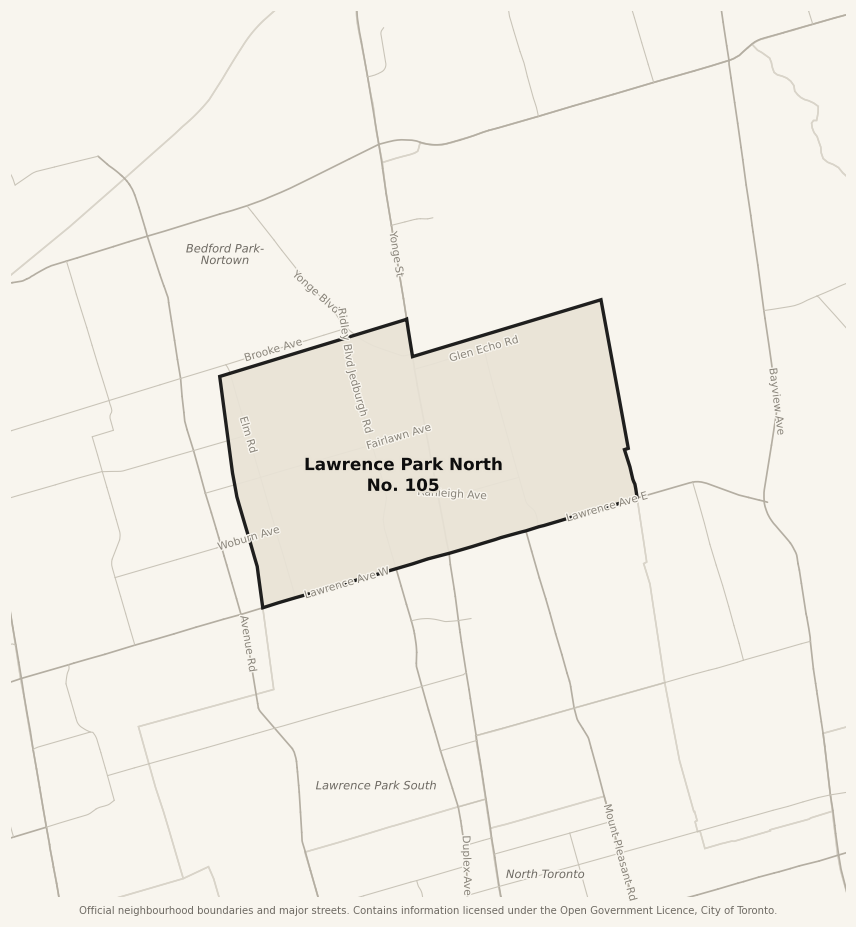
Lawrence Park North is Toronto’s quintessential established neighbourhood, where century-old architecture meets the kind of quiet, tree-lined residential character that money alone cannot buy. Bounded roughly by Yonge Street to the west, Lawrence Avenue to the south, and Blythwood Road to the north, this TRREB District C04 area has long been home to Toronto’s most successful professionals, executives, and established families who value architectural pedigree, mature landscaping, and proximity to some of the city’s best schools. Homes here range from stately detached houses on large, manicured lots to the occasional modern renovation, but what unites them is an unmistakable sense of permanence and privilege that defines the neighbourhood.
Official City of Toronto neighbourhood: Lawrence Park North (No. 105).
The History
Lawrence Park North was developed in the early 1900s as part of a larger vision for an exclusive garden suburb north of Lawrence Avenue. Wilfrid Dinnick, a Toronto businessman and philanthropist, along with the Eaton family connections and other prominent city figures, envisioned this area as a retreat for Toronto’s elite, a place where grand estates could sit on substantial lots surrounded by mature trees and private driveways. Unlike the more densely developed neighborhoods further south and west, Lawrence Park was conceived as a neighbourhood of spacious properties and architectural statement homes. The earliest residences, built between 1905 and 1920, reflect the predominant architectural styles of the era: Tudor Revival, Georgian Revival, and Classical designs that borrowed heavily from English country estates and American Colonial architecture.
The neighbourhood’s character solidified during the 1920s and 1930s as more grand homes were constructed, many designed by prominent Toronto architects of the day. This period saw the establishment of Lawrence Park Collegiate Institute (originally a boys’ school) and the development of key institutions like John Ross Robertson Public School, which served the neighbourhood’s growing population of professional families. The tree-planting initiatives of this era created the iconic canopy of mature oaks, maples, and elms that still define the streets today. Lawrence Park North became a destination for those who had “made it” in Toronto, a place to build your substantial home and raise your family in established comfort.
Post-World War II expansion brought additional development and renewal, though the neighbourhood’s fundamental character, one of substantial detached homes on large lots, remained intact. Unlike many inner Toronto neighbourhoods, Lawrence Park North resisted densification and apartment development. The late 1970s and 1980s brought some of the first significant teardown-and-rebuild activity, as older homes were demolished to make way for modern versions that could better serve contemporary family needs while respecting the neighbourhood’s low-rise character. This tension between preservation and modernization continues today, with heritage advocates and longtime residents occasionally pushing back against excessive development while acknowledging that some level of renewal is necessary and inevitable.
What You’ll Actually Find Here
Tudor and Georgian Revival Estates: The dominant housing stock in Lawrence Park North consists of substantial detached homes built between 1905 and 1940, predominantly in Tudor Revival and Georgian Revival styles. These homes typically feature brick or stone exteriors, slate roofs, leaded windows, and architectural details that reference European country manor homes. A typical example might be a 5,000-8,000+ square foot home on a lot of 100-150 feet in depth, with mature landscaping, stone walls or brick boundaries, and circular driveways. Many retain original woodwork, fireplaces, built-in cabinetry, and architectural character that commands premium pricing among buyers seeking “authentic” period homes. The quality of original craftsmanship in these homes, hand-laid brickwork, solid plaster work, hardwood floors, represents a level of construction no longer feasible at comparable price points.
Colonial Revival and Neoclassical Homes: Interspersed throughout Lawrence Park North are substantial Colonial Revival and neoclassical homes, many featuring symmetrical facades, columned porches, and classical proportions. These homes often sit on corner lots or prominent positions and represent a slightly more formal, less whimsical architectural approach than the Tudor homes. They range from well-maintained originals to extensively renovated versions. Many feature spacious principal rooms with high ceilings, formal dining rooms, and libraries or studies, spaces designed for entertaining at the level expected of Toronto’s business elite in the early 20th century.
Renovated and Modern Interpretations: Over the past 20-30 years, an increasing number of properties have undergone significant renovations or complete rebuilds. Modern Lawrence Park North homes often feature open-concept main floors that respect the original footprint and exterior character while updating interiors to contemporary standards. You’ll find homes with state-of-the-art kitchens, spa-like bathrooms, smart home technology, and expanded second-storey additions, all while maintaining the neighbourhood’s essential character. Some newer builds are total teardowns that reconstruct the original home’s footprint in a thoroughly modern manner, which remains somewhat controversial among heritage-minded neighbours.
Lot Size and Landscaping: What truly sets Lawrence Park North apart is the sheer scale of properties. Lots typically range from 80-150+ feet in depth and 40-60 feet in width, enormous by Toronto standards. This generous lot size permits substantial setbacks from the street, long driveways, mature tree canopies, and private rear gardens. Many properties feature professionally maintained landscapes with specimen trees, evergreen hedging, manicured lawns, or creative shade gardens beneath the tree canopy. The mature landscaping, particularly the soaring oaks, maples, and cedars, creates a parklike setting that is largely irreplaceable. A property with a 40-year-old oak tree in the front yard cannot be replicated; it can only be preserved or destroyed.
What Homes Cost in Lawrence Park North (C04)
Detached Homes: From January 1 to November 3, 2026, detached homes in the TRREB community of Lawrence Park North sold at a median of $2,031,000 (91 sales), semi-detached homes at $1,697,450 (34 sales) and condo apartments at $950,000 (6 sales). Premium properties on prestigious streets or featuring exceptional renovation work sell at the top of the market, and properties on streets like Lawrence Avenue West, Elm Avenue, or featuring exceptional architecture command top-of-market pricing.
In TRREB District C04, all home types averaged $2,060,899 over the 12 months to October 2026 (660 sales) and $2,202,807 in October 2026 alone (62 sales) (TRREB Market Watch).
Renovation Premiums: The quality of recent renovation work dramatically affects pricing. A home that retains original architectural details, period woodwork, and fireplaces while featuring a contemporary kitchen, bathrooms, and HVAC systems will command a significant premium. Buyers increasingly value “authenticity with amenities”, homes that look period-appropriate from the street but function as modern residences within. A property that is a money pit (requiring six figures in mechanical work, roof replacement, foundation repair) will see pricing adjusted accordingly, even if the bones are good.
Lot Size Premium: Properties with unusually large lots (150+ feet deep, corner locations) or exceptional mature trees command outsized premiums. The scarcity of large development-potential lots makes any property with 10,000+ square feet of buildable lot area a potential redevelopment opportunity, attracting investors and developers willing to pay substantially for the teardown value.
What We Love About Lawrence Park North
Architectural Character and Heritage: There is simply nowhere else in Toronto where you can walk residential streets and encounter such consistent, high-quality architectural heritage. Nearly every home tells a story, substantial brick or stone construction, slate roofs, carefully detailed cornices and trim work, original iron railings. This is not suburban homogeneity; it is the product of early-20th-century wealth and taste, where architects were hired to create distinctive homes that reflected their owners’ status and refined aesthetic sensibilities.
Mature Tree Canopy and Parklike Setting: The neighbourhood’s most intangible but most valuable asset is the mature canopy of 80-100-year-old oaks, maples, and other specimen trees. These trees create a leafy, established feeling that newer or denser neighbourhoods simply cannot replicate. Walking Lawrence Park North in late spring or early fall, when the canopy is full and the light filters through in dappled patterns, is one of Toronto’s great residential experiences. This canopy is under pressure from development, disease, and age-related decline, making preservation increasingly important.
Excellent Schools and Established Families: Lawrence Park North is home to John Ross Robertson Public School and feeds into Lawrence Park Collegiate Institute, both of which have strong reputations. The neighbourhood attracts multi-generational families who remain for decades, creating a stable, established community feel. School communities tend to be engaged and connected, with active parent associations and strong social networks that have formed over decades.
Quiet, Safe, and Residential: This is a neighbourhood where children play on tree-lined streets with minimal through-traffic, where the loudest noise is typically a leaf-blower or the occasional emergency vehicle. Crime rates are low, property crimes are rare, and the entire neighbourhood has a settled, peaceful quality that appeals to families and professionals who value tranquility. Street life is minimal by design, the neighbourhood intentionally lacks the cafe culture, retail buzz, and pedestrian activity of trendier areas, which is precisely why some people prize it.
Ravine Access and Green Space: The western edge of Lawrence Park North borders several significant ravines that cut down toward the Don Valley, providing access to extensive trail systems and natural areas. Properties bordering the ravine are particularly prized for the combination of private green space, mature vegetation, and proximity to nature. These ravines create natural buffers between neighbourhoods and contribute to the area’s horticultural character.
Proximity to Yonge Street Amenities Without Density: Lawrence Park North sits just far enough from Yonge Street to avoid the traffic and density associated with major arterial roads, but close enough that Yonge & Lawrence and its surrounding retail and dining are accessible. You get proximity to urban amenities without urban density in your immediate residential environment.
The Honest Take
Extraordinarily Expensive Entry Point: Let’s be direct: Lawrence Park North is not affordable. Detached homes there sold at a median of $2,031,000 in 2026. For first-time home buyers, young professionals, or anyone price-sensitive, this neighbourhood is simply out of reach. The premium attached to the name, the heritage, and the established neighbourhood status is significant and fully reflected in asking prices. If you’re buying here, you need to have real wealth, not aspirational debt.
Older Homes Require Substantial Investment: The architectural character that makes Lawrence Park North distinctive comes with a maintenance burden. Homes built in 1920 require updated electrical, plumbing, HVAC, and roofing systems. Tudor homes with slate roofs face six-figure replacement costs every 80-100 years. Stone or brick foundations occasionally require pointing or repair. Original windows, while beautiful and architectural character-defining, offer minimal insulation compared to modern equivalents. Buyers consistently underestimate the cost of bringing old homes to modern standards of comfort, efficiency, and safety. A $3.5 million purchase can easily incur $500,000-$1 million in genuine deferred maintenance and updates.
Car-Dependent Neighbourhood Despite TTC Access: While Lawrence station on the Yonge line provides transit access, and buses run along Lawrence and other main streets, Lawrence Park North is fundamentally a car-oriented neighbourhood. Most properties have multi-car driveways, and residents drive for shopping, schools, and professional travel. The neighbourhood lacks the walkable density necessary for car-free living. If you’re committed to car-free or car-light living, this is not your neighbourhood. Conversely, Lawrence Park North is ideal for families with multiple vehicles and driving routines.
Limited Walkable Retail and Dining: The neighbourhood itself is purely residential. There are no grocery stores, coffee shops, or restaurants within the neighbourhood boundaries. Yonge Street (approximately 3-5 minute walks away) offers retail, dining, and services, but the neighbourhood core is retail-free by design. This reinforces the residential-only character but means that daily retail needs require walking to adjacent areas or driving to other neighbourhoods.
Property Tax Burden for Older Homes: While all Toronto residential properties pay municipal property tax, older homes in Lawrence Park North with substantial square footage and lot sizes generate notable annual tax bills. A $4 million home in this neighbourhood can easily carry annual property taxes of $15,000-20,000+ depending on assessment values and any property improvements. This is not a neighbourhood for those sensitive to tax burden.
Limited Rental Market and Institutional Change: Lawrence Park North is almost exclusively owner-occupied single-family homes. There is virtually no rental market here, no bachelor apartments, no purpose-built rental condominiums, limited rooming houses or shared accommodation. This homogeneity means younger professionals, recent immigrants, or those working temporarily in Toronto are unlikely to live here. The neighbourhood consequently has limited demographic diversity and limited influx of younger household formations.
Who Lives Here
Lawrence Park North is home to Toronto’s established professional class: senior executives, lawyers, physicians, business owners, and professionals in their peak earning years. Many residents are entrepreneurs or executives with substantial personal wealth accumulated over decades. You’ll find multi-generational families, grandparents who bought in the 1960s, their children who inherited or purchased during rising markets, and grandchildren navigating affordability challenges. The neighbourhood attracts international professionals (diplomats, senior international business people, wealthy immigrants from established markets like Europe, the UK, and Asia) seeking an established, prestigious Toronto address.
Demographically, the neighbourhood skews older than Toronto’s citywide average, reflecting both the presence of long-term residents who have aged in place and the reality that younger families typically cannot afford entry. It is predominantly white and affluent, with limited racial or ethnic diversity compared to more central Toronto neighbourhoods. Religious diversity exists but is less visible than in other areas. Household compositions are predominantly married couples with children or empty-nesters, with limited single-person or non-traditional households.
What unites Lawrence Park North residents is not a shared lifestyle, ideology, or demographic characteristic, but rather a shared location choice and economic capacity to live here. Some residents are traditional, socially conservative, and deeply embedded in the neighbourhood for decades. Others are newcomers seeking prestige and established infrastructure. What they share is sufficient income or wealth to afford $3-5+ million properties and the choice to locate in an established, quiet, architecturally significant neighbourhood rather than newer, trendier, or more urban alternatives.
Schools
John Ross Robertson Public School: John Ross Robertson (JRR) is Lawrence Park North’s primary public elementary school, serving students from JK through grade 6. The school has a strong reputation for academic achievement, active parent engagement, and a traditional approach to education. It is housed in a beautiful heritage building consistent with the neighbourhood’s architectural character. JRR has French Immersion and English stream options, both of which are popular and competitive. Wait lists for popular classrooms are common. The school’s principal, administration, and teachers are generally regarded as capable and engaged, though like all Toronto schools, the institution operates under budget constraints and increasing student diversity. Many Lawrence Park North families choose JRR and remain in the neighbourhood specifically for the elementary school experience.
Lawrence Park Collegiate Institute (LPCI): Lawrence Park CI is a leading secondary school within the Toronto District School Board, serving grades 7-12. LPCI has a reputation for academic rigor, strong athletics (particularly hockey, rowing, and soccer), and numerous academic clubs and enrichment opportunities. The school offers specialized programs including International Baccalaureate (IB), Advanced Placement (AP), and other advanced curricula. Like all secondary schools in Toronto, LPCI draws from a broader catchment area than just Lawrence Park North, so the student population is more demographically diverse than the neighbourhood itself. The school building is a heritage structure with heritage challenges, heating, ventilation, and technological infrastructure are perennially under discussion, but the administration and faculty are generally well-regarded. Lawrence Park CI alumni remain closely connected through an active alumni association, and attendance at LPCI is a common shared experience among established Lawrence Park North families.
Private School Options: Parents seeking alternatives to the public system have excellent options within proximity. Branksome Hall, an independent all-girls school, is located on Avenue Road near Bloor and serves grades JK-12. Bishop Strachan School (BSS), also a leading independent girls’ school, is located at Dundas and Spadina (further south but accessible). Upper Canada College, the leading boys’ school, is located in North York. Crescent School, another boys’ school, is located in midtown. St. Clement’s School serves junior students. While not all Lawrence Park North families choose private schools, the concentration and proximity of excellent options means that many do, particularly for families who value academic specialization, single-sex education, or specific religious or pedagogical approaches.
Getting Around
Lawrence Subway Station and the Yonge Line: Lawrence Park North’s primary public transit access is Lawrence Station on the TTC’s Yonge Line (Line 1). The station is located at Yonge and Lawrence, on the western edge of the neighbourhood, approximately 5-15 minute walk from most residential addresses. The Yonge Line is the busiest TTC line and provides direct access to downtown Toronto, Bloor, Queen, King, and Union stations heading southbound, and to Bloor, Wellesley, College, and Dundas stations heading northbound during the morning commute in the opposing direction. The line is generally reliable, though crowding during peak hours is significant. Many Lawrence Park North residents use the Yonge line for commuting to downtown offices, particularly in the financial district or professional services areas.
Bus Routes and Local Transit: Several bus routes serve the neighbourhood: the 7 (Bathurst), 105 (Crosstown), and others serve adjacent arterials. The 197 bus (Yonge bus rapid transit) provides a BRT connection along Yonge Street with dedicated lanes and limited stops. While bus routes exist, most residents view TTC bus service as a secondary option for local trips, with the Yonge subway line being the primary transit amenity. The relative infrequency of buses, multiple transfers required for many destinations, and the general time-cost of transit (compared to driving) means that most households own at least one vehicle and use it for the majority of trips.
Driving and Road Access: Lawrence Park North is car-oriented. Most residents own one or more vehicles, and the neighbourhood has been designed around vehicular access. Lawrence Avenue East provides regional connection to the Don Valley Parkway (DVP) approximately 5-10 minutes away, which feeds into the Gardiner Expressway, the Lakeshore, and connections to the 401. Bloor Street, further south, also provides arterial access. Yonge Street is the primary north-south arterial, with Village Drive and other local roads providing local circulation. Residential streets are deliberately designed to discourage through-traffic and provide safe, parklike pedestrian environments, but this comes at the cost of requiring vehicular access via main streets (Lawrence, Bloor, Yonge) for regional travel. A commute to downtown Toronto by car typically requires 20-35 minutes depending on traffic and exact origin/destination.
Walkability and Pedestrian Infrastructure: Lawrence Park North is moderately walkable within the neighbourhood for local pedestrian trips (visiting neighbours, walking to nearby parks, school walks), and is highly walkable to adjacent commercial areas on Yonge Street and Lawrence Avenue East. However, the neighbourhood is not inherently car-free by design or practice. Tree-lined streets and low-traffic residential roads make walking pleasant, but the absence of retail within the neighbourhood core means that meaningful shopping or dining trips require walking beyond the neighbourhood or driving to commercial areas.
Things to Do
Yonge & Lawrence Commercial District: The intersection of Yonge and Lawrence has developed into a vibrant mixed-use neighbourhood, with retail shops, restaurants, and cafes that serve residents of surrounding neighbourhoods. You’ll find numerous casual dining options, ethnic restaurants (Korean, Vietnamese, Chinese, Italian, etc.), coffee shops, a LCBO, grocery stores, independent retail shops, and professional services. This area is approximately 5-10 minute walk from most Lawrence Park North residential locations and serves as the primary “downtown” for the neighbourhood. The retail base has evolved significantly over the past 10-15 years with new owner-occupied small businesses increasingly replacing legacy tenants. This is not a high-end luxury shopping district but rather a functional neighbourhood commercial strip with local appeal.
Sherwood Park: Sherwood Park is the primary recreation facility in the immediate area, a large city park featuring baseball diamonds, tennis courts, basketball courts, a swimming pool, green space, and recreational programming. The park is located just east of Lawrence Park North proper (on the other side of Yonge Street) but is easily accessible. In summer, the outdoor swimming pool is a popular recreation destination. The park hosts community events, markets, and gatherings. For residents without private backyard space, Sherwood Park serves as the de facto community green space.
Alexander Muir Memorial Gardens: Located at Lawrence Avenue East and Avoca Avenue (east of Yonge), the Alexander Muir Memorial Gardens is a beautiful public garden featuring formal plantings, walking paths, and horticultural displays. It is named after a Scottish-Canadian poet and serves as a peaceful green space for walking and quiet contemplation. The gardens are particularly beautiful in spring and early summer when plantings are in full bloom. This is a genuine public amenity and destination, not just a utilitarian park.
Ravine Trail Systems: The western edge of Lawrence Park North borders the Don Valley ravine system, which features extensive walking and hiking trails. These trails connect to broader trail networks that run north-south through the valley, providing nature-based recreation within the city. Dog walking is a common activity, and the trails provide excellent access to natural areas with mature forest, water features, and relatively quiet natural settings within an urban context.
Cultural and Institutional Amenities: Lawrence Park North is proximate to numerous cultural institutions: the Royal Ontario Museum (ROM) is at Avenue and Bloor, approximately 20 minutes south by car or transit. The Royal Conservatory of Music is at Bloor and Avenue Road. The Art Gallery of Ontario (AGO) is further downtown. While these institutions are not within the neighbourhood, they are accessible for residents interested in cultural activities. University of Toronto’s campus is further south, accessible by transit or car.
Yonge Street Retail and Dining (Extended): Beyond Yonge and Lawrence, Yonge Street extends south with numerous additional retail and dining options, from casual chains to independent shops. This is not a high-end shopping district, but rather a functional, diverse urban commercial street with something for most needs. North of Lawrence, Yonge Street becomes less dense and offers different retail profiles as you move toward North York.
Buying in Lawrence Park North: What to Expect
Budget Realistically and Plan for Renovation: If you’re buying a 90-100 year old home, plan a budget that includes significant renovation and updating beyond the purchase price. Many buyers underestimate deferred maintenance and the true cost of bringing old mechanical systems (furnace, water heater, electrical panel, plumbing) up to modern standards while maintaining architectural character. A rule of thumb: budget 15-25% of the purchase price for the first 5-10 years of maintenance and updates in an older Lawrence Park North home.
Hire a Good Inspector and Get a Structural Assessment: Before purchasing an older home in Lawrence Park North, hire an excellent home inspector, someone with specific experience with early-1900s construction, masonry, and heritage homes. Engage a structural engineer to assess the foundation, load-bearing walls, and any visible cracks or settling. The cost of these professional assessments ($1,500-3,000 combined) is trivial relative to the purchase price but can reveal hidden issues (foundation settling, water penetration, compromised structural elements) that may require major expenditure. Do not rely on the inspector and seller’s disclosure alone; do your own due diligence.
Tree and Landscape Assessment: Have a certified arborist assess major trees on the property, particularly if you plan to make significant changes or if mature trees appear stressed or diseased. Large mature trees are valuable, but diseased or dangerous trees are a liability. Understanding the health and longevity of the tree canopy on your property is important for long-term planning. Tree preservation bylaws in Toronto mean that significant trees cannot be removed without approval, so understand the local environment.
Understand Heritage Designation (if applicable): Some properties or neighbourhoods have heritage designations that restrict external alterations. While Lawrence Park North is not entirely heritage-designated, individual properties or street frontages may be. Understanding heritage restrictions before purchasing is crucial, as they can significantly limit renovation options and costs. If considering a teardown-and-rebuild, heritage restrictions may prevent this option.
Engage Real Estate Counsel and Understand Property Conditions: Lawrence Park North homes are sold “as-is” in most cases, and title conditions, easements, and property encumbrances can have real implications. Engage a real estate lawyer experienced in residential property to review the title, search for any easements or encroachments (shared driveways, utility easements), and identify any specific conditions or covenants that might affect your use or subdivision of the property.
Evaluate Lot Development Potential: For larger or corner properties, consider the lot’s development potential. Is it a candidate for subdividing and developing a second home? Could the existing home be demolished and replaced with something larger? What are the zoning restrictions? Development potential can significantly affect fair market value, and some buyers are purchasing for the lot subdivision or redevelopment opportunity rather than the existing home itself.
Work with a Realtor Experienced in the Neighbourhood: Lawrence Park North is a sophisticated market with nuanced pricing, specific street premiums, and neighbourhood-specific knowledge that matters. Work with a realtor who has recent comparable sales data, understands which properties are reliable long-term holds versus money pits, and can advise on realistic renovation costs and timelines. The most successful buyers in this neighbourhood are those who invested time in understanding local market dynamics before purchasing.
Ready to Explore Lawrence Park North?
Buying in Lawrence Park North means navigating one of Toronto’s most prestigious residential markets. Michael Ouzas and his team understand the nuances of this neighbourhood, from which streets command premiums to which properties offer genuine renovation potential versus money pits. Whether you’re looking for a move-in-ready family home or a character property to restore, we’ll help you find the right fit. Contact us to explore Lawrence Park North.
Related Neighbourhood Guides
Exploring similar upscale midtown neighbourhoods? Check out our guides to Lawrence Park South, Bedford Park, Forest Hill, Rosedale, and Yorkville.
Lawrence Park North Sold Prices in 2026
Every MLS® sale from January 1 to November 3, 2026. Price per square foot uses above-grade size; the basement is not included.
| Type | Sales | Median price | Per sq ft | Sold over asking |
|---|---|---|---|---|
| Detached houses | 91 | $2,031,000 | $1,222 | 34% |
| Semi-detached houses | 34 | $1,697,450 | $1,120 | 32% |
| Condo apartments | 6 | $950,000 | $982 | 17% |
The same house sells for about 9% more here than across TRREB district C04 as a whole.
See the full pocket-by-pocket numbers on the Toronto C04 stats page.